IronTithe is a classless dark fantasy RPG where your character is defined entirely by the choices you make and the marks you carry. No classes. No predetermined path. Every skill sharpened, every rune forged, every desperate bargain struck adds permanent ink to your ledger — and the world will try to mark you three times over before you're done.
The Foundation
"You are not a hero. You are thirty pounds of bone and a few pints of blood wrapped in fragile skin, stepping into a world that actively wants you dead. Measure your worth carefully."
The Playable Races
Four peoples walk the unforgiving earth of this world. Your bloodline dictates the architecture of your bones, the swiftness of your stride, and the volume of punishment your flesh can endure before breaking. Yet pedigree is not destiny. A Halfling may wade through slaughter with a veteran's grim efficiency, just as a Dwarf may dissect and master the volatile weave of the arcane. The world of IronTithe is profoundly indifferent to the legacy of your birth. It does not care what you were born to be; it measures you only by the actions you take and the scars you leave behind.

They are stone made flesh, or perhaps the reverse. History does not soften a Dwarf; it calcifies them. Of all the peoples who walk the surface world, none wear their history as visibly as the Dwarves. It is etched into their posture — a rigid solidity, shoulders squared against a burden unlifted for a millennium. It is carved into their faces, which do not soften with age like those of Men, but weather into harsh, geological topography. They are forged for the deep: dense, corded with muscle born not of mere training, but of ancestral labour within suffocating stone corridors where there is no room to swing, only to drive forward. Their skin bears the permanent kiss of the forge — ruddy copper, ashen grey, or the burnished obsidian of those who have stood too close to the fire. Their hair, when not singed away by the heat, is bound in heavy iron rings, or shorn entirely to make canvas for the ink of clan-runes. They do not wither as shorter-lived peoples do. A Dwarf of a century remains in their prime. Yet, as they pass their second century, a profound stillness settles behind their eyes. The young of other races mistake this for distance; in truth, it is the quiet, crushing gravity of having outlived the very things they built.

Their masterwork is Kel Thurum. Some call it a city, others a kingdom; in truth, it is a philosophy carved in stone. The mountain halls descend in tiers that consumed four generations to hollow, illuminated by geothermal veins the Dwarves harnessed before mankind had learned to name itself. Its civic tradition rests on a single, absolute premise: the city outlasts the individual, and the individual serves the city. Every citizen of Kel Thurum is militia. Every miner has spilled blood. The distinction between soldier and craftsman is a surface-world luxury. A Dwarf of Kel Thurum is both, or they are nothing.
Yet a festering wound lies beneath this pride — and it is no metaphor. The hold of Birn Uluhm was raised, in the deep past, inside the ribcage of a dead Titan, and that Titan’s heart never fully stopped: it still beats, faint and slow, far below the lowest gallery. For an Age the Dwarves of Birn Uluhm let it beat undisturbed, as reverence and as law. No longer. Those the surface holds now name the Chaos Dwarves have begun to —mine the heart—, drawing power from the one organ in the dead god that still holds life, bleeding their own ancestor for an industry with no buyer and no end. The bleeding does not stop. The deepest galleries of the other holds keep a permanent, silent militia at the sealed approaches, listening to the rhythm falter and resume, ensuring that what Birn Uluhm became does not climb back up the dark.
To know a Dwarf is to understand that you are, at best, a vivid chapter in a very long book. They are not cold toward shorter-lived peoples — they are warm, sometimes fiercely so, with the specific warmth of those who understand that friendship with a Human is inherently temporary and have decided that this makes it more worth having rather than less. A Dwarf who calls you a friend has made a deliberate choice to invest in something they know they will outlive. They do not find this tragic. They find it clarifying.
What they do find difficult — what the long centuries carve into them without mercy — is watching what they build become something they no longer recognize. Kel Thurum has changed four times in living Dwarven memory, not in its stones but in its soul. The city the eldest Dwarves remember is not the city that exists now. They carry those previous versions like additional weight behind their eyes, the accumulated palimpsest of everything the mountain has been, and they do not discuss this with the young, because the young have not earned the grief yet and the telling of it would only confuse them. This is why older Dwarves fall silent at unexpected moments. They are not absent. They are simply standing in two places at once — the present, and one of the many pasts the mountain has already consumed.
[Lore Hook] The other holds will tell you Birn Uluhm is lost, sealed, a closed matter. The ruling council has officially declared the heart-galleries exhausted and the approaches permanently watched. Yet the council quietly bleeds the treasury to keep that militia fed, generation after generation — and the watchers’ only standing order is to report whether the rhythm below has changed. It has not stopped. Lately, some say, it has begun to beat faster.
Stone Sense. Always knows the way out of any underground structure regardless of depth or darkness. Cannot be lost underground. Detects structural instability within 20 Ft passively.
Grudge-Forged. Against a creature that has wounded you this encounter, deal +1 damage on all successful hits, rising +1 at the start of each subsequent round the grudge endures (maximum +3).
Iron Constitution. The first Stunned condition each encounter caused by a creature of the same size or smaller is ignored entirely.

The Elves do not claim to be the firstborn of the world. Certainty is a luxury afforded only to the short-lived, who will perish long before they can be corrected. The Elves have walked the earth long enough to carry grief as a second tongue — fluent, unsurprised, and worn with the cold composure of a people who decided, centuries ago, to stop bleeding where others could see.
They are tall and spare, carved with a ruthless, angular economy. They move with the unhurried precision of those who have simply run out of reasons to rush. Their eyes bear colours that do not occur in the natural world — pale amber, necrotic violet, reflective silver — and possess a gaze defined not by distance, but by an abyssal depth. By the time an Elf reaches their fifth century, they have watched their monuments lose their purpose, and everyone they loved become ash and legend.
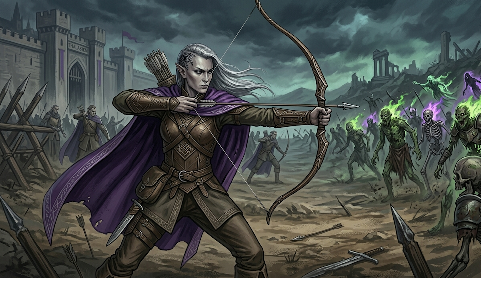
The city of Thalasien is their masterwork and their burden. It is a settlement of cold, silver beauty, its architecture as calculated as Elven speech — nothing placed carelessly, nothing wasted, every arch and spire carrying the weight of a decision made once and never revisited. Their relationship with the arcane is not spiritual, but clinical. They dissect the weave of magic as a mortician dissects a corpse, operating on the belief that absolute understanding is the only defence against absolute subjugation. This cold arithmetic has made them the most formidable arcane scholars alive. It has also left them profoundly isolated. Scholarship at that depth is a solitary burial, and five centuries of it leaves scars that cannot be translated to fleeting, younger races. The world calls this arrogance. The Elves call it accuracy.
The Blight Elves are a wound in Thalasien's history it does not speak of openly. Cousins shaped by centuries in the Pale Weald's corrupted shadow, they bleed and breathe the arcane rot that Thalasien seeks to sterilize. When a Blight Elf walks through the silver gates of the capital, no alarm is sounded. The streets simply empty. They are permitted to walk the flawless corridors entirely alone — a living ghost of a compromised bloodline, a terminal diagnosis the city refuses to acknowledge — until the crushing, engineered isolation drives them back into the rot where they belong.
An Elf outside Thalasien is a different proposition to an Elf within it. The city produces a specific kind of paralysis in those who remain — the weight of accumulated knowledge pressing down until action becomes almost impossible without adequate justification, and adequate justification requires study, and study takes time, and an Elf has time in quantities that are themselves a problem. The Elves who leave — who choose the short-lived world over the cold perfect silence of the silver city — do so because they have calculated that something out there matters more than the safety of knowing everything before touching anything. This is a minority view in Thalasien. The Elves who hold it are regarded with a mixture of pity and relief.
Outside Thalasien, an Elf is conspicuous not in appearance but in attention. They notice everything, catalogue it, cross-reference it against five centuries of prior cataloguing, and produce assessments that are frequently correct and occasionally incomprehensible because the reasoning passes through seventeen layers of prior context that the shorter-lived person in the conversation does not share. Humans find this exhausting. Dwarves find it useful. Halflings, most Elves report, seem entirely unimpressed, which the Elves find quietly unsettling without being able to articulate why.
Their relationship with death — specifically, the death of companions — is something each Elf manages privately and poorly. They do not grieve the way short-lived peoples grieve, with the raw immediacy of loss. They grieve in the manner of accumulation: the first death hardly registers, the tenth is a weight, the hundredth has become the defining texture of their existence. An old Elf who travels in the company of humans has, mathematically, already watched something very like this specific companion die several times in previous faces. Whether this makes it harder or easier to care, they do not agree on, and they do not discuss it with the people who are currently still alive.
[Lore Hook] The Elves speak of a Golden Age with the sterile neutrality of those who were present for its slaughter. What precisely ended it — what cracked the original foundations of Thalasien — is a question their scholars will answer with academic citations, but never with candour. The wound is old enough to have become ceremonial. That does not mean it has healed.
Centuries of Practice. Permanent +1 bonus to all Awareness tests. Five hundred years of accumulated awareness does not switch off.
The Long Memory. Permanent +1 bonus to all Knowledge tests relating to history, lore, and the arcane.
The Long Inoculation. Five centuries of clinical study of the weave grants you a learned immunity to magical subjugation. Permanent +1 to all resist tests against spells and abilities that attempt to control, command, or compel your mind — including sleep, charm, command, fear-as-compulsion, and similar mind-affecting effects. Damage spells and physical effects are unaffected; this is a defence against being unmade as yourself, not against being unmade as flesh.

The Halflings are the most consistently underestimated people in the known world, a deception they have spent millennia meticulously cultivating. Barely four feet at their apex, they bear the wide, open faces of a people who learned early that perceived harmlessness is an impenetrable armour. Their feet are broad and heavily calloused, preferring the bare earth; soles thick as cured hide, yet sensitive enough to read the ground's tremors as a scholar reads text. Their hands are blunt and dexterous, carrying the inherited knowledge of fingers that know the exact threshold between living soil and dead rot.
Do not mistake their warmth for fragility. They are the first to laugh and the last to break, and the space between those two states is a lethal trap. They are patient in the manner of the deep earth: absolute, silent, and possessing a long, unforgiving memory.

Their bond with the living world is neither faith nor studied discipline; it is an intrinsic, biological anchor. A Halfling who sleeps on bare earth wakes knowing the weather three days hence. One who presses a palm to ancient bark reads the tree's violent history in vibrations through the bone. They do not worship nature; they are continuous with it. The sensitivity of their feet to dead rot is not metaphorical — it is a physiological inheritance, a sensory adaptation developed across generations of walking ground that could no longer feed what it touched. A Halfling barefoot on healthy soil feels the mycorrhizal network beneath it the way a musician feels the pulse of a song through the floor. A Halfling barefoot on blighted ground feels something else entirely. They do not speak of what that feels like, except to say they know it immediately, and that knowing it immediately was, at some point in their history, the difference between life and extinction.
Their homeland is the Warrens of Oakhaven — rolling, unremarkable hills on the surface; an intricate, heavily fortified network of subterranean routes and collapse traps beneath. It is a survival bunker wearing the mask of a meadow, refined over a thousand years into something that does not look built because the Halflings understood, very early, that things which look built get targeted. The deepest warrens predate every other structure in the region by at least three thousand years. The soil of the lowest chambers carries a resonance that Halfling sensitives describe as grief compressed into geology. The elders call it the Old Record.
The Old Record is not a document. It is not kept in scrolls or carved into stone. It is maintained in a specific, ritualized oral tradition carried exclusively by the eldest of each bloodline — a chain of unbroken memory going back to the world before the current Age. What it contains, precisely, the Halflings will not say. But the weight of it is visible in the elders who carry it. They do not age the way the young do — they compact. Something in the long keeping of those memories narrows the eyes and steadies the hands and produces, in the very oldest Halfling elders, a quality of stillness that is not peace but the absence of surprise. They have heard the worst of it. They are no longer startled by what the world is capable of.
What the other races know of Halfling history is entirely what the Halflings have chosen to share, which is precisely nothing of substance. They are welcoming to outsiders, generous at the table, quick to offer what they have — and they will walk you through the Warrens with a guide who knows every safe path through the collapse traps, and you will never suspect the traps are there at all. The Church of the Radiant Compact sent a formal delegation once, with considerable resources, to extract the history the Halfling elders carry. The delegation returned with warm memories of excellent food and no information whatsoever. Three subsequent attempts produced the same result. The Church classified Halflings as a low-priority ecclesiastical concern and moved on. The Halfling elders did not discuss this outcome. They did not need to.
A Halfling who leaves the Warrens carries none of this as visible burden. They are, to all appearances, exactly what they seem: capable, warm, low to the ground, difficult to kill, and disarmingly pleasant to be around. The weight is there — the long memory, the inherited sensitivity, the knowledge of what the Old Record contains — but they wear it the way their feet wear the calloused soles: invisibly, functionally, as the accumulated evidence of everything their line has already survived.
[Lore Hook] The deepest chambers of the Warrens contain markings in a script no living linguist has successfully translated — not because the script is complex, but because every scholar who has been permitted to study it has been escorted out before completing the work, with unfailing courtesy and no explanation. The Halfling elders who oversee these escortings are uniformly apologetic and entirely immovable. One scholar who managed to transcribe a single complete symbol before being shown to the exit spent three years attempting to identify its provenance. It does not match any known writing system. It predates them all.
Beneath Notice. Enemies with 3 or more other valid targets never select you as their primary target unless no other option exists. You are seen, but you are not chosen.
Unreadable Luck. Once per encounter, after seeing any dice result, force a complete reroll of that result. The new outcome stands — better, worse, or unchanged.
Small Target. Ranged attacks against you suffer Disadvantage when you are behind any form of cover, however partial.
Humans are the most populous race in the known world, and from this sheer volume they have forged a sprawling, contradictory mass of civilisations — each fanatically convinced it is the apex of culture. They are physically volatile: compact or towering, pale or dark, shaped by ten thousand years of restless, violent migration across every forgiving and unforgiving terrain. They live barely a century. They build as though they will live forever.

This fleeting mortality is their most dangerous weapon. A Dwarf builds for the mountain. An Elf builds for posterity. A Human builds to outrun the grave. This panic breeds a people who are simultaneously the world's greatest architects and its most reliable source of catastrophic overreach. Human kingdoms are vast and fractious, bound by trade routes that double as battlelines. They are unified primarily by the Church of the Radiant Compact — a faith whose dogma travels faster than any army, and whose institutional relationship with the truth is deliberately unrecorded. The Church maintains its authority through an order of silent inquisitors whose sole purpose is not to execute heretics but to excise the margins of older histories — leaving a pristine, fabricated timeline of human righteousness that the elder races find exhausting and have never managed to halt.

Humans do not specialise; they consume. Every culture they touch is assimilated, violently or quietly, then renamed and claimed as their own invention. The elder races find this relentless tide exhausting, yet none have managed to halt it. Individually, a Human is fragile beside an Elf's precision or a Dwarf's endurance. Collectively, they are a sprawling, unpredictable equation that the rest of the world is still bleeding to solve.
What the other races consistently fail to account for is how little unified Humanity actually is. The Church of the Radiant Compact claims to speak for all Human peoples, and in the settled kingdoms its authority is real enough to be practically indistinguishable from absolute. But the settled kingdoms are not all of Humanity. The merchants of Havenspire operate on entirely different principles — commerce has its own theology, and it cares rather less about sacred lineage than the Church would prefer. The traders of SunsReach exist in the permanent negotiation between the Church's doctrinal reach and the Lizardman Scaled Embassy's practical power, producing a civic culture where pragmatism has become the only working faith. The northern frontier peoples — descendants of the steppe nomads who fled when the coalition fractured, who have spent four centuries building settlements at the edge of Orc territory — bear almost no cultural resemblance to the Church's cathedral cities, and regard the Compact with the specific suspicion reserved for institutions that have never sent help but reliably send tax assessors.
A Human player character carries this contradiction in their bones whether they acknowledge it or not. They are the Church's child, or they are its refugee, or they are the thing the Church has not yet reached and is currently building roads toward. These are not the same person and they do not want the same things, and the fact that every other race in the world treats them as interchangeable is one of the quiet indignities of being Human in a world where you are, nevertheless, the dominant species by raw count.
[Lore Hook] The Church of the Radiant Compact is the closest entity humanity has to a universal authority. It also possesses the most glaring voids in its own historical record — massacres, pacts, and cataclysms meticulously noted in the margins of Elven and Dwarven histories, yet cleanly excised from the Church's vaults. Whether this erasure is born of incompetence or ruthless policy is a question the inquisitors ensure is never asked aloud.
Driven. Once per session, declare a Purpose — a concrete, achievable objective for the session. Gain +1 to all rolls directly tied to achieving it, until the Purpose is fulfilled or explicitly abandoned. A new Purpose cannot be declared until the previous one is resolved.
Adaptable. One skill chosen at character creation costs 5 XP less per rank across its entire compounding chain. The chosen skill must have a base cost of 20 XP or higher for Humans. Chosen once, locked permanently — the choice is the gift; second-guessing is not.
The Relentless. Once per session when reduced to 0 wounds, roll 1d10. On a natural 10 only, survive at 1 wound. No bonuses, modifiers, or rerolls apply — always exactly a 10% chance. Some refuse to fall when the math says they must.
The Pillars of the Flesh (Core Characteristics)
Every survivor in IronTithe is defined by six primary characteristics. These are not mere numbers tallied on parchment — they are the architecture of your soul and the limits of your flesh. They represent how you move through a violently indifferent world. Each characteristic governs a cluster of specific skills and provides passive bonuses to your defense, the wounds you inflict, and your ability to endure.
Characteristics begin at a baseline determined by your bloodline and the bitter experience you invest at your genesis. They grow with agonizing slowness. Elevating a characteristic requires immense, compounding dedication — it is a deliberate forging of the self, never an accident of fate.
Characteristic
The Measure of Survival
Core Skills & Swap Pool
Agility
The speed of your blood and the precision of your panic. It dictates how swiftly you cross the battlefield, your capacity to dodge a lethal stroke, and your grace under absolute pressure. Your Agility modifier applies directly to your Defense and all movement-based trials. It governs Tumble — the vital art of rolling clear of devastation and denying the earth the ability to drag you down.
Core: Athletics, Evasion, Quickness
Swap pool: Stealth, Thieving, Tumble, Acrobatics, Disguise, Escapology, Sleight of Hand
Awareness
The instinct to see the knife before it swings. It measures how rapidly you perceive an ambush, read the shifting tide of a skirmish, or hear the whisper of the natural world. Awareness governs the terrifying accuracy of ranged combat, the attunement of Druidism, and the Riposte — the predator's counter-strike that turns an enemy's hesitation into an open artery. Stamina resides here: endurance is simply the awareness of your own breaking point, and the choice to ignore it.
Core: Acute Senses, Focus, Precise Strike
Swap pool: Druidism, Riposte, Stamina, Danger Sense, Lip Reading, Swift Read
Charisma
The sheer weight of your presence. This is not mere charm; it is the force of personality required to command the terrified, negotiate with the hostile, and bend the spirits of the dead to your will. Devotion draws its terrifying miracles directly from Charisma — it is the strength of your covenant with the unseen. It also governs the mending of flesh through sheer, unyielding will.
Core: Authority, Charm, Inspire
Swap pool: Mending, Devotion, Light-Soul, Deception, Intimidation, Performance, Seduction
Intellect
The cold calculation of the mind. Intellect governs memory, the deciphering of ancient traps, and the brutal geometric arithmetic required to safely channel Wizardry without unmaking yourself. It dictates your ability to evaluate an unknown threat, track a bleeding quarry across stone, and read the history of the world in its ruins.
Core: Evaluation, Knowledge, Read/Write
Swap pool: Tracker, Perception, Wizardry, Alchemy, Engineering, Medicine, Navigation
Physique
The stubborn density of flesh and bone. Raw physical power, lung capacity, and the sheer volume of punishment your body can absorb before failing. Your Physique modifier applies directly to the wounds you tear into an enemy in melee, and to your Total Wounds — a high Physique hero is a fortress of meat and iron. Masters of Ki draw their miraculous inner power from this bodily perfection.
Core: Fortitude, Hard as Nails, Rugged
Swap pool: Shieldsman, Ki, Strength Conditioning, Brawling, Climbing, Endurance, Swimming
Willpower
The refusal to break. Willpower is the anchor of the soul. It is rolled to resist fear, to survive the agonizing toll of curses, and to force your physical body to keep moving when it has been mathematically destroyed. Shamans draw their terrifying authority from Willpower — it is the force that demands the spirits of the dead listen and obey. Discipline is forged here: the dedication that hardens the mortal vessel to hold unimaginable power without shattering.
Core: Iron Will, Resolve, Spirit
Swap pool: Discipline, Shaman, Vibhuti, Survival, Meditation, Oathkeeper, Pain Tolerance, Willpower Reserve
The Power of Three (Characteristic Growth)
You do not roll dice to randomly determine your worth, nor do you buy your Core Characteristics with a pool of points. In IronTithe, you are what you survive.
Every characteristic begins at a strict baseline. To increase a Core Characteristic by +1 point, you must invest exactly 3 Skill Points into the specific skills governed by that characteristic. If you want your Physique to grow, you must bleed in the training of Fortitude, Hard as Nails, or Strength Conditioning. The flesh only hardens when it is beaten.
The Forging of Destiny (Character Creation)
IronTithe demands a classless, uncompromising genesis. There are no pre-ordained archetypes or gentle paths laid out for you. You begin as a blank sheet of parchment — a hollow vessel of bone and muscle. Your choices are the only ink available. You forge your survivor from the ash up, spending your experience on the precise tools that will keep you breathing. The steps below dictate how a life is built for this world.
1 The Bloodline (Race)
Select your origin: Dwarf, Elf, Halfling, or Human. Your bloodline sets your foundational physical reality — your height, weight, base movement distance, and the starting capacity of your wounds. It does not chain your potential. A Halfling may become a hardened warlord; a Dwarf may surgically dissect the arcane. Your race is where you begin, not where you must end.
2 The Toll of Experience (Allocate 300 XP)
You awaken with 300 Experience Points (XP) — the ledger of your past survival. This budget is sufficient to forge a competent combatant, but impossible to master everything. Skills are purchased from the Master Skill List, each bearing a compounding cost and a maximum threshold. Characteristics demand an even steeper toll, but provide passive, permanent superiority across all associated trials.
Heed the unwritten laws of survival:
- Specialise or perish. Spreading 300 XP thinly across all disciplines produces a corpse with many mediocre hobbies. Focus your intent.
- Do not neglect the flesh. Skills like Fortitude (expanding your wound threshold), Evasion (slipping the blade), and Iron Will (denying the arcane) are often ignored until the moment they are fatal to lack.
- Magic demands a vessel. The arcane and divine are useless without the characteristic to channel them. A Wizard without Intellect is merely a scholar waiting to die.
- Time is a weapon. Investing in Quickness expands your Action Points — the most lethal currency on the battlefield.
3 The Derived Truths (Calculations)
Once your experience is spent, calculate the physical truth of your capabilities:
- Total Wounds: Your racial base, bolstered by your Physique modifier, and expanded by survival skills like Fortitude or Hard as Nails. This is the exact volume of ruin you can suffer before the dark takes you.
- Base Defense: The threshold an enemy must cross to strike you. Every character begins at a base Defense of 3, raised by the armour you bear and by the Evasion skill (the trained art of not being where the blade falls). Light, agile fighters lean on Evasion; the heavily armoured lean on iron. The full formula is laid out below.
- Damage Mitigation: Distinct from Defense. Defense dictates if the blade lands; Mitigation dictates how much of the butchery your armour absorbs before it reaches meat.
- Action Points (AP): You begin with a base of 1 AP per exchange, expanded through the Quickness skill. Record your total, and respect the Power of 3 rule for carrying potential into the next heartbeat.
- Resist Bonus: Forged from your Willpower. The sheer mental density applied against terror, madness, and malefic magic.
Calculating Your Defense
Defense = 3 (base) + Armour’s Def value + Evasion bonus
Every survivor starts with a base Defense of 3 — the bare reflex of a living thing that does not wish to be hit. To it you add two things: the Def value of your armour (listed in the Armory; this is a bonus, not a replacement — Field Plate’s “Def 4” means +4), and your Evasion bonus of +1 per 3 points of the Evasion skill. The Evasion portion is reduced by your armour’s Agility penalty — iron that slows you cannot also help you slip aside — so the two paths do not freely stack.
Two survivors, two paths. Korr wears Field Plate (Def +4) and trains no Evasion: his Defense is 3 + 4 = 7, bought with iron. Sable wears only Leather (Def +2, a −1 Agility penalty) and holds 9 points of Evasion (+3). That Evasion bonus is trimmed by Leather’s −1 to +2 for Defense, so her total is 3 + 2 + 2 = 7 as well — the same wall, built from speed instead of steel. (Heavier armour with a steeper Agility penalty would trim her Evasion further, which is exactly why the nimble fighter keeps her plate light.)
4 The Armament
You are granted a starting sum of gold (typically 50–100, dictated by the GM's mercy). Spend it in the Armory on the tools of violence and survival.
- Honour your proficiencies. Wielding a weapon outside your Combat training imposes Disadvantage on your attempt to hit and your attempt to wound. It is a fool's gamble.
- Iron blinds the arcane. Heavy armour imposes severe penalties to spellcasting (To-Cast rolls). Consult the Arcane Interference laws before caging a Wizard in plate.
- Pack for the dark. Torches, rope, and bandages are not glorious, but they are the difference between a hero's return and a permanent grave.
5 The Soul of the Survivor
Iron and math do not make a hero. Before the dice roll, you must know what drives the vessel:
- What is their purpose? Revenge, salvation, greed, or sheer survival. This is the engine of your existence.
- What breaks their nerve? A hero without fear is a statue. Name the one terror that makes your character hesitate.
- What is their unhealed scar? A broken vow, an unpaid debt, a secret kept from the grave. Give the GM the thread, and they will pull it.
The Hero's Resources
Luck & Fortune
Defying the Inevitable
Luck: The gods may be absent, but probability still plays favorites. Roll 1d10 at the dawn of each session. This is your Luck pool. You may burn up to half your total Luck (rounded up) on a single test, adding it to the outcome to force a success or stave off a disaster.
The Absolute Failure: If the die lands on a natural 1, Luck cannot twist it into a victory — a 1 simply fails, and no point of Luck makes the strike land, the spell take hold, or the test succeed. Luck nudges the math; it cannot escape a 1. Fortune, however, can: because a reroll replaces the die outright rather than adding to it, a Fortune reroll may be spent to reroll a natural 1. That is the line between the two resources — Luck nudges and cannot save a 1; Fortune replaces and therefore can.
Fortune (Rerolls): Rerolls are a measure of destiny's favour. Your capacity to alter fate is a read-only manifestation derived directly from your accumulated Fortune points. A reroll is absolute — it obliterates the previous timeline and replaces the die entirely, where Luck merely nudges the math.
⚖ The IronTithe — The Law of the Ledger
The living world does not give; it lends. From every mortal it collects in three columns — Mind, Body, and Soul — and the collection is not a tenth, as the village priests tally their grain, but a third. The price is paid in iron, and a mortal carries iron in one vault only: the blood. This is why the world bleeds those it collects from — a living world that gave without collecting would have nothing left to spend — and why the Church calls the law the TrineTithe but the soldiers call it by its truer name: the IronTithe. Both keep ledgers. Neither has seen the ledger that matters.
This is the spine of creation made into law, and what it teaches at the table is simple: nothing comes free — not power, not growth, not survival. The Tithe collects in three modes.
I. The Tithe of Becoming. The constant. Every skill you buy, point by point, is the Weave's price for growth — paid by every soul that ever sharpened itself, with no exception of class or birth. You have been paying the Tithe since your first advancement; the ledger simply now has a name. (This is not a new rule — it is the law made visible in a system you already use.)
II. The Tithe of the Die. The law made felt, at the table, in the moment.
Every wound is a collection. When blood is spilled — theirs or yours — the world takes its due; the IronTithe is always counting. Yet the ledger runs both ways: the world that bled you may find itself, in turn, in your debt. Nothing bleeds for free.
In play, the ledger turns on the extremes of the die. On any damage-dealing attack or working (melee, ranged, or an offensive spell or blessing that deals damage):
- A natural 1 — the world collects from you. You suffer 3 damage, the Tithe levied straight from your own flesh, ignoring all Mitigation — it is not a blow that armour can turn, but the world taking what it is owed. This is separate from the action itself, which still simply fails.
- A natural 10 — the world collects from your target. Your enemy suffers 3 damage, likewise ignoring all Mitigation — and it falls upon them whether or not your own strike lands. The world reaches past your hand to take its due from your foe; your blade may have gone wide, but the ledger does not miss. This fires once per turn, in the press of combat or comparable peril.
The Tithe of the Die only ever takes — from you on a 1, from your foe on a 10 — and it never heals; restoration is no part of this bargain. It rides only on rolls meant to deal damage; a buff, a heal, a ward, or any working that sheds no blood carries no Tithe in either direction. Luck cannot stop the Tithe — it nudges the math but never escapes a natural 1 or unmakes a natural 10, so the levy is collected all the same. Fortune can: a reroll replaces the die outright, and a 1 or 10 that is rerolled away was never rolled at all — there is no Tithe to collect (the same line drawn under The Absolute Failure, above). The Tithe of the Die is a mortal reckoning: the world does not tithe its own creatures, so a monster’s natural 1 or 10 does not invoke it, and in an opposed contest between two souls neither is tithed — the ledger runs between mortal and world, not mortal and mortal.
III. The Tithe of the Deep-Drawn. The surcharge on those who borrow deepest. Overreach (reaching past your Max TN) and the Malefic toll of the darkest workings are the Tithe collected with interest — the price paid by any soul that draws more from the Weave than it has earned. That only casters and the reckless meet this mode is no flaw in the law: all pay the base Tithe, and these few pay more. (Also not a new rule — these costs already stand; they are simply named as what they are.)
Three modes, one law. You pay to become, you pay on the fall of the die, and you pay interest on what you borrow. The scars you carry and the ledgers you keep are the world's receipts. Nothing bleeds for free.
At the Table — The Ledger Collects
The world collects from you. Doran hurls a bolt of force at a charging brute and his To-Cast die comes up a natural 1. The spell fails — that much is the plain rule, the working simply does not take hold. But the 1 is a damaging roll, so the Tithe of the Die collects: the world draws 3 damage straight from Doran’s own flesh, ignoring his robes and every ward — this is not a blow to be parried, it is iron leaving the only vault a mortal keeps it in. He cannot spend Luck to stop it (Luck never escapes a 1); only a Fortune reroll, by erasing the 1 entirely, would have prevented the collection.
The world collects from your foe — even when you miss. A round later, Mira thrusts her spear at the brute and rolls a natural 10 — but with her modifiers it still falls one short of the brute’s Defense. Her spear misses. And yet the 10, on a damaging strike, turns the ledger anyway: the world reaches past her failed thrust and collects 3 damage from the brute, ignoring its armour. Mira’s steel never touched it, but the world took its due all the same. (Had her 10 also hit, the brute would take her weapon damage and the 3 — and on the optional Criticals rule, a confirmed Critical besides.) This collection fires once per turn. Note what never happens here: nobody is healed. The Tithe of the Die only ever takes — from you on a 1, from your enemy on a 10 — and only on blows meant to draw blood. A nat-1 on a Mending check or a buff would carry no Tithe at all.
Action Points (AP)
The Currency of Violence
Time in the fray is measured in panicked breaths and drawing steel. Every soul is granted a baseline of 1 Action Point (AP) per exchange. This immediate potential can only be expanded through the Quickness skill or grueling, deliberate investment of Experience.
- The Strike: Driving a one-handed blade costs 1 Action, while hauling a Heavy Crossbow into firing position demands 3 Actions.
- The Weave: The devastating complexity of a spell dictates the exact AP cost required to manifest it.
- The Pivot: Activating Focus, tearing free from entangling roots, or swallowing a vital elixir typically costs 1 Action.
Holding & Carrying Actions — The Power of 3
The Discipline of Restraint
Two disciplines of patience live here: holding an action to spring it at the perfect moment, and carrying unspent potential into the next breath. They are priced very differently — and one of them is free.
I. The Held Action — Reactions. There are two ways to act outside your own turn, and the world charges for only one of them.
- The Drawn Bow (a declared Hold) — no cost, no penalty. On your turn, instead of spending an action, you may hold it: name a trigger (“I loose the moment the beast crosses the threshold”) and the exact action held. The action still costs its normal AP — you are timing it, not getting it free — but holding adds no fee and no penalty. When your trigger trips, you act instantaneously: your held action resolves before the triggering enemy action completes. You planned this. Foresight is never taxed.
- Initiative breaks the tie. When two held or reactive actions fire on the same instant — you and a foe both holding, or both triggering on the same moment — the one who won initiative resolves first. This is what initiative truly buys in a patient fight: not merely the first move of the round, but victory in contested timing. You spent nothing to hold; you are spending the initiative you already earned. (If initiative itself is tied, any ability that wins initiative ties resolves the standoff — a master of Quickness with First Blood takes the moment, as they take every tie.)
- The Snap Reaction (undeclared) — −2 penalty. If you did not hold, yet seize a sudden opening out of turn anyway — swinging at the orc as it barrels past — you act in genuine chaos, and improvisation costs you −2 to that To-Hit or To-Cast roll. A mind forged with 6+ points in Discipline ignores this penalty entirely, reacting as cleanly as if it had been planned. This is the whole line: hold, and the moment is yours for nothing; react cold, and you pay for the chaos.
- The Fading Opportunity. A held action cannot be hoarded. If your trigger has not occurred by the dawn of your next turn, the held AP bleeds away into nothing.
At the Table — The Contested Moment
Mira holds her spear-thrust, naming her trigger: “the moment the orc charges into reach.” The orc, across the field, has also held — waiting to swing the instant Mira closes. On the orc’s turn it charges; Mira’s trigger trips. Both held actions now want to resolve on the same instant. Because Mira won initiative at the start of the fight, her spear lands first — if it drops the orc or knocks it Prone, the orc’s charge may never resolve at all. Had the orc won initiative, its blow would have struck first, and Mira’s spear would land only if she were still standing to throw it. Neither of them paid AP to hold beyond the cost of the action itself; the initiative each rolled at the start of the fight is what decided the tie. (Had Mira not held at all — had she simply tried to stab the orc mid-charge on reflex — she would take the −2 snap-reaction penalty, unless her Discipline is 6 or higher.)
II. Carrying AP — The Power of 3. Patience is also a weapon you save for later. For every 3 points of base AP you possess, you may carry 1 unspent AP into the subsequent turn — the coil of muscle and mind readying for an overwhelming assault. This carried AP must be explicitly declared as your turn ends, and it is fleeting: it cannot be hoarded beyond the following round.
AP Carry-Over Scale
Base AP
Max Carry
The Tactical Choice
3 AP
1
Strike twice now, carry 1 — or unleash all 3
4 AP
1
Spend 3 now, carry 1
5 AP
1
Spend 4 now, carry 1
6 AP
2
Spend 4 now, carry 2 — or unleash 5, carry 1
9 AP
3
The terrifying flexibility of a living legend
Formula: floor(Base AP ÷ 3) = maximum AP that may cross the threshold of a turn.
Reading the carry. Take your base AP, divide by 3, round down — that is the most you may hold over. Mira’s base is 5 AP, so floor(5 ÷ 3) = 1: she may carry a single point into next turn, no more, and only if she declares it as her turn ends.
Worked — Mira’s Coiled Strike
Base 5 AP → carry max 1. This turn she spends only 4 (two spear-jabs) and declares 1 carried. Next turn she has 5 + 1 = 6 AP — enough for an all-out flurry the instant the line breaks. Spend it that turn or lose it; it cannot be hoarded a third round.
The Iron Constraints:
- No boundaries. Carried AP is fluid; it may be burned for steel, spellcraft, evasion, or utility.
- No channeling. You cannot weave carried AP into a multi-turn spellcasting sequence.
- The Two-Turn limit. AP does not pool forever. If you carry it, you must spend it on the immediate next turn, or it vanishes.
The Pillars of the Flesh (Core Characteristics)
Every survivor in IronTithe is defined by six primary characteristics. These are not mere numbers tallied on parchment — they are the architecture of your soul and the limits of your flesh. They represent how you move through a violently indifferent world. Each characteristic governs a cluster of specific skills and provides passive bonuses to your defense, the wounds you inflict, and your ability to endure.
Characteristics begin at a baseline determined by your bloodline and the bitter experience you invest at your genesis. They grow with agonizing slowness. Elevating a characteristic requires immense, compounding dedication — it is a deliberate forging of the self, never an accident of fate.
| Characteristic | The Measure of Survival | Core Skills & Swap Pool |
|---|---|---|
| Agility | The speed of your blood and the precision of your panic. It dictates how swiftly you cross the battlefield, your capacity to dodge a lethal stroke, and your grace under absolute pressure. Your Agility modifier applies directly to your Defense and all movement-based trials. It governs Tumble — the vital art of rolling clear of devastation and denying the earth the ability to drag you down. | Core: Athletics, Evasion, Quickness Swap pool: Stealth, Thieving, Tumble, Acrobatics, Disguise, Escapology, Sleight of Hand |
| Awareness | The instinct to see the knife before it swings. It measures how rapidly you perceive an ambush, read the shifting tide of a skirmish, or hear the whisper of the natural world. Awareness governs the terrifying accuracy of ranged combat, the attunement of Druidism, and the Riposte — the predator's counter-strike that turns an enemy's hesitation into an open artery. Stamina resides here: endurance is simply the awareness of your own breaking point, and the choice to ignore it. | Core: Acute Senses, Focus, Precise Strike Swap pool: Druidism, Riposte, Stamina, Danger Sense, Lip Reading, Swift Read |
| Charisma | The sheer weight of your presence. This is not mere charm; it is the force of personality required to command the terrified, negotiate with the hostile, and bend the spirits of the dead to your will. Devotion draws its terrifying miracles directly from Charisma — it is the strength of your covenant with the unseen. It also governs the mending of flesh through sheer, unyielding will. | Core: Authority, Charm, Inspire Swap pool: Mending, Devotion, Light-Soul, Deception, Intimidation, Performance, Seduction |
| Intellect | The cold calculation of the mind. Intellect governs memory, the deciphering of ancient traps, and the brutal geometric arithmetic required to safely channel Wizardry without unmaking yourself. It dictates your ability to evaluate an unknown threat, track a bleeding quarry across stone, and read the history of the world in its ruins. | Core: Evaluation, Knowledge, Read/Write Swap pool: Tracker, Perception, Wizardry, Alchemy, Engineering, Medicine, Navigation |
| Physique | The stubborn density of flesh and bone. Raw physical power, lung capacity, and the sheer volume of punishment your body can absorb before failing. Your Physique modifier applies directly to the wounds you tear into an enemy in melee, and to your Total Wounds — a high Physique hero is a fortress of meat and iron. Masters of Ki draw their miraculous inner power from this bodily perfection. | Core: Fortitude, Hard as Nails, Rugged Swap pool: Shieldsman, Ki, Strength Conditioning, Brawling, Climbing, Endurance, Swimming |
| Willpower | The refusal to break. Willpower is the anchor of the soul. It is rolled to resist fear, to survive the agonizing toll of curses, and to force your physical body to keep moving when it has been mathematically destroyed. Shamans draw their terrifying authority from Willpower — it is the force that demands the spirits of the dead listen and obey. Discipline is forged here: the dedication that hardens the mortal vessel to hold unimaginable power without shattering. | Core: Iron Will, Resolve, Spirit Swap pool: Discipline, Shaman, Vibhuti, Survival, Meditation, Oathkeeper, Pain Tolerance, Willpower Reserve |
You do not roll dice to randomly determine your worth, nor do you buy your Core Characteristics with a pool of points. In IronTithe, you are what you survive.
Every characteristic begins at a strict baseline. To increase a Core Characteristic by +1 point, you must invest exactly 3 Skill Points into the specific skills governed by that characteristic. If you want your Physique to grow, you must bleed in the training of Fortitude, Hard as Nails, or Strength Conditioning. The flesh only hardens when it is beaten.
IronTithe demands a classless, uncompromising genesis. There are no pre-ordained archetypes or gentle paths laid out for you. You begin as a blank sheet of parchment — a hollow vessel of bone and muscle. Your choices are the only ink available. You forge your survivor from the ash up, spending your experience on the precise tools that will keep you breathing. The steps below dictate how a life is built for this world.
1 The Bloodline (Race)
Select your origin: Dwarf, Elf, Halfling, or Human. Your bloodline sets your foundational physical reality — your height, weight, base movement distance, and the starting capacity of your wounds. It does not chain your potential. A Halfling may become a hardened warlord; a Dwarf may surgically dissect the arcane. Your race is where you begin, not where you must end.
2 The Toll of Experience (Allocate 300 XP)
You awaken with 300 Experience Points (XP) — the ledger of your past survival. This budget is sufficient to forge a competent combatant, but impossible to master everything. Skills are purchased from the Master Skill List, each bearing a compounding cost and a maximum threshold. Characteristics demand an even steeper toll, but provide passive, permanent superiority across all associated trials.
Heed the unwritten laws of survival:
- Specialise or perish. Spreading 300 XP thinly across all disciplines produces a corpse with many mediocre hobbies. Focus your intent.
- Do not neglect the flesh. Skills like Fortitude (expanding your wound threshold), Evasion (slipping the blade), and Iron Will (denying the arcane) are often ignored until the moment they are fatal to lack.
- Magic demands a vessel. The arcane and divine are useless without the characteristic to channel them. A Wizard without Intellect is merely a scholar waiting to die.
- Time is a weapon. Investing in Quickness expands your Action Points — the most lethal currency on the battlefield.
3 The Derived Truths (Calculations)
Once your experience is spent, calculate the physical truth of your capabilities:
- Total Wounds: Your racial base, bolstered by your Physique modifier, and expanded by survival skills like Fortitude or Hard as Nails. This is the exact volume of ruin you can suffer before the dark takes you.
- Base Defense: The threshold an enemy must cross to strike you. Every character begins at a base Defense of 3, raised by the armour you bear and by the Evasion skill (the trained art of not being where the blade falls). Light, agile fighters lean on Evasion; the heavily armoured lean on iron. The full formula is laid out below.
- Damage Mitigation: Distinct from Defense. Defense dictates if the blade lands; Mitigation dictates how much of the butchery your armour absorbs before it reaches meat.
- Action Points (AP): You begin with a base of 1 AP per exchange, expanded through the Quickness skill. Record your total, and respect the Power of 3 rule for carrying potential into the next heartbeat.
- Resist Bonus: Forged from your Willpower. The sheer mental density applied against terror, madness, and malefic magic.
Defense = 3 (base) + Armour’s Def value + Evasion bonus
Every survivor starts with a base Defense of 3 — the bare reflex of a living thing that does not wish to be hit. To it you add two things: the Def value of your armour (listed in the Armory; this is a bonus, not a replacement — Field Plate’s “Def 4” means +4), and your Evasion bonus of +1 per 3 points of the Evasion skill. The Evasion portion is reduced by your armour’s Agility penalty — iron that slows you cannot also help you slip aside — so the two paths do not freely stack.
Two survivors, two paths. Korr wears Field Plate (Def +4) and trains no Evasion: his Defense is 3 + 4 = 7, bought with iron. Sable wears only Leather (Def +2, a −1 Agility penalty) and holds 9 points of Evasion (+3). That Evasion bonus is trimmed by Leather’s −1 to +2 for Defense, so her total is 3 + 2 + 2 = 7 as well — the same wall, built from speed instead of steel. (Heavier armour with a steeper Agility penalty would trim her Evasion further, which is exactly why the nimble fighter keeps her plate light.)
4 The Armament
You are granted a starting sum of gold (typically 50–100, dictated by the GM's mercy). Spend it in the Armory on the tools of violence and survival.
- Honour your proficiencies. Wielding a weapon outside your Combat training imposes Disadvantage on your attempt to hit and your attempt to wound. It is a fool's gamble.
- Iron blinds the arcane. Heavy armour imposes severe penalties to spellcasting (To-Cast rolls). Consult the Arcane Interference laws before caging a Wizard in plate.
- Pack for the dark. Torches, rope, and bandages are not glorious, but they are the difference between a hero's return and a permanent grave.
5 The Soul of the Survivor
Iron and math do not make a hero. Before the dice roll, you must know what drives the vessel:
- What is their purpose? Revenge, salvation, greed, or sheer survival. This is the engine of your existence.
- What breaks their nerve? A hero without fear is a statue. Name the one terror that makes your character hesitate.
- What is their unhealed scar? A broken vow, an unpaid debt, a secret kept from the grave. Give the GM the thread, and they will pull it.
The Hero's Resources
Luck: The gods may be absent, but probability still plays favorites. Roll 1d10 at the dawn of each session. This is your Luck pool. You may burn up to half your total Luck (rounded up) on a single test, adding it to the outcome to force a success or stave off a disaster.
The Absolute Failure: If the die lands on a natural 1, Luck cannot twist it into a victory — a 1 simply fails, and no point of Luck makes the strike land, the spell take hold, or the test succeed. Luck nudges the math; it cannot escape a 1. Fortune, however, can: because a reroll replaces the die outright rather than adding to it, a Fortune reroll may be spent to reroll a natural 1. That is the line between the two resources — Luck nudges and cannot save a 1; Fortune replaces and therefore can.
Fortune (Rerolls): Rerolls are a measure of destiny's favour. Your capacity to alter fate is a read-only manifestation derived directly from your accumulated Fortune points. A reroll is absolute — it obliterates the previous timeline and replaces the die entirely, where Luck merely nudges the math.
The living world does not give; it lends. From every mortal it collects in three columns — Mind, Body, and Soul — and the collection is not a tenth, as the village priests tally their grain, but a third. The price is paid in iron, and a mortal carries iron in one vault only: the blood. This is why the world bleeds those it collects from — a living world that gave without collecting would have nothing left to spend — and why the Church calls the law the TrineTithe but the soldiers call it by its truer name: the IronTithe. Both keep ledgers. Neither has seen the ledger that matters.
This is the spine of creation made into law, and what it teaches at the table is simple: nothing comes free — not power, not growth, not survival. The Tithe collects in three modes.
I. The Tithe of Becoming. The constant. Every skill you buy, point by point, is the Weave's price for growth — paid by every soul that ever sharpened itself, with no exception of class or birth. You have been paying the Tithe since your first advancement; the ledger simply now has a name. (This is not a new rule — it is the law made visible in a system you already use.)
II. The Tithe of the Die. The law made felt, at the table, in the moment.
Every wound is a collection. When blood is spilled — theirs or yours — the world takes its due; the IronTithe is always counting. Yet the ledger runs both ways: the world that bled you may find itself, in turn, in your debt. Nothing bleeds for free.
In play, the ledger turns on the extremes of the die. On any damage-dealing attack or working (melee, ranged, or an offensive spell or blessing that deals damage):
- A natural 1 — the world collects from you. You suffer 3 damage, the Tithe levied straight from your own flesh, ignoring all Mitigation — it is not a blow that armour can turn, but the world taking what it is owed. This is separate from the action itself, which still simply fails.
- A natural 10 — the world collects from your target. Your enemy suffers 3 damage, likewise ignoring all Mitigation — and it falls upon them whether or not your own strike lands. The world reaches past your hand to take its due from your foe; your blade may have gone wide, but the ledger does not miss. This fires once per turn, in the press of combat or comparable peril.
The Tithe of the Die only ever takes — from you on a 1, from your foe on a 10 — and it never heals; restoration is no part of this bargain. It rides only on rolls meant to deal damage; a buff, a heal, a ward, or any working that sheds no blood carries no Tithe in either direction. Luck cannot stop the Tithe — it nudges the math but never escapes a natural 1 or unmakes a natural 10, so the levy is collected all the same. Fortune can: a reroll replaces the die outright, and a 1 or 10 that is rerolled away was never rolled at all — there is no Tithe to collect (the same line drawn under The Absolute Failure, above). The Tithe of the Die is a mortal reckoning: the world does not tithe its own creatures, so a monster’s natural 1 or 10 does not invoke it, and in an opposed contest between two souls neither is tithed — the ledger runs between mortal and world, not mortal and mortal.
III. The Tithe of the Deep-Drawn. The surcharge on those who borrow deepest. Overreach (reaching past your Max TN) and the Malefic toll of the darkest workings are the Tithe collected with interest — the price paid by any soul that draws more from the Weave than it has earned. That only casters and the reckless meet this mode is no flaw in the law: all pay the base Tithe, and these few pay more. (Also not a new rule — these costs already stand; they are simply named as what they are.)
Three modes, one law. You pay to become, you pay on the fall of the die, and you pay interest on what you borrow. The scars you carry and the ledgers you keep are the world's receipts. Nothing bleeds for free.
The world collects from you. Doran hurls a bolt of force at a charging brute and his To-Cast die comes up a natural 1. The spell fails — that much is the plain rule, the working simply does not take hold. But the 1 is a damaging roll, so the Tithe of the Die collects: the world draws 3 damage straight from Doran’s own flesh, ignoring his robes and every ward — this is not a blow to be parried, it is iron leaving the only vault a mortal keeps it in. He cannot spend Luck to stop it (Luck never escapes a 1); only a Fortune reroll, by erasing the 1 entirely, would have prevented the collection.
The world collects from your foe — even when you miss. A round later, Mira thrusts her spear at the brute and rolls a natural 10 — but with her modifiers it still falls one short of the brute’s Defense. Her spear misses. And yet the 10, on a damaging strike, turns the ledger anyway: the world reaches past her failed thrust and collects 3 damage from the brute, ignoring its armour. Mira’s steel never touched it, but the world took its due all the same. (Had her 10 also hit, the brute would take her weapon damage and the 3 — and on the optional Criticals rule, a confirmed Critical besides.) This collection fires once per turn. Note what never happens here: nobody is healed. The Tithe of the Die only ever takes — from you on a 1, from your enemy on a 10 — and only on blows meant to draw blood. A nat-1 on a Mending check or a buff would carry no Tithe at all.
Time in the fray is measured in panicked breaths and drawing steel. Every soul is granted a baseline of 1 Action Point (AP) per exchange. This immediate potential can only be expanded through the Quickness skill or grueling, deliberate investment of Experience.
- The Strike: Driving a one-handed blade costs 1 Action, while hauling a Heavy Crossbow into firing position demands 3 Actions.
- The Weave: The devastating complexity of a spell dictates the exact AP cost required to manifest it.
- The Pivot: Activating Focus, tearing free from entangling roots, or swallowing a vital elixir typically costs 1 Action.
Two disciplines of patience live here: holding an action to spring it at the perfect moment, and carrying unspent potential into the next breath. They are priced very differently — and one of them is free.
I. The Held Action — Reactions. There are two ways to act outside your own turn, and the world charges for only one of them.
- The Drawn Bow (a declared Hold) — no cost, no penalty. On your turn, instead of spending an action, you may hold it: name a trigger (“I loose the moment the beast crosses the threshold”) and the exact action held. The action still costs its normal AP — you are timing it, not getting it free — but holding adds no fee and no penalty. When your trigger trips, you act instantaneously: your held action resolves before the triggering enemy action completes. You planned this. Foresight is never taxed.
- Initiative breaks the tie. When two held or reactive actions fire on the same instant — you and a foe both holding, or both triggering on the same moment — the one who won initiative resolves first. This is what initiative truly buys in a patient fight: not merely the first move of the round, but victory in contested timing. You spent nothing to hold; you are spending the initiative you already earned. (If initiative itself is tied, any ability that wins initiative ties resolves the standoff — a master of Quickness with First Blood takes the moment, as they take every tie.)
- The Snap Reaction (undeclared) — −2 penalty. If you did not hold, yet seize a sudden opening out of turn anyway — swinging at the orc as it barrels past — you act in genuine chaos, and improvisation costs you −2 to that To-Hit or To-Cast roll. A mind forged with 6+ points in Discipline ignores this penalty entirely, reacting as cleanly as if it had been planned. This is the whole line: hold, and the moment is yours for nothing; react cold, and you pay for the chaos.
- The Fading Opportunity. A held action cannot be hoarded. If your trigger has not occurred by the dawn of your next turn, the held AP bleeds away into nothing.
Mira holds her spear-thrust, naming her trigger: “the moment the orc charges into reach.” The orc, across the field, has also held — waiting to swing the instant Mira closes. On the orc’s turn it charges; Mira’s trigger trips. Both held actions now want to resolve on the same instant. Because Mira won initiative at the start of the fight, her spear lands first — if it drops the orc or knocks it Prone, the orc’s charge may never resolve at all. Had the orc won initiative, its blow would have struck first, and Mira’s spear would land only if she were still standing to throw it. Neither of them paid AP to hold beyond the cost of the action itself; the initiative each rolled at the start of the fight is what decided the tie. (Had Mira not held at all — had she simply tried to stab the orc mid-charge on reflex — she would take the −2 snap-reaction penalty, unless her Discipline is 6 or higher.)
II. Carrying AP — The Power of 3. Patience is also a weapon you save for later. For every 3 points of base AP you possess, you may carry 1 unspent AP into the subsequent turn — the coil of muscle and mind readying for an overwhelming assault. This carried AP must be explicitly declared as your turn ends, and it is fleeting: it cannot be hoarded beyond the following round.
| Base AP | Max Carry | The Tactical Choice |
|---|---|---|
| 3 AP | 1 | Strike twice now, carry 1 — or unleash all 3 |
| 4 AP | 1 | Spend 3 now, carry 1 |
| 5 AP | 1 | Spend 4 now, carry 1 |
| 6 AP | 2 | Spend 4 now, carry 2 — or unleash 5, carry 1 |
| 9 AP | 3 | The terrifying flexibility of a living legend |
Reading the carry. Take your base AP, divide by 3, round down — that is the most you may hold over. Mira’s base is 5 AP, so floor(5 ÷ 3) = 1: she may carry a single point into next turn, no more, and only if she declares it as her turn ends.
Base 5 AP → carry max 1. This turn she spends only 4 (two spear-jabs) and declares 1 carried. Next turn she has 5 + 1 = 6 AP — enough for an all-out flurry the instant the line breaks. Spend it that turn or lose it; it cannot be hoarded a third round.
The Iron Constraints:
- No boundaries. Carried AP is fluid; it may be burned for steel, spellcraft, evasion, or utility.
- No channeling. You cannot weave carried AP into a multi-turn spellcasting sequence.
- The Two-Turn limit. AP does not pool forever. If you carry it, you must spend it on the immediate next turn, or it vanishes.
Anatomy of a Turn
"Time on the battlefield is measured in panicked breaths and drawn steel. Hesitation is a luxury paid for in blood."
Combat does not wait for the ready. It begins with a sudden, violent clash of intent. Initiative is decided by rolling a single 1d10 against the GM's 1d10. Add your Initiative bonus — derived from your skill investments — to the roll. The fastest player character's total is compared against the fastest adversary's total to determine who acts first.
The Predator's Edge (Surprise): If a party strikes from a hidden position, they seize the momentum, gaining Advantage on the initiative roll. If the ambushing party is entirely undetected before the strike, they gain Advantage (rolling 2d10 and dropping the lowest) alongside a flat +2 bonus to their final result.
During your party's turn, you may traverse the battlefield up to the maximum distance dictated by your bloodline. Movement is fluid — you may execute a partial move, unleash an attack, and then expend the remainder of your distance.
Sprint (1 AP): Push your muscles past their resting limit to move an additional 15 Ft. You may declare this multiple times in a single turn, provided you possess the Action Points to pay the toll.
The Toll of the Earth (Terrain Penalties): The world seeks to drag you down. Deduct distance for the following hazards: Uneasy ground (-5 Ft), Rough terrain (-10 Ft), or Risky environments (-20 Ft).
Patience is a weapon, and the world charges for only one kind of it. (The full rule, with the carrying of unspent AP, lives in Chapter I under Holding & Carrying Actions.)
- The Held Action (no cost, no penalty): On your turn you may hold an action rather than spend it — name a trigger ("I loose the moment the beast crosses the threshold") and the exact action held. It still costs its normal AP; you are timing it, not getting it free. When the trigger trips, you act instantaneously, resolving before the enemy completes their triggering action. Holding adds no fee and no penalty: foresight is never taxed.
- Initiative breaks the tie: when two held or reactive actions fire on the same instant, whoever won initiative resolves first. That is what initiative buys in a patient fight — not the first move of the round, but victory in contested timing.
- The Snap Reaction (−2): acting out of turn without having held — seizing a sudden opening in the chaos — imposes a −2 penalty to that To-Hit or To-Cast roll, ignored entirely by a mind forged with 6+ points in Discipline. Hold, and the moment is yours for nothing; react cold, and you pay for the chaos.
- The Fading Opportunity: a held action cannot be hoarded. If the trigger has not occurred by the dawn of your next turn, the held AP bleeds away into nothing.
Core Mechanics
"The dice govern the chaos of the unknown. Learn to master them, or be broken by them."
To carve a wound into an enemy or to successfully force the arcane weave to obey your command, you roll a single 1d10. You must achieve a total score equal to or higher than the target's Defense value, or the spell's specific Target Number (TN). You apply your natural characteristic modifiers and accrued skill bonuses to this final result.
The Power of Three runs through the bones of this world. When you act against an unresisting task — scaling a wall, picking a lock, recalling a fact — you roll against a Difficulty Value the GM sets. But when you act against someone who pushes back, the contest takes a single, universal shape, the same on both sides of the struggle:
— the higher total prevails —
Each side rolls the die and adds the points it has trained into the relevant skill — usually two different skills, because the one who acts and the one who resists are doing different things. A thief picking a pocket rolls 1d10 + Sleight of Hand against the mark's 1d10 + Acute Senses. A commander forcing a command rolls 1d10 + Authority; the target who refuses rolls 1d10 + their resist skill. The characteristic does not enter a trained contest — it has its own jobs elsewhere (it shapes wounds, casting, and the untrained roll below), and folding it into every test inflated the whole curve. Skill, sharpened by training, decides the trained contest.
The untrained roll their nature, at a cost. If you have no points in the relevant skill, you do not lose by default — but you roll at a penalty, leaning on raw aptitude where you lack training: Disadvantage on the d10 (roll two, take the lower) + the governing characteristic. Training is what steadies the hand; without it the die is unkind, but a naturally gifted soul can still prevail on instinct. (This is the characteristic's place in a contest — the fallback of the untrained, not a bonus stacked atop skill.)
Two skills are the exception. Inspire and Performance still roll 1d10 + Skill + Characteristic. Both are uncontested projection — you radiate Charisma at allies or an audience against a flat Difficulty Value, never against a defender's bar — so the characteristic cannot distort an opposed contest there. For them, presence and craft combine.
On a tie, the defender holds — the status quo is not overturned by a dead heat. Advantage and Disadvantage, the Decisive Strike, and the Absolute Failure all apply to each side's d10 exactly as in any other roll.
Rolling a full opposed test for every side of every contest is right for a duel between two named souls — but no GM wants to roll a defence for each of a dozen charging beasts. So creatures defend by a pre-computed version of the same contest. A creature does not roll to resist; instead, you must beat its standing bar:
This is the creature's side of the contest — its defence already averaged into a fixed number, with the d10's swing folded into the margin you need to clear. The Resist bonus is drawn from the creature's Tier unless its Bestiary entry overrides it, so a TN 7 Willpower test forces a 7 from a mere Minion but demands a 10 from a towering Boss, all without rewriting a single ability.
This is why individual abilities need no special wording. When a Shieldsman's bash reads “the target must surpass Physique TN 8 + Resist bonus or fall Prone,” or a Light-Soul aura forces a Willpower TN, that is simply a contest resolved against a creature. Against a fully-statted NPC, the GM may instead let them roll the living opposed test — same rule, slower and more dramatic, reserved for foes who deserve it.
Sable needs to slip past a watch-post. There are two sentries, and the rules handle them differently — this is the whole shape of the Mark of Three.
The named captain (a living contest). The watch-captain is a real NPC the GM is playing, so they roll the full opposed test. Sable rolls 1d10 + her Stealth against the captain’s 1d10 + his Acute Senses — two different skills, because she is hiding and he is watching. Sable has 6 Stealth and rolls a 5 → 11. The captain has 4 Senses and rolls a 6 → 10. Eleven beats ten: Sable slips by. (Note the characteristic enters neither side — trained skill alone decides it. Had Sable been untrained in Stealth, she’d instead roll Disadvantage on the die + her Agility, leaning on raw instinct where she lacked the craft. And on a tie, the defender holds — the captain would have caught her.)
The ordinary sentry (a static bar). The second guard is a nameless Minion — the GM does not roll for him. Instead his defence is pre-computed into a bar: Awareness TN 7 + Resist bonus. A Minion’s Resist bonus is +0, so Sable must simply surpass 7 on her 1d10 + Stealth. She rolls a 3, +6 Stealth = 9, clearing 7 easily. The bar already is the guard’s side of the contest, the die-swing folded into the number she had to beat — which is why a dozen such guards need no dice of their own. Were he an Elite instead (Resist +2, so an effective bar of 9), that same roll of 9 would only meet the bar, not surpass it — and a contest she fails to win outright goes to the defender. The harder the foe’s tier, the higher the bar climbs, all without rewriting a line of his stat block.
Every roll in the game is one of three shapes, and each resolves the same way whether you are trained or not. The die is always 1d10; what you add — and whether you roll at Disadvantage — depends only on whether you have trained the skill.
The Three Shapes
- Against a task (a wall, a lock, a riddle) — roll against the GM's Difficulty Value.
- Against a person who resists — opposed roll, higher total wins (ties favour the defender).
- Against a creature — roll against its Law of Resistance bar ([Characteristic] TN + Resist by Tier). The creature does not roll.
Trained vs Untrained — Universal
The same rule governs all three shapes. If you have trained the skill, you roll cleanly; if you have not, you roll at a penalty:
(Inspire and Performance alone also add their characteristic)
This untrained rule is universal — identical whether you face a task's DV, a person's opposed roll, or a creature's bar. Raw nature carries you where training does not, but the die is unkind without it. If both sides of an opposed contest are untrained, both roll Dis.d10 + characteristic, and a tie still favours the defender.
Trained-Only Skills
Some skills are pure learned craft — there is no raw-talent version of casting a spell or reading a dead language. With zero points you cannot attempt: Alchemy, Engineering, Medicine, Read/Write, Linguistics, Riposte, Precise Strike, any Combat proficiency (Melee / Mounted / Ranged), and any of the seven Disciplines (Devotion, Druidism, Wizardry, Ki, Shamanism, Vibhuti, Runecraft). For these, “untrained” is not a penalised roll — it is no roll at all. The knowledge, or the technique, is the price of entry.
Passive Skills
A handful of skills are never rolled — they grant a standing bonus (Fortitude's wounds, Iron Will's resilience, Hard as Nails' mitigation, and the like). They have no trained/untrained test; their points simply apply.
Control is powerful precisely because it steals a turn rather than wounds — and a foe stun-locked out of an entire fight is no fun for anyone at the table. So control has a built-in limit. Once a creature has been subjected to a control effect this encounter — forced compliance, a withdrawal command, Dominate, a fear-driven rout, or any effect that strips or dictates its action — it rolls with Advantage to resist every further control attempt for the rest of that encounter (and a creature defending by a static bar instead lowers the attacker's roll by Disadvantage).
The first domination lands on its own merits; the second fights uphill. A controller can still remove the most dangerous enemy from the opening exchange — that is the role — but cannot chain-lock a single key foe into permanent helplessness. The limit applies symmetrically: it protects the party's own champions from being locked down just as it protects the GM's. Damage has no such ceiling; control does, by design.
When the tactical reality of the battlefield shifts, the dice reflect the absolute advantage or the crushing pressure of the moment:
- Advantage: Roll an additional 1d10. Select the highest score as your absolute result.
- Disadvantage: Roll an additional 1d10. The world conspires against you; you are forced to take the lesser score as your absolute result.
If your final To-Hit roll (1d10 + To-Hit bonuses) meets or shatters the target's Defense and the physical d10 result displayed a natural 10, the strike finds an artery. Roll a second 1d10. No base To-Hit bonuses apply to this secondary roll — only dedicated points in the Precise Strike skill carry over.
- If this raw second roll (+ any Precise Strike points) meets or beats the target's Defense → you rip an extra 1d10 damage from the enemy on top of your original butchery.
- If it falls short of Defense → the chain of devastation ends. You still deal the original hit's damage normally.
The Endless Chain: If the secondary roll is itself a natural 10 and meets or beats Defense, you gain another extra 1d10 damage and immediately roll again. This chain continues unbroken as long as each successive natural 10 meets Defense. Precise Strike points apply to every roll in this bloody sequence.
If your d10 reveals a natural 1, the action fails — automatically and undeniably — no matter how much skill or power you bring to bear. A natural 1 is simply a failure: on an attack, a clean miss; on a test, a failed test, with whatever the situation naturally costs (you do not clear the pit, your grip slips, the lock holds). In the base rules nothing worse happens — there is no automatic fumble or self-injury. Luck cannot rescue a natural 1 — no point of Luck makes a 1 succeed or undoes its failure. Fortune, however, may reroll a natural 1, for a reroll does not nudge the result but replaces the die entirely. (Tables wanting more drama can adopt the optional Critical Miss & Fumble rules at the end of this book, where a natural 1 may trigger a consequence beyond mere failure. The one backlash that is always in force is not tied to the die at all — see Overreach, where reaching past your Max TN exacts its own price regardless of what you roll.)
Melee Combat
"The clash of steel and the breaking of bone. In the melee, only the swift and the brutal survive."
If you are not currently fighting for your life against multiple opponents, you may take a clinical moment to find a lethal gap in your target's guard.
- The Opening: Gain Advantage on your next melee To-Hit roll.
- The Execution: Add your Physique characteristic to the total damage caused on a successful strike.
Proficiency is the foundation. You must declare a single weapon category (Blunt, Edged, Piercing, Polearm, or Ranged) when investing your first point in the Combat skill. Wielding a weapon you are not formally trained in is a fool's gamble — imposing Disadvantage on both your To-Hit and To-Wound rolls.
The Gateway to Mastery: Advanced specializations are not universal. You may only purchase an advanced mastery (such as Skewer or Linebreaker) if you possess a formal proficiency in the required weapon category and meet the specific characteristic requirements defined in your ledger.
- Weapon Stances: Stances like 2H-Weapon (doubles Physique modifier to wounds, 2 AP cost) are considered passive modifiers. They stack with active specialization maneuvers (e.g., using Skewer while wielding a 2H-weapon).
- The Action Economy: Maneuvers defined in your ledger (e.g., Blitz, Full-Weight) override standard attack AP costs. You pay the maneuver's cost; you do not pay for both.
- 1H-Weapon w/ Shield: The veteran's choice. Balanced defense and offense. Suffers no penalty To-Hit or To-Wound.
- 2H-Weapon: Both hands on the grip focus every ounce of your Physique into the blow. Your Physique modifier to damage is doubled. There is no To-Hit penalty for a proficient wielder — the weight demands commitment, not recklessness. Costs 2 AP per strike. Halflings cannot wield 2H weapons.
- Dual-Wield (Off-Hand): A flurry of steel. Grants 1 additional attack per turn with the off-hand weapon. The off-hand strike uses half your Physique modifier to wounds (finesse weapons use half Agility modifier instead). No To-Hit penalty for proficient wielders. (Requires two Small/Medium weapons, or one Large and one Small/Medium weapon).
- Unarmed: Desperate, brutal brawling. Grants 1 additional attack. Suffer Disadvantage To-Wound against any target wearing Leather armor or heavier.
- Mounted: The terror of the high ground. Gain Advantage on both To-Hit and To-Wound against smaller or equal-sized unmounted targets.
The Ambush (the opening strike): The deadliest blow is the one the victim never knew was coming. To attempt an Ambush you must be in a hidden, undetected position and striking before the fight is truly joined — this is the first blow, not a mid-melee maneuver. The target rolls Awareness vs your Stealth:
- Target fails → a true Ambush. Your damage bonus is tripled (the Power of Three) — you roll your weapon die as normal, but every flat modifier to that strike's damage (characteristic mod, Strength Conditioning, Size-Up, enchantments, and the like) is multiplied by three. A 1d10 + 9 strike becomes 1d10 + 27. The weapon die itself is never multiplied. This applies once, to the opening blow only.
- Target succeeds → they catch the threat in time and turn into it. The strike still lands from an unexpected angle, but it resolves as a Backstab (below) rather than a full Ambush. You are never left with nothing for the attempt.
The bonus is tripled once, on the final assembled total — a stance that already doubles a modifier (such as 2H) is resolved first, then the whole bonus is tripled; sources do not compound separately. Ambush is a melee and ranged opener alike; the ×3 is the same. The mid-fight Backstab, below, is melee only.
The Backstab (mid-fight): Once the fight is joined, slipping a blade into a foe who is not tracking you grants +1 extra d10 of damage on that strike. You must either pass a Stealth vs Awareness test to be unseen in the moment, or strike a target already pressed by 3 or more melee attackers (one to the front and both flanks) — so beset they cannot track another blade, and no test is needed. Exception: a foe with Battle-Ready (or a comparable always-alert ability) is never overwhelmed this way; against them the Stealth vs Awareness test is always required. Backstab is purely melee — it is a matter of position, which range does not have.
Outnumbered: Swarming your prey. Outnumbering a single target at least 2-to-1 in melee grants Advantage To-Hit to the attackers.
Ranks: Disciplined formations wield weapons like spears, allowing To-Hit attempts from a 2nd-line rank with absolutely no penalty.
Disengage: Fleeing the fray is rarely safe. Roll 1d10 + Agility. This total sets the Defense Value (DV) the enemy must beat to land their free strike against your retreating back.
Sable has crept up on a sentry, unseen, before the fight has begun — the textbook setup for an Ambush. The sentry rolls Awareness vs her Stealth and fails: he never feels her there. So her damage bonus is tripled. Her dagger strike is normally 1d10 + 9 (her Agility mod, a Size-Up, and a keen edge). The weapon die is never multiplied — but the +9 of flat bonus becomes +27, so the opening blow lands as 1d10 + 27. That single strike is very often a kill, which is the whole point of the first blade no one saw coming. It applies once, to this opening blow only.
Had the sentry made his Awareness roll, he’d have caught the threat a heartbeat early — and the strike would degrade gracefully to a Backstab instead: not the tripled bonus, but a flat +1 extra d10 of damage (so 2d10 + 9) for slipping a blade into a foe not yet tracking her. Sable is never left with nothing for the attempt. Once the fight is truly joined, the Ambush window is gone for good — from then on she relies on the mid-fight Backstab, earned either by passing a Stealth vs Awareness test in the moment, or by striking a foe already pinned by three melee attackers. (Were she using a bow, the Ambush’s ×3 would work identically as the opening shot — but the mid-fight Backstab is melee only; at range her in-combat tool is the Aim action instead.)
Ranged Combat
"Death from afar. A steady hand and a cold eye can end a skirmish before the enemy even clears their scabbards."
You take a steadying breath, ignoring the chaos of the fray to align your sights with absolute, lethal intent.
- The Clear Shot: Gain Advantage on your next ranged To-Hit roll.
- The Vital Organ: Add your Awareness characteristic to the total damage caused on a successful strike.
- The Long Vantage: Your maximum effective range is increased by 50% for this specific shot.
The Law of Iron: Ranged weapons bearing high action costs (2+) represent the grueling mechanics of reloading. A pre-loaded weapon demands only 1 Action to loose its first shot.
You must select a specific ranged proficiency when investing your first point in the Combat (Ranged) skill. Wielding an unfamiliar instrument of war imposes Disadvantage To-Hit.
- Bow: Shortbow (1 AP), Longbow, Recurve, Elven Bow (2 AP). Each requires its own proficiency investment.
- Crossbow: Hand Crossbow (1 AP), Standard Crossbow (2 AP), Heavy Crossbow (3 AP).
- Throwing: Knives, Throwing Axes, Javelins, Darts, Slings. Throwing weapons add your full Physique modifier to wounds — the weight of the projectile carries the force.
- Black Powder: Pistol (2 AP), Rifle (3 AP), Blunderbuss (3 AP, 15 Ft AoE).
- Entangling: Whip, Lasso. These weapons do not deal damage directly — on a successful hit the target must pass an Agility test or be Bound. The attacker chooses which limb is snared.
Concealment: Hiding behind timber or stone grants the target Disadvantage To-Hit against your incoming fire. Attempting to thread a shot to a specific individual within a clustered group imposes a -1 penalty for every obstructing body.
Firing into the Melee: Loosing a projectile into a tangled melee is a desperate gamble. Doing so imposes Disadvantage To-Hit, unless your intended target is at least twice the physical size of your ally. A missed shot under these conditions does not strike your ally; the penalty simply represents the hesitation of attempting a safe aim.
There is no purer ambush than the bolt the target never hears. A ranged attacker striking from a hidden, undetected position as the opening blow — before the fight is joined — may attempt an Ambush exactly as a melee assassin does. The target rolls Awareness vs your Stealth:
- Target fails → your damage bonus is tripled (the Power of Three): the weapon die is rolled as normal, and every flat modifier to the shot's damage is multiplied by three. The shot from the dark that no one saw coming.
- Target succeeds → they sense the danger an instant before it lands. The Ambush is lost, but you still had the drop on them: the shot is taken with Advantage. (Ranged has no Backstab to fall back to — “behind” means nothing at distance — so a sensed ambush degrades to a clean, advantaged shot instead.)
Backstab is melee-only; the ranged attacker’s in-fight equivalent is Aim (above) — the prepared shot, repeatable whenever the chaos allows. Thrown weapons (knives, axes, javelins) Ambush as ranged: a blade from hiding is a killing shot, but a thrown weapon never earns a melee Backstab.
The Arcane & Divine
"Magic is the bleeding essence of a ruined world. To channel it is to rewrite the laws of reality, but the weave always demands a toll."
Quick Hits: Magic & Blessings
The Target Number (TN) dictates the absolute baseline effort required to manifest a spell, and caps the volume of energy you can safely draw. Every additional 1 AP spent beyond the baseline allows you to select one enhancement from the Overcast Menu.
The Reach of the Caster — Maximum TN
No mortal can call on power beyond their training and their composure. The highest-TN spell or blessing a caster may attempt is governed by two things: their depth in their vocation, and their discipline of mind.
Maximum TN = (points in your casting vocation) + (Discipline skill ÷ 6, rounded down). A wizard with 9 points of Wizardry and 6 points of Discipline may attempt spells up to TN 10 (9 + 1). The vocation is the wellspring; Discipline is the steady hand that lets you draw deeper without spilling. A magic item or relic may raise this ceiling further.
Reaching beyond — Overreach. A desperate caster may attempt a spell or blessing above their Maximum TN — but never by more than 3. Reaching beyond your ceiling costs 1 additional Action Point, paid up front the moment you commit, whether the casting succeeds or fails — the wrenching of the weave demands more than the spell alone. Each step beyond the ceiling also compounds the danger: the To-Cast roll grows harder, and on failure the weave tears its price from your own flesh. Success means you wrenched the power out cleanly — you suffer only the To-Cast penalty and the spent Action Point. Failure invites the backlash below. To reach past what you have earned is always a gamble with your own body.
| Steps Over Max TN | To-Cast Penalty | Cost to Attempt | Backlash on Failure |
|---|---|---|---|
| +1 TN over | −1 To-Cast | +1 AP | 1d10 damage (ignore Mitigation) + 1 ⊛ Stunned |
| +2 TN over | −2 To-Cast | +1 AP | 2d10 damage (ignore Mitigation) + 2 ⊛ Stunned |
| +3 TN over | −3 To-Cast | +1 AP | 3d10 damage (ignore Mitigation) + 3 ⊛ Stunned |
The backlash wounds ignore all Mitigation — armour cannot stop the weave turning on the one who forced it. The Stunned conditions stack into the normal Action-loss rule, so a failed +3 reach leaves a caster gravely wounded and reeling into their next turn. Attempting more than 3 TN above your Maximum is simply impossible — the power does not answer.
Doran has 9 points of Wizardry and 6 of Discipline, so his Maximum TN is 9 + (6 ÷ 6) = 10. The ogre is barrelling toward Sable, and the one thing that drops it in its tracks is Barometric Crush — a TN 12 working that pins everything in the area to the earth. That is two steps past his ceiling. He commits to the Overreach. The spell’s base toll is already 3 Action Points (a TN 10–12 working), and the +2 reach adds 1 more Action Point on top — 4 AP in all, paid the instant he commits, win or lose — along with a −2 To-Cast penalty on the roll. He needs to hit TN 12: he rolls a 7, adds his casting bonus of +6, subtracts the −2 Overreach penalty → 11. Eleven falls short of twelve. Failure — and the weave tears its price from his flesh: the +2 backlash is 2d10 damage that ignores all Mitigation (his armour is irrelevant; the weave turns on him) plus 2 Stunned conditions. He rolls 13 on the backlash dice, drops to a dangerous wound total, and the two Stuns mean he loses his next action entirely. Had he rolled just one higher — a total of 12 — the Crush would have torn out cleanly: he’d still have paid the 4 AP and eaten the −2 on the roll, but suffered no backlash at all. That single point is the whole gamble of reaching past what you have earned.
⚖ Optional Rule — Essence (Proposed — under consideration, not yet in force)
A proposed system to give casting and blessing-work real attrition across an encounter — so a caster must weigh what to spend their power on and how long the fight may last, rather than loosing their mightiest working every round. The group is invited to weigh in before this becomes binding.
Your Essence pool = (vocation ÷ 3 + Discipline ÷ 3 + Characteristic ÷ 3) × 3 — every term a third, the whole multiplied by three, in keeping with the Power of Three. The Characteristic is your discipline's primary attribute: Intellect (Wizardry), Willpower (Shamanism & Vibhuti), Charisma (Devotion), Awareness (Druidism), or Physique (Ki). A Devotion healer with 9 Devotion, 6 Discipline, and Charisma 6 has a pool of (3 + 2 + 2) × 3 = 21 Essence. (Runecraft draws no Essence — it is a crafting discipline, not a channelled one.)
Because the pool counts your governing characteristic as well as your skill, it rewards commitment to a single path: a pure caster who invests in both their discipline and its attribute draws the deepest well, while a hybrid who splits attention between the weave and the blade carries a shallower one. Essence measures devotion to the craft, not merely points spent.
Each spell or blessing costs its TN in Essence when cast. A TN 8 Greater Heal costs 8; a TN 3 Lesser Heal costs 3. Cantrips (TN 0) are always free and never draw from the pool. When your Essence cannot cover a working's TN, you cannot cast it — your well has run dry until the next encounter.
Essence refreshes fully at the start of each encounter. It is not recovered mid-fight by ordinary means. The intent: cantrips and small workings flow freely, but every major spell is a genuine choice — and a caster who empties their well early has a hard fight ahead.
| Spell/Blessing TN | Base AP Toll | Max d10s Rolled |
|---|---|---|
| TN 1 – 3 | 1 Action Point | D1d10 |
| TN 4 – 6 | 1 Action Point | 1d10 |
| TN 7 – 9 | 2 Action Points | 2d10 |
| TN 10 – 12 | 3 Action Points | 3d10 |
| TN 13 – 15 | 4 Action Points | 4d10 |
| TN 16 – 18 | 5 Action Points | 5d10 |
| TN 19+ | 6 Action Points | 6d10 |
*D1d10: The spell is a fledgling effort. Roll 1d10 at Disadvantage when calculating the final wounds or healing for these low-tier cantrips.
You may burn additional Action Points beyond the base cost to gorge the spell with power. You may select the same enhancement multiple times, capped only by your Max d10s limit.
- ᛭ Empower: Add 1d10 + your Primary Characteristic to the sheer Wounds caused or flesh healed.
- ◎ Precision: Gain a flat +2 tactical bonus to the To-Cast or Invoke roll.
- ⛨ Piercing: The magic burns through defenses, ignoring 3 points of the target's Damage Mitigation.
- ⊞ Enlarge: The spell blooms, increasing its Area of Effect (AoE) by 10 Feet.
- ◎ Extend: The anomaly lingers, increasing the duration of the effect by +1 Turn.
- ↟ Vantage: The magic reaches further, increasing maximum range by +50 Feet.
- ⌁ Echo: Apply a non-damaging aura or buff to +1 additional soul.
Primary Characteristics Dictated By Blood: Intellect (Wizardry), Willpower (Shamanism & Vibhuti), Charisma (Devotion), Awareness (Druidism), or Physique (Ki). Every channelled discipline draws its Empower bonus and its Essence from its governing characteristic. (Runecraft alone stands apart — a crafting discipline, not a channelled one.)
Into the Meat-Grinder (Melee): There is no penalty to manifest magic when targeting souls actively engaged in the bloody press of melee.
Resisting the Weave: Targets may attempt to slip the magic (Agility test) or deny its reality (Willpower test) to reduce wounds or evade effects entirely. The Defense Value (DV) they must shatter is exactly equal to your total To-Cast roll.
A Natural 1 (Simple Failure): A natural 1 on a casting attempt is simply a failure — the working does not take hold, and the AP and any Tithe spent are lost. In the base rules it carries no backlash of its own; Luck cannot rescue it, though Fortune may reroll it (see The Absolute Failure). The catastrophic backfire of the Miscast / Wrath table is not triggered by the die — it is the price of Overreach (reaching past your Max TN), and is paid on a failed reach whatever the roll shows. (Tables wanting a botched cast to misfire on a natural 1 may adopt the optional Critical Miss rules at the end of this book.)
Damage Mitigation is the spine of every armoured build, and the rules guard it. Magic that bypasses all Damage Mitigation — ignoring armour, shields, and warded flesh alike — is the privilege of the highest workings alone. As a rule, only effects of TN 16 or higher may bypass all Mitigation; this is the tier where a spell is costly and rare enough that turning steel to paper is its earned reward.
Below that line, a working may still pierce defences, but only so far. A lower-TN spell that "burns through armour" bypasses mundane Damage Mitigation only — ordinary leather, mail, and plate yield, but magical wards, enchanted armour, and arcane Mitigation still hold. The named exception is when a spell is turned against a foe whose own nature has no defence against it (an Vraxxal unit struck by its own pre-world register, for instance) — there, the bypass may run full even at a lower TN, because no ward it carries is tuned against that frequency.
In short: total bypass is a capstone reward. Mid-tier magic makes armour worse, not irrelevant.
Korr stands in Field Plate. His Defense is built from the base 3 every character starts with plus the plate’s +4 — a Defense of 7 — and the plate carries a Damage Mitigation of 6. A bandit swings a maul (a two-handed weapon: 1d10, doubling the wielder’s Physique modifier) and his To-Hit clears Korr’s Defense of 7 — the blow lands. Now the butchery is measured against the plate. He rolls 5 on the weapon die and adds twice his Physique modifier (+2 × 2 = 4) → 9 damage. Korr’s armour drinks the first 6 of it; only 3 reaches meat. Korr’s wound pool drops by 3, not 9 — the plate did its work. Note the two-step nature of the exchange: Defense decided whether the maul connected at all; Mitigation decided how much of the connection actually hurt. A weaker hit — say a 2 on the die for 6 total — would have been swallowed whole, 6 against 6, and Korr would feel nothing but the ring of impact. That is why armoured fighters dread volume of damage and bypass-effects far more than any single clean hit.
Heavy iron and steel actively suffocate the arcane weave. Each classification of armor bears a Tension Value (TN) that brutally penalizes To-Cast rolls.
| Armor | TN | Wizard / Druid / Shaman | Devotion | Vibhuti | Ki |
|---|---|---|---|---|---|
| Furs / Leather / Mithril | 0 | None | None | None | None |
| Studded Leather | 1 | −1 To-Cast | None | None ⚑ | None |
| Chainmail | 2 | −1 To-Cast | None | −1 To-Cast | −1 To-Cast |
| Banded / Splint Mail | 3 | −2 To-Cast | None | −1 To-Cast | −1 To-Cast |
| Plate / Field Plate | 4 | −3 To-Cast | −2 To-Cast | −2 To-Cast | −2 To-Cast |
| Full Plate | 5 | −3 To-Cast | −2 To-Cast | −3 To-Cast | −3 To-Cast |
- Wizard / Druid / Shaman: The clinical geometry of the weave, attunement to the earth, and the flow of spirits are all scrambled by restrictive steel — these traditions suffer the steepest interference of any caster. The penalty climbs with the armour: −1 in studded or chain, −2 in banded or splint, and −3 in any plate. Heavy iron does not silence them outright, but a mage who fights in plate has accepted that every spell is an uphill struggle.
- Devotion: The covenant flows through iron rings as readily as through linen. Furs, leather, studded leather, chainmail, banded, and splint mail impose no penalty whatsoever. Only the encasing rigidity of plate, field plate, and full plate disrupts the connection, imposing a flat −2 To-Cast. Iron may cage the flesh, but it cannot silence a covenant until it seals the body whole.
- Vibhuti: Furs, leather, and studded leather impose no penalty. Chainmail, banded, and splint mail halve the TN penalty. Plate and field plate also halve the TN penalty. Full plate imposes a flat −3 To-Cast — the same hard ceiling every arcane caster meets in plate; at that level the constriction of chest and throat is severe, but the penalty climbs no higher than any other tradition's. A Speaker in full plate is someone who has made a decision about which survival matters more.
- Ki: Furs, leather, and studded leather impose no penalty. Chainmail, banded, and splint mail halve the TN penalty. Plate and field plate also halve the TN penalty. Full plate imposes a flat −3 To-Cast — the same hard ceiling every other tradition meets in plate. Ki is born of the blood and bone, but it flows on breath and unimpeded motion; heavy iron that locks the chest and shortens the breath chokes the channel as surely as it scrambles a mage’s gestures. The monk who fights in plate has chosen the wall over the wellspring.
- Mithril: Bears a TN of 0. The ancient, perfect construction of this metal excises the interference entirely.
Enchanted Arms & Armour
Beyond named relics, the working soldier’s magic comes in three reliable grades. An enchanted weapon grants a flat bonus to both To-Hit and Wounds — +1, +2, or +3. Enchanted armour and shields add their bonus to Defense — +1, +2, or +3 — stacking with the armour’s normal Damage Mitigation (the enchantment makes you harder to hit; the steel still absorbs what does land). By the enchanters’ convention, +1 is Common-grade, +2 Rare, and +3 Legendary. The full rollable tables of enchanted gear are catalogued in the Reliquary.
Those fluent in the weave can surgically dissect and snuff out enemy magic the moment it is birthed.
- The Cost of Readiness: You must already reside in a Reactive Stance (having burned 1 AP), and you must hold enough residual Action Points to perfectly match the incoming spell's AP cost.
- The Attacker Rolls: 1d10 + To-Cast bonuses + Primary Skill Points.
- The Defender Rolls: 1d10 + To-Cast bonuses + Primary Skill Points OR their Resist Bonus.
The Verdict:
- The Snuff (Defender Wins): The magic collapses instantly into harmless ash. All AP invested by the attacker is utterly lost.
- The Spell-Clash (A Perfect Tie): The violently opposed energies destabilize and detonate exactly at the midpoint between the casters. Both mages immediately suffer half of the spell's intended wounds, unmitigated.
- The Crushing Reversal (Defender Wins on a Nat 10): The attacker's mind is violently thrown back by the severed weave. They must pass a DV 10 Willpower test or immediately suffer 1 ⊛ Stunned condition.
Arcane Mastery: When a practitioner claws their way to 15 points in Wizardry, Shamanism, or Devotion, the world permanently acknowledges them. You may from that moment forward add your Spirit skill points as a flat, brutal bonus to all damage dealt or flesh healed by your incantations and blessings.
Status & Conditions
"The battlefield is profoundly cruel. Blood loss, terror, and the breaking of bone will pull you into the dark just as swiftly as an enemy's steel."
I. Physical Trauma
The life rushing from an open artery. Lose 1d10 Damage per stack at the dawn of your turn. Bleeding compounds infinitely — each distinct application adds another 1d10 to the inevitable per-turn loss.
The Clot: Bleeding cannot be ignored; it only ends through deliberate, magical intervention — a Mending skill application, a Devotion blessing, a Druidic weave, or an alchemical draught. Natural recovery is a myth here. (The Hard as Nails skill at 6 points grants 'Bloody Minded' — allowing the survivor to ignore the hemorrhage for a single turn).
Lesser Poison: The venom of beasts and cheap alchemy. Lose 1d10 Damage per turn. At the end of each turn, your body attempts to burn it out; surpass Physique TN 7 + Resist bonus to end the affliction.
Greater Poison: Rare, deliberate, and catastrophic. Lose 2d10 Damage per turn. The threshold to purge it is a brutal Physique TN 10 + Resist bonus.
Toxins and hemorrhage do not cancel one another out. Poison and Bleeding are distinct realities and stack independently.
A creeping, necrotic rot. Lose 1d10 Damage per turn. Furthermore, the infection eats away at your foundation, inflicting a -1 penalty to a random characteristic every 24 hours until eradicated. Disease cannot be resisted through sheer grit — only magical healing or dedicated Mending can excise it.
II. Tactical Conditions
Concussive trauma that scrambles the senses. Each Stunned condition brutally strips 1 Action Point from your available pool for that turn. It stacks absolutely — two conditions rob 2 AP, three rob 3 AP. A survivor reduced to 0 AP is a paralyzed spectator to their own slaughter.
If Stunned is applied to a target already devoid of AP, the debt carries forward, robbing them on the dawn of their next turn.
To fall is to invite the butcher. The earth is an anvil, and while Prone, you are entirely vulnerable:
- You suffer Disadvantage on all offensive To-Hit rolls (melee and ranged).
- The enemy gains Advantage on all strikes against you.
- Your movement is halved.
- No Reactions are permitted. You cannot Dodge, Parry, or Riposte.
- Your Base Defense drops by a flat -2.
Forcing yourself off the blood-slicked ground costs 1 AP.
Stripped of steel. You are reduced to unarmed strikes until the weapon is retrieved. Snatching it from the mud costs 1 AP if it lies within 5 Ft.
The Mechanics of Disarmament: Achieved through specific monster abilities, a called shot requiring a Natural 10 at Disadvantage, or the mastery of a 9-point Riposte. Two-handed weapons are heavily anchored; disarming one requires two consecutive natural 10 called strikes.
Pinned / Entangled: You cannot move. All attacks and casts suffer Disadvantage. You must tear free by spending 1 AP and shattering a Physique or Agility TN 8 + Resist bonus.
Frozen: The flesh is entirely locked. No physical actions are possible, only Willpower-based spellcraft or pure mental exertion. Requires external heat to thaw.
III. Mental & Sensory
The mind breaking under the weight of the unnatural. You must surpass a Willpower TN equal to the creature's Fear Rating (X) + Resist bonus. Failure breaks your nerve entirely — you must burn every available action sprinting directly away from the horror. You cannot strike, cast, or advance until the panic subsides. Re-test at the dawn of each turn.
The lesser terror. The body functions, but the will is fracturing. You suffer a crushing -2 penalty to all rolls and cannot step closer to the source of your dread.
The terror of the dark. All attacks suffer Disadvantage. Your Defense value is stripped of its Agility and Awareness modifiers, leaving you protected only by the static weight of your physical armor's Damage Mitigation.
IV. The Threshold of Collapse
The mortal frame can only process so much agony before it simply stops responding. If you are ever crushed under the weight of three or more conditions simultaneously — of any kind, including multiples of the same condition, you are Overwhelmed.
While Overwhelmed, your nervous system is in shock. You cannot execute any Reaction Actions — no Dodge, no Parry, no Riposte — until at least one condition is purged. Three Bleed stacks, three Stunned conditions, or any combination that reaches three total — all trigger the Breaking Point equally.
Korr is holding a doorway when it goes bad. A spear opens him — 1 Bleeding. A shaman’s curse rattles him — 1 Stunned. Both are survivable; he’s still parrying, still dangerous. Then a second spear-thrust lands a second Bleeding stack. That is three conditions at once (2 Bleed + 1 Stunned), and the kind does not matter — Korr is Overwhelmed. His nervous system shorts: until he clears at least one condition, he cannot Parry, Dodge, or Riposte — every reaction he relies on to survive the doorway is gone, at the exact moment he needs them most. Petra’s next Mend matters twice over now: a successful heal with her Clean Hands perk (were she at 6 points) would strip one condition and pull Korr back under the threshold, restoring his reactions. Failing that, Korr’s own turn is spent just trying to shed a stack — the Breaking Point is the system punishing a character who let damage and debuffs pile up unanswered.
The brink of the void. The moment your flesh reaches 0 Wounds you fall Unconscious and Prone, dropping whatever you hold. You are senseless and helpless: you cannot act, move, cast, or take Reactions, and all attacks against you are made with Advantage. You take no actions while Unconscious unless a specific magical ability or advanced skill expressly allows otherwise.
Surviving the drop. What happens next depends on Iron Will and whether you are Bleeding:
• With Iron Will: you linger Unconscious-but-alive for a number of turns equal to your Iron Will points before death takes you — a window for your companions to reach you. Each active Bleeding stack reduces this window by 1 turn. If your Bleeding stacks meet or exceed your Iron Will turns, your window has already closed to nothing — you die at the end of that turn (your own, or the group’s if you were the last to act), with no turns of grace remaining. Your companions may still snatch you back if any of them can reach you with a heal or stabilise before that turn ends.
• Without Iron Will, and Bleeding: you die at the end of the turn in which you dropped to 0 (your own turn, or the group’s if you were the last to act). Your companions may still save you if any of them have actions left that turn (an emergency heal, a stabilise); otherwise, you are gone.
• Without Iron Will, no Bleeding: you are Unconscious and may be stabilised or healed at leisure (unless the table uses the optional Dying Clock, below).
Healed back from the brink. If healing restores you to 1 or more Wounds while Unconscious from a Collapse, you do not leap to your feet. At the end of your party's turn you regain consciousness and may make up to half your movement. You may optionally attempt a Resolve test (DV 10) to also take a single 1 AP action that turn — but if you attempt it and fail, you gain the Shaken condition. On the following turn you act normally, unless still Shaken. (The Battlefield Clarity intervention overrides this — a patient revived by it acts normally from their next turn.)
Optional Rule — The Dying Clock. (GM's discretion.) For a tenser bleed-out, an Unconscious character instead loses 1 Wound at the start of each of their turns and dies if they reach the negative death threshold before being stabilised or healed. Tables that prefer a stable downed state may ignore this; a character at 0 without Bleeding is then simply Unconscious until roused.
The ogre’s club puts Korr at 0 wounds. He has 2 points of Iron Will — normally a 2-turn window before death — but the blow opened him up, leaving 1 Bleeding stack. Each Bleeding stack eats one turn off the window, so his actual grace is 2 − 1 = 1 turn. The table now has a single turn to reach him before the dark takes him. (Had he been carrying 2 Bleeding stacks against his 2 Iron Will turns, the stacks would meet his window and he would have died at the end of that turn — his own, or the group’s if he were last to act — with no turns of grace left, though his companions could still snatch him back before the turn closed. That is the rule’s teeth.)
Petra acts on that one turn. She reaches him and Mends (the in-combat test from her skill, above) — she succeeds and restores him to 3 wounds. Being healed to 1+ wounds from a Collapse, Korr does not spring up: at the end of the party’s turn he regains consciousness and may move up to half his speed. He could gamble on a Resolve test (DV 10) to also squeeze out one 1-AP action this turn — but a failure would leave him Shaken, so the cautious play is to take the half-move, find cover, and act normally next turn. The bleed still needs dealing with: Petra’s 4 points of Mending couldn’t clear it (Clean Hands wants 6), so unless someone stops it, that 1 stack will keep gnawing.
Growth & Advancement
"Experience is the finest teacher, though its lessons are exclusively paid for in blood and bone. You do not advance; you merely survive long enough to become something harder to kill."
In IronTithe, power is never granted by arbitrary milestones — it is dragged out of the earth. Characters earn Experience Points (XP) through the sheer grit of surviving trials, executing the profane, and navigating the consequences of their choices. A standard expedition yields between 25 and 75 XP, dictated entirely by the magnitude of the horrors overcome.
True mastery is a grueling, arithmetic climb. Skills operate on a Compounding XP Cost. The first step is cheap; true dedication demands absolute sacrifice.
- Rank 1: 15 XP
- Rank 2: 30 XP
- Rank 3: 45 XP
- Rank 4: 60 XP
*Specialized vocations or high-tier Masteries carry steeper base tolls, but mirror this brutal, compounding logic.
Your six Core Characteristics are the architecture of your flesh, and they are not static. For every 3 Skill Points poured into the disciplines belonging to a specific characteristic, that parent stat permanently increases by 1 point. You do not buy raw power with gold or prayers; you build it through relentless, specific trauma.
There are no classes here, only the choices you make to stay alive. Advanced Skills demand a foundation (you cannot master Wizardry without first grasping Knowledge). But you are never chained to your past. A scholar who survives a massacre may spend their next 100 XP entirely on the blade. You are whatever you have bled to become.
"The path you were on is not the path you were meant to walk. What you built can be unmade. What remains is scar tissue — and scar tissue is stronger than what it replaced."
Not every path a survivor walks leads where they intended. A soldier loses their sword arm. A priest loses their faith. A scholar's obsession consumes them. The Skill Atrophy rule gives this terrifying transformation mechanical weight.
The Sacrifice: Atrophy allows you to voluntarily reduce points in a skill you no longer maintain, recovering a fraction of the XP to forge a new identity. This is not a clean reset. It is a sacrifice with a scar. A fighter who lets their Combat skill atrophy from 6 to 2 still carries the memory in their bones; they simply stopped feeding the fire.
When a skill is left to rot, you recover 1 XP for every 3 XP originally spent on the discarded points. The Power of Three governs both the building and the unravelling of mastery.
Example: You rip away 3 points of Stealth (which originally cost 45 XP). Divided by 3, you reclaim 15 XP. The remaining 30 XP are gone — the brutal price of abandoning your training.
The Iron Restrictions:
- The body remembers. A skill cannot be reduced to zero. Minimum 1 point must remain.
- The quiet dark. Atrophy requires a minimum of one week of in-game downtime. It cannot be done in the chaos of a dungeon.
- Magic is permanent. Devotion, Druidism, Shamanism, Wizardry, Ki, Runecraft, and the Vibhuti cannot be atrophied. The weave does not forget those who touch it — and the forces the Vibhuti invokes do not forget those who have spoken their Bija.
- The foundation crumbles. If atrophying a skill drops your total investment below the Power of Three threshold, the parent characteristic score drops immediately.
On the Ledger: Mark the withered skill with a ⚗ symbol.
The Master Skill List
"A sword can be shattered and a shield can be sundered. Your skills are the only tools the world cannot pry from your hands. Master them, or die holding them."
For an exhaustive breakdown of all primary skills, consult the Primary Skills Compendium.
"You are not given a self. You assemble one from the pieces the world has left within reach — and the moment you build with a piece, that piece becomes you."
Each of the six Core Characteristics holds six skill rows on the Ledger. Three of these are fixed core skills — the bedrock disciplines that define what it means to be Agile, Aware, Charismatic, Intellectual, Physical, or Wilful in this world. The remaining three are swap slots — flexible positions you fill from a defined pool of alternates. The discipline of each characteristic (Devotion, Wizardry, Druidism, Ki, Shaman, or the Vibhuti) appears in its parent characteristic's pool as a default, ready to be claimed by those who would walk the weave. The Power of Three governs not only the building of skills, but the architecture in which they are held: three pillars, three pivots.
No two swap slots in the same characteristic may hold the same skill. The Architecture demands distinction; you are not given two of the same tool.
Before Commitment. While a swap slot holds zero invested points, it may be reassigned freely to any other skill in its pool. This applies during Character Creation and during play. A slot with no investment is a possibility, not yet a commitment.
The First Point Seals the Choice. The moment you invest your first point into a skill — disciplines included — that skill becomes a permanent feature of your character. It cannot be swapped away by ordinary means. What you have chosen to bleed for, you have chosen to become.
There is one path back. There is always one path back.
A Reformation is a narrative event of sufficient weight to remake a portion of the self — a new Oath sworn beneath a witness-stone; a near-death survived and answered for; a faith abandoned and another taken up; a power that claims you against your will and rewrites the shape of your purpose. The GM is the arbiter of when Reformation may occur. It is not a refund mechanism. It is a story the character has lived through.
When Reformation is granted, the player may swap one committed skill — discipline or otherwise — for any valid alternate in that slot's pool. The abandoned skill refunds 1 XP per 3 XP originally invested; the remaining XP is lost. The Power of Three governs both the building and the unmaking. The new skill enters the slot at zero points and must be invested in anew.
On Prerequisites and Vestigial Knowledge. Reformation affects the swapped skill alone. Prerequisite skills purchased to enable the abandoned path — Read/Write learned to study a spellbook, a Knowledge specialisation taken to anchor a discipline — remain on the sheet. Literacy is not a vow that can be unmade; once you have learned to read the old languages, that learning is yours regardless of whether you continue to practice. A Reformed Wizard becomes a literate non-caster. A Reformed Priest still knows the catechisms they no longer believe. The discipline checkbox in the Magic section may remain ticked as a record of what the character once was — a vestigial truth — or the player may untick it as part of the narrative event. The ledger does not enforce either choice; the GM does.
Example: A Devotion-caster suffers Reformation after their god goes silent. They had 3 points invested in Devotion at base cost 15 XP (a total of 90 XP through compounding: 15 + 30 + 45). Reformation refunds 1 XP per 3 invested — 30 XP returned to their pool. The remaining 60 XP is the price of having walked the path. They place the freed slot under Deception and begin again at 0. Their Read/Write point and Knowledge (Religion) entry remain — they still know the scriptures, even if the scriptures no longer answer.
On the Ledger: Swap slots are marked by a clickable skill name. Tap the name to open the picker; the popup lists all valid alternates in the pool, alphabetically, with the current selection marked. While the slot is uncommitted (0 points), the picker is fully active. Once invested, the picker is sealed — only a GM-authorised Reformation can unseal it.
See Skill Atrophy (above) for the related but distinct mechanic of voluntarily reducing a skill in place without changing the slot. Atrophy reshapes investment; Reformation reshapes the self. Note that disciplines cannot be atrophied (the weave does not forget) — Reformation is the only path to release a discipline once it has been committed.
Agility Skills
MIN. REQ: None | GOVERNS: Agility
The body as instrument — trained to move through space with precision that looks effortless and is anything but. Acrobatics covers the gap between what the battlefield gives you and where you need to be: vaulting obstacles, running across surfaces that shouldn't hold weight, threading gaps that shouldn't fit a person. Roll 1d10 + Acrobatics Points against the GM's DV for all tests involving dynamic movement, balance, and precision athletics. Every 3 points increases your Agility characteristic by 1.
- Passive — Fluid Movement: You suffer no movement penalty for difficult terrain that can be vaulted, climbed over, or navigated dynamically. You treat unstable surfaces (ship decks, icy slopes, rooftops) as firm ground for the purposes of movement and attack.
- At 3 points — Wall Run: Once per turn, you may run along a vertical surface for up to 15 Ft as part of your movement — crossing a wall face or scrambling over a sheer obstacle through momentum alone. This is lateral or upward travel across the surface, not inverted movement; you cannot run along ceilings. You must end your movement on a surface that supports weight, or you fall.
- At 6 points — Aerial Strike: When you attack an enemy after vaulting or dropping from height, add +1 To-Hit and +1d10 damage to the attack — the momentum translates directly into killing force. Once per turn.
- At 9 points — Perfect Form: Falling damage is reduced by half (you land rolling, never quite right but never broken). Additionally, once per encounter you may use Acrobatics to move through an occupied space — passing through enemy lines or over a target — as a 2 AP action without triggering opportunity attacks, provided you succeed on an Acrobatics test against the highest enemy Awareness in the path.
Every 3 points invested permanently increases your Agility characteristic by 1.
MIN. REQ: None | GOVERNS: Agility
The body is the ultimate weapon, forged not in the armory but through exhaustion, sweat, and sheer physical exertion. Each point improves jumping and running distances. Every 3 points increases your Agility characteristic by 1.
- Passive: Each point improves jump distance and sprint capacity. Roll 1d10 + Skill Points for physical feat tests.
- At 3 points — Physical Force: Ranged weapon wounds are increased by your Awareness modifier — your conditioning translates directly into throwing and firing power.
- At 6 points — Sure-Footed: Ignore all movement penalties from difficult terrain — rough ground, mud, rubble, shallow water. You move through it at full speed.
- At 9 points — Burst: Once per encounter, double your movement distance for one turn — a sudden explosive sprint that carries you across the battlefield before anyone can react.
MIN. REQ: None | GOVERNS: Agility
Identity is a costume worn over a skeleton, and you have learned to change costumes faster than most people change their minds. Disguise is not merely prosthetics and dye — it is posture, gait, voice, and the specific quality of confidence that makes an assumed identity feel inevitable rather than performed. Roll 1d10 + Disguise against a scrutineer's 1d10 + Insight (untrained: Dis.d10 + Awareness) when maintaining a disguise under scrutiny. Every 3 points increases your Agility characteristic by 1.
- Passive — Second Skin: Maintaining a passive disguise (moving through a crowd, conducting routine business) requires no roll — only active scrutiny or prolonged close interaction triggers a test. You know how to make your disguise survive the glance.
- At 3 points — Voice Work: Your disguise now extends convincingly to voice, accent, and mannerism. Impersonating a specific known individual requires a Disguise test against observers' Awareness + 1; impersonating a type (a guard, a merchant, a clerk) is a standard test. Written documents, signatures, and official seals can be forged with a Disguise test against a DV the GM sets by the forgery's complexity and the scrutiny it will face.
- At 6 points — Field Kit: You can construct a functional disguise from available materials in 10 minutes with a DV 8 Disguise test rather than requiring specialist supplies. A natural environment with clothing and basic tools is sufficient. The disguise is good enough to withstand casual inspection and a single roll of scrutiny.
- At 9 points — Perfect Mirror: Once per session, after observing a target for at least 10 minutes, you may assume their identity so precisely that people who know them well require an Awareness test against DV 12 to detect the deception. You replicate their speech patterns, movement habits, and social rhythms. The disguise holds until the target themselves appears in the same space.
Every 3 points invested permanently increases your Agility characteristic by 1.
MIN. REQ: None | GOVERNS: Agility
The study of restraint — not how to apply it, but how to refuse it. Manacles, rope, grapples, nets, magical binding, and the grip of something three times your size: none of these are permanent if you know where the give is. Escapology is half anatomy, half engineering, and half the cold certainty that you will find the weakness before your captor realises you're looking. Roll 1d10 + Escapology for all escape and slip attempts; against a living captor it is opposed by their 1d10 + Brawling (untrained: Dis.d10 + Physique). Every 3 points increases your Agility characteristic by 1.
- Passive — Read the Bind: When restrained by any means, you immediately gain a mental assessment of the restraint's weakest point. The GM must tell you the type of restraint and its approximate difficulty to escape — you cannot be kept ignorant of what holds you.
- At 3 points — Slip: Once per encounter, when successfully Grappled, spend 1 AP as a reaction to immediately attempt an escape roll against the grappler's Physique + 1. On success, you are free and may move up to 5 Ft. On failure, the grapple continues normally.
- At 6 points — Patience: Given time and no active supervision, you can attempt to escape any non-magical restraint — chains, manacles, rope, locked rooms — over the course of minutes to an hour depending on complexity, with an Escapology test at +3 against a DV the GM sets by complexity. You may retry as time allows. With supervision, you escape as soon as the supervisor's attention lapses.
- At 9 points — Counter-Lock: Once per encounter when an enemy attempts to Grapple you, you may counter-grapple as a reaction — turning their attempt into your grapple at no AP cost. Make an opposed Physique test; on success, they are now Grappled by you. On failure, they complete their grapple normally.
Every 3 points invested permanently increases your Agility characteristic by 1.
MIN. REQ: None | GOVERNS: Agility
Tactical flexibility in combat — the difference between a blade that bites and one that meets empty air. You read where the strike is going before it arrives, slipping just enough to turn lethal into survivable. Your Evasion bonus applies to both Defense and Damage Mitigation, reduced by your armor's Agility penalty.
- Passive: Every 3 points adds +1 Defense and +1 Damage Mitigation against physical attacks. This bonus is reduced by your armor's Agility penalty for the Defense component, but always applies fully to Damage Mitigation.
- At 3 points — Dodge: Once per encounter, spend 1 AP as a reaction to completely negate all wounds from one physical attack that hits you. Declare after the hit is confirmed but before wounds are applied. Does not work against spells.
- At 6 points — Roll Clear: Whenever you are caught in an AoE effect, you suffer only half damage — your instinct carries you to the edge of the blast.
- At 9 points — Impossible to Pin: Your dodge reaction now applies to spells targeting you directly. When a spell hits, spend 1 AP as a reaction to suffer only half damage as you twist clear. Does not apply to AoE spells.
MIN. REQ: None | GOVERNS: Agility
Mastery of rapid movement — fluid, economical, terrifyingly fast. Every 3 points increases your Action Pool by 1 and your Agility characteristic by 1.
- Passive: +1 AP per 3 points invested. Swap weapons or drink a potion for 1 AP rather than a full action.
- At 6 points — Fluid Motion: Once per turn, swap weapon or drink a potion as a free action — your hands move faster than the cost of thought.
- At 9 points — First Blood: You always act before any enemy of equal or lower Initiative — ties in Initiative always resolve in your favour. This extends to contested held actions: when your hold and a foe's trigger on the same instant, you win the timing, because you win the tie (see Holding & Carrying Actions).
MIN. REQ: None | GOVERNS: Agility
The hand is faster than the eye, and the eye sees what it expects to see. Sleight of Hand is the discipline of misdirection — making the audience look at the wrong thing while the interesting event happens somewhere they aren't watching. In combat, it translates to concealed weapons, palmed items, and the ability to introduce objects into spaces that should be impossible to reach undetected. Roll 1d10 + Sleight of Hand against an observer's 1d10 + Acute Senses (untrained: Dis.d10 + Awareness) for all concealment, palming, and misdirection tests. Every 3 points increases your Agility characteristic by 1.
- Passive — Always Prepared: You may conceal up to 3 items smaller than dagger-size on your person that cannot be found by a standard search — only a thorough strip-search with at least 1 minute of inspection discovers them. A single concealed weapon of up to shortsword size can be drawn as a free action once per combat.
- At 3 points — The Pass: Transfer an item to or from another person within arm's reach as a free action without detection. Both parties must be willing for a transfer; a forced extraction from an unwilling target (picking a pocket in combat) requires a roll against their Awareness.
- At 6 points — Poisoner's Touch: During melee combat, you may apply a contact poison, a picked pocket, or swap an object within an enemy's reach as a 1 AP action alongside an attack. The target must succeed on an Awareness test against DV 8 + your Agility modifier to notice.
- At 9 points — Now You See It: Once per encounter, you may cause a weapon, potion, or small object being held or worn by an enemy to simply vanish from their possession — transferred to your own — during a moment of contact. The target does not notice until they reach for the item. No test required if the target is currently engaged in combat with another creature; a test is required if you are their primary focus.
Every 3 points invested permanently increases your Agility characteristic by 1.
MIN. REQ: None | GOVERNS: Agility
Locks are puzzles waiting for a solution and pockets are temporary storage for gold that hasn't found a better home. Roll 1d10 + Thieving for all larceny. Against locks and traps this is set against a GM difficulty; against a living mark (pick pocket, cut purse) it is opposed by their 1d10 + Acute Senses (untrained: Dis.d10 + Awareness). Every 3 points increases your Agility characteristic by 1.
- Passive: All thieving actions use 1d10 + Skill Points. Pick Pocket is an opposed test vs the target's Acute Senses (untrained: Dis.d10 + Awareness).
- At 3 points — Nimble Fingers: Gain +1 bonus to all lock picking attempts and halve the time required to pick any lock — your hands know where the pins sit before you find them.
- At 6 points — Arcane Deft: Gain +2 bonus to disarm magical traps. This bonus only applies if you possess at least 1 point in Wizardry, Devotion, or Runecraft — understanding the magical signature is half the work of neutralising it.
- At 9 points — Lift: As a 2 AP action, attempt to steal one equipped item from a target. Opposed test: your Thieving roll vs their Awareness + Agility modifier. On success the item is in your hand. On failure they notice immediately.
MIN. REQ: None | GOVERNS: Agility
The art of controlled falling and dynamic evasion — rolling clear of danger before it arrives, landing without losing your footing, and denying the battlefield the satisfaction of putting you on the ground. Where Evasion avoids a targeted strike, Tumble handles the chaos: explosions, knockbacks, grapples, and every force that tries to rob you of your position.
- Passive Resistance: Each point in Tumble grants +1 to any test made to avoid being knocked Prone, Pushed, or Grappled.
- At 3 points — Emergency Roll: Once per turn, spend 1 AP as a reaction to roll clear of any AoE effect, moving up to 10 Ft in any direction before it resolves.
- At 6 points — Sure Footing: Falling no longer knocks you Prone. You ignore the first Prone condition applied to you each encounter.
- At 9 points — Death Roll: Once per encounter, when reduced to 0 wounds by a physical impact, make a Tumble test against TN 12. On success, remain at 1 wound on your feet.
Every 3 points invested permanently increases your Agility characteristic by 1.
Awareness Skills
MIN. REQ: None | GOVERNS: Awareness
The world speaks in whispers, shifting shadows, and the metallic tang of drawn steel. While others are blind to the subtle warnings of the environment, your instincts are honed to a razor's edge. Roll 1d10 + Skill Points for all sensory detection tests. Every 3 points increases your Awareness characteristic by 1.
- Passive: Gain +1 bonus to all sensory detection tests per point invested — spotting hidden threats, detecting ambushes, noticing concealed objects.
- At 3 points — Sharpened Edge: Gain an additional +1 bonus to all sensory tests on top of your existing skill points — your senses have crossed a threshold beyond the merely attentive.
- At 6 points — Combat Awareness: Gain Advantage on all tests made to detect or resist an ambush attempt — and when you succeed at detecting one, you learn its specifics: the number of attackers and their positions. Where instinct only whispers that something is wrong, your trained senses read the whole trap. You read the stillness before the strike.
- At 9 points — Predator Sense: You can sense the direction and approximate distance of any living creature within 60 Ft even through walls and darkness — not sight, but a primal awareness of presence that no concealment fully blocks.
MIN. REQ: None | GOVERNS: Awareness
Something moves wrong in the corner of your vision. The silence is the wrong quality. The air smells like iron half a second before anyone has bled. Danger Sense is not prophecy — it is the body's accumulated experience compressed into a signal faster than conscious processing, and the discipline of trusting it. Every 3 points increases your Awareness characteristic by 1.
- Passive — Threat Radar: You are never caught flat-footed. Even when surprised, you act in the surprise round at half initiative rather than being locked out entirely. Your instincts register the threat before your mind does.
- At 3 points — Ambush Instinct: Your instincts sound a silent alarm near prepared ambushes within 50 Ft — the GM must tell you that something is wrong, but never what, where, or how many. This is a gut-warning, not a sighting; reading the trap's specifics is the work of Acute Senses. It triggers before you enter the kill zone. In addition, you are never the target of an automatic flanking bonus — your Danger Sense registers the flanker's movement before it completes.
- At 6 points — Sixth Sense: Once per encounter, when an attack would reduce you to 0 wounds, you may spend 1 AP as a reaction to interpose — throwing yourself aside and reducing the damage by Danger Sense pts × 2. This triggers on instinct: you do not need to declare it in advance.
- At 9 points — Precognitive Edge: Your initiative is permanently increased by +Danger Sense pts. Additionally, once per session, you may declare that your Danger Sense has screamed loudly enough to stop you doing something catastrophic — walking into a lethal trap, opening a cursed container, drinking a poisoned drink. The GM must confirm the threat was real. You learn nothing beyond the fact that stopping was correct.
Every 3 points invested permanently increases your Awareness characteristic by 1.
MIN. REQ: Knowledge (Druid), Read/Scribe (1)
Unlocks the Druidic magical discipline. Each point allows you to learn one spell. Every 3 points increases your Awareness characteristic by 1. At 6 points, you must choose a specialized Path.
MIN. REQ: None | GOVERNS: Awareness
The world narrows to a single point. The frantic rhythm of the melee slows as your pulse steadies. You do not merely strike — you choose exactly where the blade will bite. Your total Focus points form a pool you distribute between Potency (flat wound/heal bonus) and Penetration (armor pierce) when you take the Focus action for 1 AP. Every 3 points grants +1 To-Hit whenever you use Focus and increases your Awareness by 1.
- Passive: Every 3 points grants a passive +1 To-Hit on any action that follows a Focus action. Distribute your pool freely between Potency and Penetration each use.
- At 6 points — Instant Focus: Once per encounter, use the Focus action as a free action at no AP cost — your mastery allows one moment of perfect clarity without breaking your rhythm.
- At 9 points — Total Commitment: When you Focus before an attack or spell, you may apply your entire Focus pool to both Potency and Penetration simultaneously rather than splitting — your concentration so complete that the full force of your mind bears down on both wound power and armor denial at once.
MIN. REQ: None | GOVERNS: Awareness
Every face is a ledger of small tells, and you have learned to read the entries others think are private. Insight is the counter to the social blade: when a target attempts to Deceive, Charm, Intimidate, Seduce, or Disguise against you, add your Insight points to your opposed test to see through it. You also sense hostile intent a beat early — a hand drifting to a hilt, the wrong kind of smile. Every 3 points increases your Awareness characteristic by 1.
- Passive: Add +1 per point to any opposed test made to resist or detect a social skill used against you.
- At 3 points — Read the Room: Once per scene, the GM tells you whether a specific statement made to you is a deliberate lie (not the truth behind it, only that it is false).
MIN. REQ: Read/Write (1) | GOVERNS: Awareness
Mouths are a second ledger kept by the inattentive. What people say aloud is the version they've decided to share — what their lips form when they think no one is watching is closer to the truth. Lip Reading extends your intelligence range across a room without requiring proximity, letting you attend two conversations simultaneously: the one happening in front of you and the one happening thirty feet away. Roll 1d10 + Lip Reading against a GM difficulty for unclear or fast speech; a target deliberately concealing their words opposes with 1d10 + Stealth. Every 3 points increases your Awareness characteristic by 1.
- Passive — Silent Read: You can read the lips of any speaker you can clearly see within 50 Ft who is speaking a language you know. In standard lighting and calm conditions this requires no roll. Poor light, a beard, or a speaker turned partially away increases DV by 2–4.
- At 3 points — Cross-Language: You may attempt to lip-read speakers of languages you do not know fluently — extracting individual words, names, or numbers on a DV 10 test. On a natural 10 you reconstruct the grammatical structure of the sentence. Over time and repeated exposure, this can serve as functional language acquisition for spoken languages.
- At 6 points — Double Audience: You may conduct a conversation normally while simultaneously lip-reading a different conversation across the room with no penalty to either — your attention splits cleanly. This is the skill at full function: you become the room's second pair of ears without being audible in either channel.
- At 9 points — The Unguarded Moment: Once per session, when you observe a target at an unguarded moment — speaking to themselves, reacting silently, mouthing words in thought — the GM must give you one truthful piece of information the target has not consciously chosen to reveal. What a person says when they think no one is watching is the most honest thing about them.
Every 3 points invested permanently increases your Awareness characteristic by 1.
MIN. REQ: Melee or Ranged Proficiency · ⚒ Trained-Only
Deadly accuracy that extends your explosion chain on melee and ranged attacks. Precise Strike points apply to the second and all subsequent explosion rolls — replacing the To-Hit bonus that does not carry over to those rolls.
- Explosion Roll Bonus: Add all Precise Strike points to each explosion roll, allowing you to meet or beat high Defense values a raw d10 alone could not reach.
- Passive — To-Hit: Every 3 points adds +1 To-Hit on your initial attack roll.
- Passive — Wounds: Every 3 points adds +2 bonus damage on every confirmed hit.
- Advanced Skill Triggers: Any Advanced Skill that activates "on a natural 10" still requires the explosion roll to meet or beat Defense. Precise Strike points count toward that threshold.
MIN. REQ: Read/Write (3) | GOVERNS: Awareness
The ability to extract information faster than it can be hidden. A document left on a desk, a letter being sealed, a ledger opened during a tense negotiation: Swift Read is the skill of consuming text at a rate that turns a glance into a complete briefing. In a world where information is power and most powerful people do not expect to be read in real time, this is a weapon that never runs out of ammunition. Every 3 points increases your Awareness characteristic by 1.
- Passive — Speed of Comprehension: You read at Swift Read pts × 3 times normal speed with full retention and comprehension. At 1 point, a ten-page document takes two minutes. At 9 points, you can absorb a full legal document while it is being passed across a table.
- At 3 points — Photographic Glimpse: On a successful Awareness test against DV 9, you may retain the full, word-for-word content of any written text you have seen — even briefly. This functions as perfect recall: the text is stored in memory as if you had it in front of you, and can be recalled and transcribed accurately later.
- At 6 points — Structural Analysis: When reading any document, you automatically identify redactions, forgeries, substituted pages, added marginalia, or alterations — anything that was not part of the original composition reads to you as a discordant note. You cannot be fooled by sophisticated document manipulation without an opposed test against your Swift Read + Awareness.
- At 9 points — Living Archive: Your reading retention is now absolute and permanent. Any text you have ever fully read can be recalled and reproduced verbatim, in full, at any time — every book, every contract, every intercepted letter. Additionally, once per session you may cross-reference your stored information to produce a connection between two texts you have read that yields a piece of intelligence the GM confirms as accurate.
Every 3 points invested permanently increases your Awareness characteristic by 1.
Charisma Skills
MIN. REQ: None | GOVERNS: Charisma
Some lead by the grace of kings, but you lead by the absolute weight of your presence. To force a command, roll 1d10 + Authority against the target's resist roll of 1d10 + their resist skill (Zealotry for the strong-willed; an untrained target rolls Dis.d10 + Willpower). If your total wins, they must comply with your demand. Every 3 points increases your Charisma characteristic by 1.
- Passive: Your command forces a single target to comply with your demand on a failed Willpower resist test.
- At 3 points — Voice of Command: Your authority can now affect up to 3 creatures simultaneously with a single action — your presence fills the room rather than targeting one soul.
- At 6 points — Crushing Weight: Any target that fails their resist test not only complies but also suffers 1 Shaken condition — the psychological weight of your command rattles them beyond mere compliance.
MIN. REQ: None | GOVERNS: Charisma
Natural social influence and magnetism — weaving words and presence into a subtle snare. To charm a target, roll 1d10 + Charm against their resist roll: the target defends with 1d10 + Zealotry to shrug off the emotional sway, or 1d10 + Insight to spot the manipulation (defender's choice). An untrained defender rolls Dis.d10 + the relevant characteristic. Every 3 points increases your Charisma characteristic by 1.
- Passive: On a success, the target is immediately charmed — they regard you as a trusted acquaintance and are unlikely to act against your obvious interests.
- At 3 points — Lingering Allure: A successfully charmed target suffers a cumulative -1 penalty to their resist test each subsequent round — the longer you hold their attention the harder it becomes to shake. The effect ends when they finally succeed or the encounter ends.
- At 6 points — Willing Hand: A charmed target will perform one reasonable task for you before the charm wears off — carry a message, open a door, vouch for you to a guard. The task cannot be obviously suicidal or deeply against their interests.
MIN. REQ: None | GOVERNS: Charisma
Where the Light-Souled burn the corrupt, the Dark-Souled have let the corruption in and learned to wield it. A spirit marked by the void — by the Vraxxal register, by the Titan-Blood that unmade Birn Uluhm, or simply by a will that chose the shadow — becomes a conduit for profane power. The pure recoil from you; the holy struggles to find purchase on a soul already given over. Every point grants +1 damage against the pure and the consecrated by any means — melee, ranged, or magical. Every 3 points increases your Charisma characteristic by 1.
- Passive: Deal +1 damage per point to Good-aligned and consecrated creatures — celestials and the divine (Archangels, Seraphim, Cherubim), the faithful (paladins, clerics, the blessed), and the sacred-natural (treants, fey, unicorns, Pyreborn, woodland spirits, and others bound to the light or the living order) — by any means of attack. As Light burns the corrupt and unnatural, the void in you burns the pure and the hallowed. (Ordinary unaligned mortals and spiritually-neutral monsters are unaffected — the bonus strikes the sacred, not the merely living.)
- Corruption Resource: Dark-Soul is the prerequisite that gates the fallen path. Profane blessings, necrotic leeching, and command of the lesser undead draw on your Dark-Soul points the way the Crusader's powers draw on Light-Soul.
- At 3 points — Profane Dread: Once per encounter as a free action, exude the wrongness of the void. All Good or consecrated creatures within 20 Ft must surpass Willpower TN 6 + Resist bonus or become Shaken — your unmade soul is a physical affront to them.
- At 6 points — Profane Ward: Gain +1 Damage Mitigation per 3 points specifically against attacks from Good and consecrated creatures — the righteous blow meets a soul already burned, and finds less to catch. (Mirrors Light-Soul’s Sanctified Bastion, which wards against the attacks of Evil creatures.)
The Sundered Soul (Light & Dark are mutually exclusive): A soul cannot be both pure and corrupt. Your effective Light-Soul is reduced by your Dark-Soul points, and your effective Dark-Soul is reduced by your Light-Soul points (to a minimum of 0) for all purposes — bonus damage, prerequisites, Wards, and the encounter powers. A character who invests in both holds only the difference between them; one who splits evenly holds neither. Choose a side, or be nothing to either.
MIN. REQ: None | GOVERNS: Charisma
The lie that lands is the one that contains more truth than the target can immediately verify. Deception is not the art of fabrication — fabrications unravel under pressure. It is the art of constructing narratives that feel real because they are adjacent to something real, told by someone who believes them in the moment. Roll 1d10 + Deception against the target's 1d10 + Insight (untrained: Dis.d10 + Awareness) for all deceptive social interactions. Every 3 points increases your Charisma characteristic by 1.
- Passive — Baseline: You never reveal tells under passive social observation — nervous habits, micro-expressions, vocal stress, tells that betray lying. A target can only detect your deception through active scrutiny and an opposed Awareness test.
- At 3 points — The Confident Lie: Once per encounter, you may state a falsehood as an absolute fact with such conviction that the target must beat your 1d10 + Deception with their own 1d10 + Insight (untrained: Dis.d10 + Awareness) or act on it as if it were true for 1 turn. This functions even in combat — a false call of "Cease fire!" or "They're retreating!" can redirect enemies for a turn.
- At 6 points — Plausible Deniability: Retroactively, once per session, you may decide that something you said earlier in the session was deliberately misleading rather than simply wrong — reframing a statement you made in good faith as intentional misdirection. The GM must allow the retroactive interpretation if it is narratively plausible.
- At 9 points — Deep Cover: You may construct a false identity so thoroughly that even magic designed to detect lies finds nothing — the deception has been internalised to the point where it is not a lie to you in the moment of speaking. This does not protect against abilities that read thoughts rather than words, but defeats all aura-based and verbal truth-detection effects while the identity is active.
Every 3 points invested permanently increases your Charisma characteristic by 1.
MIN. REQ: Knowledge (Theology), Read/Scribe (1)
Unlocks divine blessings. Each point allows you to learn one blessing. Every 3 points increases your Charisma characteristic by 1.
MIN. REQ: None
The ability to rally the weary and drag the dying back to the fight. A successful Charisma test grants bonuses to all allies within 25 Ft. Every 3 points increases your Charisma characteristic by 1.
MIN. REQ: None | GOVERNS: Charisma
Fear is the oldest currency and you have learned to spend it efficiently. Intimidation is not rage, not size, and not the volume of your voice — it is the specific quality of presence that makes a target run an internal calculation and conclude the math does not favour them. The most effective practitioners barely raise their voice. Roll 1d10 + Intimidation against the target's resist roll of 1d10 + their resist skill (Zealotry for the resolute; untrained targets roll Dis.d10 + Willpower) for all intimidation attempts. Every 3 points increases your Charisma characteristic by 1.
- Passive — Weight of Reputation: Any target who has witnessed you successfully Intimidate someone this session suffers −2 Willpower on their own resist test against your Intimidation — the demonstration is its own argument. This stacks once.
- At 3 points — Stand Down: As a 1 AP action in combat, you may direct a single Intimidation attempt against one enemy within 30 Ft: roll 1d10 + Intimidation against their 1d10 + resist skill (untrained: Dis.d10 + Willpower). On success, they must spend their next action on a withdrawal action rather than attacking — they cannot be compelled to flee entirely, but they cannot advance toward you. This has no effect on mindless creatures or creatures immune to Fear.
- At 6 points — Break the Line: Once per encounter, direct your Intimidation at all enemies within 20 Ft simultaneously. Each must make a Willpower test against DV 8 + your Intimidation points or suffer the Ψ Shaken condition for 1 turn. A result of natural 1 on the resist roll causes Ψ Fear instead.
- At 9 points — The Last Offer: Once per session, you may make an Intimidation attempt against a single target that functions as a binding ultimatum — if they fail the resist, they comply completely with one demand you state, provided compliance does not mean their certain death. They know what will happen if they refuse. So do you. So does everyone watching.
Every 3 points invested permanently increases your Charisma characteristic by 1.
MIN. REQ: None | GOVERNS: Charisma
The darkness does not merely fear your blade — it fears the light that guides it. Your consecrated spirit burns the corrupt, turning your very presence into a ward against shadow. Often found in the devoted, but the divine light recognises no prerequisite beyond genuine conviction — a warrior who has faced enough darkness develops their own. Every point grants +1 wound against Evil creatures by any means — melee, ranged, or magical. Every 3 points increases your Charisma characteristic by 1.
- Passive: Deal +1 wound per point to Undead, Daemons, Beastmen, Chaos Beasts, and Cultists by any means of attack.
- At 3 points — Holy Light: Once per encounter as a free action, radiate divine light. All Undead within 20 Ft must surpass Willpower TN 6 + Resist bonus or become Shaken — the purity of your soul is a physical force to them.
- At 6 points — Sanctified Bastion: Gain +1 Damage Mitigation per 3 points specifically against attacks from Evil creatures — their blows meet something more than flesh.
MIN. REQ: None | GOVERNS: Charisma
The crowd is a single creature with a hundred eyes and Performance is the art of feeding it exactly what it wants before it knows what that is. Music, theatre, oratory, storytelling, religious ceremony, political address — the mechanism is the same in all of them: a calibrated emotional transfer from practitioner to audience that leaves the audience feeling what you intended rather than what they arrived with. Roll 1d10 + Performance Points + Charisma modifier against the GM's DV for all performance and oratory tests. Every 3 points increases your Charisma characteristic by 1.
- Passive — Command the Room: In any social situation involving more than five people, you automatically draw attention — you are the focal point of any space you inhabit when you choose to be. All Charisma-based tests made while performing or addressing a crowd gain Advantage.
- At 3 points — Cover: A performance in progress provides active concealment for other party members operating in the area — the audience's attention is locked onto you. Other party members gain Advantage on all Stealth and Thieving tests made while your performance is active. The moment the performance ends or you are interrupted, the cover evaporates.
- At 6 points — Crowd Reading: Over the course of a performance, you can assess the emotional state, hidden concerns, and likely behaviour of your audience with the precision of a political survey. After 10 minutes of performance, the GM provides you with one significant piece of accurate intelligence about the crowd — who the powerbroker is, what the room is afraid of, what they want to hear that would move them.
- At 9 points — The Rally: Once per session, you may deliver a performance of sufficient force to alter the morale state of all allies within earshot. All allies who hear you gain +2 To-Hit, +2 Damage Mitigation, and immunity to Fear effects for 3 turns. This requires 1 full turn of uninterrupted performance to activate and ends if you are Silenced, Stunned, or Unconscious.
Every 3 points invested permanently increases your Charisma characteristic by 1.
MIN. REQ: None | GOVERNS: Charisma
Desire is the oldest lever and Seduction is the art of finding it in people who believe they do not have one. This is not primarily a romantic skill — it is the skill of making a target want to give you what you need because giving it to you is the most appealing option available. A merchant seduced toward a bad deal. A guard seduced toward inattention. A commander seduced toward confidence. The application is negotiation, intelligence gathering, distraction, and access. Roll 1d10 + Seduction against the target's resist roll of 1d10 + Zealotry (untrained: Dis.d10 + Willpower). Every 3 points increases your Charisma characteristic by 1.
- Passive — Read the Want: You automatically identify what a target most desires within the first minute of interaction — not a specific object, but the category: recognition, security, power, belonging, relief, escape. The GM tells you the type. You choose how to present yourself as the source of it.
- At 3 points — The Opening: A successful Seduction test creates a Receptive state in the target for the rest of the scene — they are favourably disposed, lower their guard, and answer questions without suspicion. This is not compulsion; they will still resist requests that conflict with their values, but the initial social barrier is gone.
- At 6 points — Exploit: Against a target already in the Receptive state, you may make one request that they would normally refuse — extract a secret, gain access to a restricted area, receive a significant material favour. Roll 1d10 + Seduction against the target's 1d10 + Zealotry (untrained defender: Dis.d10 + Willpower; the GM may have the target add situational resolve for a request that cuts hard against their interests). On a success they comply and do not realise the request was unusual until later, if at all.
- At 9 points — Loyal Tool: Once per session, after at least one hour of interaction with a non-hostile target, you may attempt a full Seduction: roll 1d10 + Seduction against the target's 1d10 + Zealotry, with Advantage — the hours of groundwork tilt the odds in your favour. On success, the target becomes a reliable social asset — providing information, access, or cover on request for the remainder of the session without requiring further tests. This creates a genuine temporary alignment of interest rather than mind control; the target believes the arrangement benefits them.
Every 3 points invested permanently increases your Charisma characteristic by 1.
Intellect Skills
MIN. REQ: Read/Write (1), Evaluate (1) | GOVERNS: Intellect · ⚒ Trained-Only
Chemistry applied to lethality, healing, and the grey space between them. Alchemy is not magic — it does not require a tradition or a mark or the Church's tolerance. It requires access to materials, a stable workspace, and the specific kind of patience that does not flinch when something explodes. Roll 1d10 + Alchemy Points against the formula's DV when crafting compounds. Every 3 points increases your Intellect characteristic by 1.
- Passive — Identification: You can identify any alchemical compound, poison, or reagent by inspection. You know whether a substance is magical in origin, its general class, and its approximate potency. This requires no test for compounds of DV 8 or below; higher complexity requires a roll.
- At 3 points — Field Synthesis: Given basic reagents (available in any market or most wilderness environments), you can craft Alchemist's Fire, basic Antitoxin, Acid Flask, or Healing Draughts (restoring Alchemy pts × 2 wounds) over 30 minutes. The crafted item functions identically to purchased versions. You can produce up to 3 items per long rest.
- At 6 points — Advanced Compounds: You can craft complex formulas: contact poisons (Physique TN 9 or Poisoned + one condition of your choice), sleep agents (inhaled, Willpower TN 8 or Unconscious for 1 hour), and alchemical grenades (2d10 fire or acid in a 10 Ft AoE on impact). Crafting advanced compounds takes 1 hour and requires specific reagents the GM determines are available in the region.
- At 9 points — Masterwork Formula: Once per long rest, you may craft a Masterwork compound — a single-use alchemical item of significant power. Examples: a Philosopher's Draught that restores all wounds and clears all conditions; a contact compound that renders a target unconscious on skin contact for 8 hours; a hardening agent that grants +3 Damage Mitigation to armour for one encounter. The GM determines appropriate DV for each Masterwork (typically DV 12–16).
Crafting Table. A crafting attempt is a single Alchemy test against the listed DV, given appropriate reagents and an hour of work (combat items can be thrown as a 1 AP action once made). You may only craft items whose tier you have reached. On a failed test the reagents are wasted; on a natural 1 a volatile batch affects the crafter instead.
| Item | Tier | DV | Effect (game terms) |
|---|---|---|---|
| Poisons (applied to a weapon or thrown; target resists with Physique vs the DV) | |||
| Dull-Edge Draught | 1 | 6 | On a hit, target suffers Poison (1): 2 wounds at the start of each of their turns for 2 turns unless they pass a Physique test vs DV 6. |
| Crawling Numbness | 3 | 8 | Target who fails a Physique test vs DV 8 is Slowed (half movement, −2 to AP-based actions) for 1d3 turns. |
| Black Lily Extract | 6 | 10 | Potent contact poison. Target failing Physique vs DV 10 takes Poison (3) — 3 damage/turn for 3 turns — and cannot recover Wounds by any means while poisoned. |
| Widow's Silence | 9 | 12 | Masterwork. On a failed Physique test vs DV 12, target is Paralyzed for 1 turn, then suffers Poison (3) for 3 turns. A natural 1 on the resist is lethal at the GM's discretion. One dose per long rest. |
| Remedies & Healing (consumed as a 1 AP action) | |||
| Field Poultice | 1 | 6 | Restores 1d10 wounds and stops one active Bleed. Non-magical; usable once per wound site. |
| Antitoxin | 3 | 8 | Immediately ends one Poison or Disease condition and grants Advantage on the next resist against the same within the hour. |
| Greater Restorative | 6 | 10 | Restores 2d10 wounds and clears one of: Stunned, Slowed, Shaken, or Blinded. Does not stack with magical healing in the same turn. |
| Phoenix Tincture | 9 | 12 | Masterwork. Stabilises a dying character at 1 wound and restores 3d10 on the next turn, or pre-emptively grants the drinker +10 temporary Wounds for the encounter. One per long rest. |
| Utility (thrown as a 1 AP action; affects a 10 Ft area unless noted) | |||
| Smoke Vial | 1 | 6 | Creates a 10 Ft cloud of obscuring smoke for 1d3 turns — all attacks through it are at Disadvantage; grants cover for escape. |
| Acid Flask | 3 | 8 | Direct hit deals 2d10 damage and reduces the target's armour mitigation by 2 for the encounter (eats through plate, leather, hide alike). |
| Alchemist's Fire | 6 | 10 | Hits for 3d10 damage and sets the target alight: 1d10 damage/turn until they spend an action to douse it. Ignites flammable terrain. |
| Sunburst Charge | 9 | 12 | Masterwork. A 15 Ft detonation: 4d10 damage (Agility vs DV 12 for half) and all who fail are Blinded for 1d3 turns. One per long rest. |
Every 3 points invested permanently increases your Intellect characteristic by 1.
MIN. REQ: Read/Write (1) | GOVERNS: Intellect · ⚒ Trained-Only
Structures do not fail at random — they fail at precisely the point where load exceeds design, and the engineer is the person who can read that point in advance. Engineering covers construction, demolition, trap design, siege mechanics, and the structural analysis of anything built by human or inhuman hands. Roll 1d10 + Engineering Points against DV for all construction and analysis tests. Every 3 points increases your Intellect characteristic by 1.
- Passive — Structural Eye: You automatically identify the structural weaknesses of any building, bridge, wall, or constructed surface within your line of sight — the GM tells you the load-bearing points, the collapse sequence, and the minimum force required to trigger a failure. In dungeons and underground spaces, you sense instability in ceilings, floors, and tunnels before anyone else does.
- At 3 points — Rapid Construction: You can construct functional field fortifications — barricades, palisades, covered positions — in half the time of an unskilled crew, and your constructions provide double the standard cover bonus to those behind them. Traps you design grant Advantage to the opponent's roll to detect them and deal an additional Engineering pts damage on activation.
- At 6 points — Controlled Demolition: Given access to a structure's foundation or a key load-bearing point — and the appropriate tools, charges, or equipment for the job — you can bring down a building, collapse a tunnel, or breach a wall in a controlled manner — directing the collapse with Engineering pts × 5 Ft of precision. Uncontrolled collapse creates a 30 Ft AoE of debris; controlled collapse can target a specific area as small as 10 Ft across.
- At 9 points — Master Siege: You understand every siege weapon, fortification design, and military engineering application in the known world. You can command siege operations at full effectiveness, design fortifications that add +Engineering pts to the effective Defense of any position you have had 24 hours to prepare, and analyse any magical or mundane barrier to identify whether it can be physically bypassed and how.
Every 3 points invested permanently increases your Intellect characteristic by 1.
MIN. REQ: None | GOVERNS: Intellect
The trained eye that reads history, craftsmanship, and arcane signatures in every object. Roll 1d10 + Skill Points against the GM's DV to identify items, assess value, and detect enchantments. Every 3 points increases your Intellect characteristic by 1.
- Passive: Removes Disadvantage when identifying or appraising obscure and magical objects. Your first point alone is the difference between guessing and knowing.
- At 3 points — Curse Sight: On a successful test, detect whether an object is cursed or carries a negative enchantment — the malignant resonance is visible to your trained eye before anyone touches it.
- At 6 points — Arcanist's Eye: Identify the full magical properties of any item without a test — inspection alone is sufficient. What others need rituals to discover, you read in the construction.
MIN. REQ: None | GOVERNS: Intellect
A sword can be shattered and gold can be stolen, but a secret once learned is a weapon that never dulls. Each point represents deep expertise in one specific field — Bestiary, History, Lore, Magic, Races, or Religions. Roll 1d10 + Points in that field against the GM's DV. Every 3 points increases your Intellect characteristic by 1.
- Passive: Each point purchased must be assigned to a specific field. Roll 1d10 + field points to recall information, identify weaknesses, or translate texts.
- At 3 points — Total Recall: Once per session, recall one obscure fact within your field as a free action with no roll required.
- At 6 points — Authority: Within your field of Knowledge, gain +2 to all related tests.
MIN. REQ: None | GOVERNS: Intellect · ⚒ Trained-Only
Every script is a lock, and every language a key cut to a different age. Where Read/Write grants fluency in living tongues, Linguistics is the deeper study of decipherment — codes, ciphers, dead languages, and writing that predates the current Age. Each point lets you attempt progressively older and stranger scripts, rolling 1d10 + Linguistics points against the GM's DV to wring meaning from the unreadable. Every 3 points increases your Intellect characteristic by 1.
- Passive: Attempt to decipher unknown languages, codes, and ciphers; higher point totals unlock older and more alien scripts.
- At 6 points — Tongue of the First Age: You may attempt scripts that no living scholar has cracked — though some things were written to stay unread, and the GM decides what answers back.
MIN. REQ: Read/Write (1), Mending (1) | GOVERNS: Intellect · ⚒ Trained-Only
The body is a system, and systems have known failure modes. Medicine is the empirical discipline of understanding those failure modes well enough to interrupt them — setting bones, managing infection, identifying disease, and extracting foreign objects from places they were never supposed to be. Where Mending is field instinct, Medicine is methodology. Roll 1d10 + Medicine Points against DV for all medical diagnosis and treatment tests. Every 3 points increases your Intellect characteristic by 1.
- Passive — Diagnosis: On examination of a patient, you immediately and accurately identify all injuries, diseases, and conditions — their cause, severity, and progression. You know exactly what is wrong and what is required to address it. You never waste resources treating the symptom instead of the cause.
- At 3 points — Clinical Treatment: Out of combat, you restore Medicine pts × 3 wounds to a patient over 10 minutes of treatment. This can be repeated once per long rest per patient. You can also remove any non-magical Disease or Poison condition with a Medicine test against DV 8 — the treatment takes 30 minutes and basic medical supplies.
- At 6 points — Surgery: With 1 hour, appropriate tools, and a stable environment, you can address injuries that would otherwise be permanent — restoring lost function, repairing internal damage from massive wounds, or counteracting the secondary effects of extreme physical trauma. A successful Medicine test against DV 12 allows a patient to recover from injuries that the standard wound system would treat as permanent consequences of 0-wound events.
- At 9 points — Battlefield Clarity: Once per encounter, you may spend 2 AP to perform emergency medicine on an adjacent ally at 0 wounds — restoring them to Medicine pts × 2 wounds and removing the Unconscious condition. This is not standard stabilisation; it is emergency intervention. The patient can act normally from their next turn. This functions even in active combat.
Every 3 points invested permanently increases your Intellect characteristic by 1.
MIN. REQ: Read/Write (1) | GOVERNS: Intellect
The world has a geometry if you know how to read it — stars, currents, prevailing winds, the angle of shadows, the way moss grows and rivers cut. Navigation is the translation of environment into position, and position into direction. At its highest levels it extends beyond physical space into the reading of political geography, trade routes, and the kind of situational awareness that tells you which direction threat comes from before it arrives. Roll 1d10 + Navigation Points against DV for all orientation, charting, and route-planning tests. Every 3 points increases your Intellect characteristic by 1. Navigation is domain-specific: you must hold the relevant Knowledge for the environment you are navigating (e.g. Knowledge: Seas for ocean voyaging, Knowledge: Forests for wildwood travel, Knowledge: Skies for aerial routes). Without the matching Knowledge, you can read a compass and follow obvious landmarks but gain no Navigation bonus in that domain.
- Passive — Orientation: You are never lost. In any environment — underground, at sea, in magical obscurement, or in an unmarked city — you maintain accurate awareness of your position and direction. You always know which way north is. You can always retrace a path you have travelled.
- At 3 points — Route Planning: Given a destination and basic geographic information, you identify the optimal route with regard to speed, safety, or concealment — your choice. Your travel time for any overland journey is reduced by 25% through efficient path selection. You automatically identify ambush-prone terrain, chokepoints, and positions of tactical advantage along any planned route.
- At 6 points — Dead Reckoning: At sea or in completely unmapped territory, you can determine your precise position through environmental observation alone — star angle, water temperature, wind direction, geological markers. You can produce an accurate sketch-map of any area you have moved through. Your estimates of position are accurate to within 5% of actual distance, regardless of how long you have been without landmarks.
- At 9 points — The Long View: Your Navigation extends into strategic cartographic intelligence. Given 24 hours of study of any region — maps, reports, locals' accounts, aerial observation — you can identify the three most likely invasion routes, the two most defensible positions, the single most critical supply chokepoint, and the location any army would most plausibly establish as a headquarters. This is strategic military intelligence extracted from geography, and it is accurate.
Every 3 points invested permanently increases your Intellect characteristic by 1.
MIN. REQ: None
The ability to see through lies, illusions, and the subtle currents of magic. Perception serves both the warrior's eye and the caster's instinct. (This is a combat and casting precision skill — it sharpens spell, blessing, and ranged output. For sensory detection — spotting threats, hidden objects, and ambushes — see Acute Senses.)
- Casting Explosion Chain: When a To-Cast roll (any of the six disciplines) is a confirmed success and the d10 showed a natural 10, roll a second 1d10. No casting bonus applies to this roll — only Perception points. If the raw roll + Perception points meets or beats the TN, you gain an extra 1d10 wounds or healing. Chain continues on each subsequent natural 10 by the same rule.
- Passive — Cast Wounds: Every 3 points adds +1 bonus wound to all offensive spell and blessing output.
- Passive — Ranged To-Hit: Every 3 points adds +1 To-Hit on ranged attacks.
- Passive — Intellect: Every 3 points increases your Intellect characteristic.
- Counter Charm/Illusion: Roll 1d10 + Perception points to resist or see through social manipulation and magical deception.
MIN. REQ: None | GOVERNS: Intellect · ⚒ Trained-Only
To speak is to ripple the air — to write is to carve your will into history. Each point represents full proficiency in one language: reading, writing, and speaking. This skill is a prerequisite for most advanced academic and magical studies. Every 3 points increases your Intellect characteristic by 1.
- Passive: Each point purchased grants fluency in one language of your choosing. You can accurately copy scrolls, translate documents, and author original works in any language you know.
- At 3 points — Ancient Script: You can decipher ancient, damaged, or partially destroyed texts that would defeat others entirely — piecing together meaning from fragments, archaic script, and deteriorated parchment.
- At 6 points — Scroll Scribe: Transcribe a magical scroll accurately enough that it can be cast once by any character with the relevant discipline — your understanding of the written form is precise enough to preserve the enchantment.
MIN. REQ: Knowledge (Magic), Read/Scribe (1)
The study of the arcane threads. Each point allows you to learn one spell. Every 3 points increases your Intellect characteristic by 1.
Physique Skills
MIN. REQ: None | GOVERNS: Physique
The oldest form of combat — no weapons, no rules, and the deeply practical understanding that most fights happen in spaces too small for a sword. Brawling is the skill of making your body itself into a weapon: elbows, knees, headbutts, improvised grips, and the specific economy of violence that operates in taverns, alleys, and anywhere else that combat becomes immediate and close. Every 3 points increases your Physique characteristic by 1.
- Passive — Always Armed: Your unarmed strikes deal 1d10 + Physique modifier + Brawling pts wounds. Against an unprepared or unarmed-untrained opponent, your attacks impose Disadvantage on their defence — though this edge is lost against any opponent wearing armor, whose protection blunts the close-quarters tricks that work on the unguarded. You suffer no penalty for fighting in confined spaces where weapons cannot be freely swung — tight corridors, grapples, and crowd situations are your natural habitat.
- At 3 points — Opportunist: Whenever an adjacent enemy fails an attack roll against you, you may spend 1 AP as a reaction to immediately deliver one unarmed strike against them. The missed attack opened a gap. You fill it.
- At 6 points — Dirty Fighter: Once per turn, alongside your normal attack, you may attempt one of the following as a 1 AP action: eye gouge (target suffers −2 To-Hit for 1 turn), kidney shot (target loses 1 AP on their next turn), or leg sweep (target must make a Physique test against a DV the GM sets by the target's footing and size — roughly DV 8 for a typical humanoid on even ground, higher for the braced, heavy, or many-legged — or be Prone). No roll required on your part — only a test for the target.
- At 9 points — Brawler's Finish: Once per encounter, when an enemy is Prone, Stunned, or Grappled by you, you may make a Brawling attack as a 2 AP action that deals 3d10 + your melee damage bonus (the physical Damage figure shown in your Combat Mastery) wounds bypassing all mundane Damage Mitigation. This is not a finisher — it is simply what happens when you have someone where you want them and no reason to stop.
Every 3 points invested permanently increases your Physique characteristic by 1.
MIN. REQ: None | GOVERNS: Physique
Gravity is the most democratic of opponents. Climbing is the art of refusing to acknowledge its authority over you — reading surfaces for purchase, distributing weight across holds that would crumble under anything but expert technique, and covering vertical distance that tactical planning always fails to account for. Roll 1d10 + Climbing Points against DV for difficult ascents. Every 3 points increases your Physique characteristic by 1.
- Passive — Vertical Movement: You move vertically at half your standard movement speed without a test in standard conditions — rough stone, timber framing, cliff faces with natural features. Sheer surfaces, wet stone, or extreme angles require a test. You are never surprised while climbing — you always have at least one free hand available.
- At 3 points — Free Climber: You can ascend surfaces that offer minimal purchase — smooth stone, brick walls, worked marble, ship hulls — with a Climbing test against a DV the GM sets by how little purchase the surface offers. The surfaces listed here sit around the middle of that band (roughly DV 9); a flawless marble face or a slick, weathered hull climbs harder, a brick wall with deep mortar lines easier. On success you move at half speed. Ropes, pitons, and climbing gear give you Advantage on all tests and allow normal movement speed on any climbable surface.
- At 6 points — Combat Climber: You may attack and cast spells at full effectiveness while climbing. You no longer need to find a stable platform — a wall hold is sufficient. In addition, you may drop from any height as a free action to land adjacent to an enemy and immediately make one attack as part of the same action, adding Climbing pts as bonus wounds from the impact.
- At 9 points — The Impossible Wall: No surface is unclimbable. You can scale surfaces that offer zero natural purchase — glass, ice, water-soaked stone — by reading micro-variations in texture, pressure, and thermal differential that are invisible to everyone else. Tests against these surfaces are never at Disadvantage. You automatically identify the fastest and most tactically useful climbing route in any environment.
Every 3 points invested permanently increases your Physique characteristic by 1.
MIN. REQ: None | GOVERNS: Physique
Every point grants +1 permanent Wound. The body that doesn't stop is the body that wins. Endurance is not strength — it is the systematic refusal of the nervous system to register that stopping is an option. The practitioner runs further, fights longer, absorbs more, and continues operating in conditions that have already rendered everyone else non-functional. Every 3 points increases your Physique characteristic by 1.
- Passive — Iron Constitution: +1 wound per point. You require half the normal recovery time between encounters to recover to full wounds — your body's baseline repair rate is elevated. Exhaustion conditions that would remove AP or impose Disadvantage take one additional stack to apply against you.
- At 3 points — Second Wind: Once per encounter, as a free action, recover Endurance pts × 2 wounds. This does not require any action expenditure and can be used even at 0 wounds before collapsing — it functions as the body's emergency reserve kicking in.
- At 6 points — Sustained Effort: You may maintain peak physical performance indefinitely without fatigue penalties. Forced marches, extended swims, sustained combat, and any other activity where other characters accumulate Exhausted conditions over time do not stack on you until the activity has continued for twice the normal threshold. When they do begin, they stack at half rate.
- At 9 points — Tireless: You can no longer be Exhausted. The ⊛ Exhausted condition cannot be applied to you from any source — forced marches, sustained combat, sleeplessness, magical fatigue, or otherwise — and any existing Exhausted stacks are cleared the moment you reach this mastery. Where lesser practitioners merely resist or delay the body's collapse, yours has forgotten how.
Every 3 points invested permanently increases your Physique characteristic by 1.
MIN. REQ: None | GOVERNS: Physique
Deep wells of physical stamina that most people simply do not possess. Every point grants +10 permanent Wounds. These wounds are added before Size Multipliers are applied. Every 3 points increases your Physique characteristic by 1.
- Passive: +10 wounds per point invested. Size Synergy — a Large creature gains +20 wounds per point, Giant +30, and so on.
- At 6 points — Immovable: Ignore the first Stunned condition applied to you each encounter — your body absorbs the impact and keeps functioning through sheer mass.
- At 9 points — Last Stand: Once per session, when you would be reduced to 0 wounds, you instead remain at 10% of your total wound threshold (rounded down, minimum 1). Your body simply refuses to go down when it matters most.
MIN. REQ: None | GOVERNS: Physique
Some men bleed at the first sign of steel. You simply refuse to acknowledge the pain. Every point grants +2 permanent Wounds and +1 Damage Mitigation against physical attacks for every 2 points invested. Every 3 points increases your Willpower characteristic by 1.
- Passive: +2 wounds per point. +1 Damage Mitigation vs physical attacks per 2 points invested.
- At 3 points — Iron Constitution: Your body begins resisting the arcane as stubbornly as steel resists rust. You gain Damage Mitigation against spell and blessing damage equal to half your Hard as Nails points (rounded down). Stacks with your physical WM separately.
- At 6 points — Bloody Minded: Once per encounter, ignore all Bleeding damage for 1 turn — you grit through it and keep moving, dealing with it after the immediate threat is handled.
MIN. REQ: Knowledge (Ki), Read/Scribe (1)
Channeling the spirit through the body. Each point unlocks one Ki power. Every 3 points increases your Physique characteristic by 1.
MIN. REQ: None | GOVERNS: Physique
The mountain does not move because the wind asks it to. Steadfast is the discipline of the planted foot — the counter to every shove, charge, grapple, and arcane shunt that would move you against your will. Add your points to any test made to resist forced movement, knockback, push effects, grapples, or being knocked Prone. Every 3 points increases your Physique characteristic by 1.
- Passive: Add +1 per point to all tests to resist being moved, shoved, pushed, pulled, grappled, or knocked Prone.
- At 6 points — Immovable: Forced movement against you is halved (round down) before any test is rolled.
MIN. REQ: None | GOVERNS: Physique
Physical power training that translates raw strength directly into lethality. Every point grants +2 permanent Wounds. Every 3 points increases your Physique characteristic by 1 and grants +2 bonus to all melee weapon wound rolls.
- Passive: +2 wounds per point. Iron Grip: every 3 points adds +2 to all melee wound rolls. Advantage on all Bending Bars, Breaking Doors, and Grapple tests.
- At 6 points — Wrestler: Grapple attempts cost only 1 AP instead of a full action, and you have Advantage on the grapple test — your training makes seizing control of a body feel effortless.
- At 9 points — Slam: While grappling a target you may move with them at half speed, dragging or carrying them. If you drive them into an obstacle — wall, pillar, or another creature — they take 1d10 + Physique modifier impact damage in addition to any other effects. The obstacle's occupant (if any) takes the same.
MIN. REQ: None | GOVERNS: Physique
Water is not a barrier — it is a medium, and those who have trained in it treat it accordingly. Swimming covers open water, rough seas, strong currents, underwater navigation, and the specific combat applications of a three-dimensional space where most opponents have stopped thinking tactically. Roll 1d10 + Swimming Points against DV for difficult water conditions. Every 3 points increases your Physique characteristic by 1.
- Passive — Water Competency: You move through water at Swimming pts × Ft per AP (minimum your standard land speed at 5 points). You can hold your breath for Swimming pts × 2 minutes and suffer no panic or disorientation while submerged. Armour penalty to Swimming: worn armour drags in water and applies a penalty to all Swimming tests and to swimming speed — Mithril/Elven, Padded, or Gambeson −1; Leather or Studded −2; Chain −3; Plate −5. A character in Plate who fails a Swimming test risks sinking; the GM may require the armour be shed to continue.
- At 3 points — Subsurface Combat: You fight underwater without penalty. Standard attacks, spells with audible components (where relevant), and tactical positioning all function normally while submerged. Enemies without Swimming skill suffer Disadvantage attacking you underwater — the medium is alien to them and familiar to you.
- At 6 points — Powerful Current: In rough water, currents, or tidal conditions that would sweep an unskilled swimmer off course, you move freely. Additionally, once per encounter when in water or an adjacent water source, you may drag a creature into the water as a 2 AP grapple action — the target is Grappled and must contend with water conditions while you operate freely. A target without Swimming skill is immediately Stunned by the transition.
- At 9 points — Aquatic Predator: In water, your movement speed is doubled and you may move in three dimensions at full speed. Any creature without Swimming skill that is Grappled by you in water must make a Physique test against DV 10 + your Swimming points each turn or gain one Exhausted condition from the effort of fighting the water and you simultaneously. At 3 Exhausted conditions, they begin drowning.
Every 3 points invested permanently increases your Physique characteristic by 1.
Willpower Skills
MIN. REQ: None
Mental tenacity so dense it borders on the physical. Grants +2 permanent Wounds and allows you to survive, while Unconscious, for a number of turns equal to your Iron Will points when reduced to 0 Wounds before death takes you — each active Bleeding stack reducing this window by 1 turn (see Unconscious & The Collapse). (Designer note: this 1-point-per-turn survival window may be revisited for scaling.) Every 3 points increases your Willpower characteristic by 1.
MIN. REQ: None | GOVERNS: Willpower
Every point grants +1 permanent Wound. The disciplined mind holds its shape under pressure that scatters an untrained one. Meditation is the systematic discipline of the inner space — sustaining a working's structure across the breath between turns, recovering from the toll of exertion, and reaching, at its peak, a focus so total the world itself seems to pause. Where other skills resist the mind being broken, Meditation governs the mind's capacity to hold. Every 3 points increases your Willpower characteristic by 1.
- Passive — Composure: Your trained stillness is the bedrock on which the later disciplines are built — the longer you hold the inner space, the more the mind can carry without slipping. (Resisting fear and mental coercion is the province of Zealotry and Resolve; Meditation no longer duplicates that save.)
- At 3 points — Meditative Recovery: During a short rest (10 minutes of undisturbed quiet), recover Meditation pts × 2 wounds and clear one mental condition — Fear, Shaken, Confused, or Exhausted. This requires genuine stillness; combat situations prevent it.
- At 3 points — Channeling: You are the disciplined exception to the No Channeling Iron Constraint. You may carry AP into a multi-turn spellcasting sequence — beginning a working whose AP cost exceeds a single turn's actions and completing it on the next turn (e.g. a 4-AP cast when you have only 3 AP available). The standard Two-Turn limit still applies: the carried AP must be spent on the immediately following turn or it bleeds away, and the working fails. Only one cast may be channeled at a time.
- At 6 points — Unbroken Focus: A cast you are channeling across turns is not easily knocked loose. When you take damage, suffer fear, or are otherwise disrupted while channeling, add Meditation pts to the test to hold the working together. (This protects an in-progress, banked cast — distinct from Willpower Reserve, which guards already-active sustained effects.) Additionally, if the optional Essence rule is in play, your pool is increased by +1.
- At 9 points — The Eye: Once per encounter, as a free action, you may enter a state of absolute concentration for 1 turn. During this turn: you are immune to all conditions, your next action costs 0 AP, and any test you make is rolled with Advantage. The Eye cannot be maintained — it lasts exactly one turn and then the ordinary world rushes back in.
Every 3 points invested permanently increases your Willpower characteristic by 1.
MIN. REQ: None | GOVERNS: Willpower
Every point grants +1 permanent Wound. An oath is an anchor, and an anchor holds against current. Oathkeeper is the discipline of binding oneself to a stated commitment — a pledge, a vow, a covenant — and deriving mechanical power from the act of maintaining it. The character who has sworn does not fight the same fight as the character who merely intends. Every 3 points increases your Willpower characteristic by 1.
- Passive — The Sworn State: +1 wound per point. At character creation or with GM approval, declare one active Oath — a specific obligation, prohibition, or commitment. While the Oath is intact, you gain +Oathkeeper pts bonus to all Willpower resist tests and +1 To-Hit per 3 Oathkeeper pts when acting directly in service of the Oath. If the Oath is broken, all bonuses are lost until the Oath is renewed or a new Oath is sworn.
- At 3 points — Oath-Bound Strike: Once per encounter, when attacking a creature or in a situation that directly violates your Oath, your attack deals an additional Oathkeeper pts × 2 damage — the conviction behind the blow makes it land differently.
- At 6 points — Unbreakable: While your Oath is active, you are immune to compulsion effects — Dominated, Charmed, and mind-control effects that would cause you to act against your Oath fail automatically without a test. Your sworn intent is a structural barrier that external will cannot navigate around.
- At 9 points — Martyr's Force: Once per session, when you would be reduced to 0 wounds while acting in direct service of your Oath, you instead remain at 1 wound. Additionally, all allies who can see or hear you witnessing this moment gain +2 To-Hit and +2 Willpower resist for the remainder of the encounter — the sight of someone who will not fall for a reason they believe in changes the arithmetic for everyone around them.
Every 3 points invested permanently increases your Willpower characteristic by 1.
MIN. REQ: None | GOVERNS: Willpower (Power of Three: Physique)
Every point grants +2 permanent Wounds. Pain is data. Pain Tolerance is the training that separates the signal from the noise — allowing the body to continue functioning under conditions where the nervous system's interrupts have fired and most organisms have stopped. This is not numbness; it is the precise calibration of what requires stopping for and what does not. Every 3 points increases your Physique characteristic by 1.
- Passive — High Threshold: +2 wounds per point. The wound total at which you suffer mechanical penalties (Disadvantage, AP reduction) is increased by Pain Tolerance pts × 3. The body's protest is registered and set aside. You fight at full effectiveness until significantly closer to 0 than most characters.
- At 3 points — Ignore It: Once per turn, negate the mechanical effect of one Stunned condition — the AP cost is not applied this turn. You register the hit; you simply refuse to give it the attention it is demanding.
- At 6 points — Tectonic: Conditions that impose wound penalties — Bleeding, Poison dealing ongoing damage, and burns — deal half their stated damage per turn against you. The ongoing damage mechanism still functions, but your body processes it at reduced rate. Additionally, you add Pain Tolerance pts to all tests made to resist torture, interrogation, or prolonged physical duress.
- At 9 points — Won’t Stay Down: Once per session, when you reach 0 wounds, you do not become Unconscious. Instead you remain at 1 wound for one full round — acting normally and ignoring all incoming wounds during this time — before the damage catches up and you collapse unless healed. You cannot be killed during this round by direct damage; only by effects that state “cannot be saved from death” or equivalent. The body has not consented to being finished yet.
Every 3 points invested permanently increases your Physique characteristic by 1.
MIN. REQ: None | GOVERNS: Willpower
When the mind screams to surrender and the soul feels the cold pull of the void, it is Resolve that holds the line. Not training — stubbornness. The bedrock refusal to be moved. Resolve guards the will: it endures the magic that tries to seize or break your mind — the dread a spell presses into you, the compulsion that would bend you, the Dominate that would steal your very agency, the magical despair that hollows lesser souls. Every point grants +1 permanent Wound, and the sheer refusal to fall grants +1 additional Wound for every 3 points invested — a body that outlasts what should have broken it. Every 3 points increases your Willpower characteristic by 1. (Resolve guards the mind, not the body: magical damage is turned aside by Spirit, and mundane coercion — being talked, charmed, or pressured by people — is the province of Zealotry. To be broadly magic-hardened is to invest in both Resolve and Spirit; the will and the soul are warded separately.)
- Passive: +1 wound per point, plus +1 wound per 3 points (stubborn toughness). To resist Fear, Terror, magical compulsion, Dominate, and other hostile mind-magic, roll 1d10 + Resolve against the effect (untrained: Dis.d10 + Willpower). The will refuses what the spell demands.
- At 3 points — Shake It Off: Remove the Shaken condition from yourself as a free action once per turn. Where Discipline prevents it, Resolve recovers from it — the reactive iron rather than the proactive steel.
- At 6 points — Unbiddable Mind: Gain a flat +2 bonus to all rolls made to resist magical compulsion and Dominate effects. A will the arcane cannot redirect.
- At 9 points — Iron Bulwark: Once per turn as a free action, extend your full Resist bonus to one adjacent ally until the start of your next turn — your presence alone steadies those beside you against the arcane.
MIN. REQ: None | GOVERNS: Willpower
Your body is not a closed vessel but a cathedral of the soul — open to the restorative currents of the world and warded against the arcane forces that would burn, corrupt, or unmake the flesh. Spirit guards the soul and body: where Resolve refuses what magic asks of your mind, Spirit blunts what magic does to your substance. Every point grants +1 wound whenever healed by any Blessing. You gain +1 Damage Mitigation against Blessings and Spells per 2 points invested, and every 3 points increases your Willpower characteristic by 1 (the Power of Three). Spirit is the sole home of magical damage mitigation — the soul’s resilience against arcane harm. (Magical mind-control and fear are turned aside by Resolve, not Spirit; the broadly magic-hardened invest in both.)
- Passive: Gain +1 wound on every Blessing heal. Gain +1 Damage Mitigation against magical damage (Blessings and Spells) per 2 points invested.
- At 3 points — Arcane Sensitivity: You can sense the presence of active magic within 30 Ft — a subtle awareness of the weave, not its details. You know something magical is present, not what it is.
- At 6 points — Resonant Vessel: Once per encounter, the next Blessing that heals you grants +Willpower modifier additional damage on top of the normal roll — your spirit draws the healing deeper than flesh alone allows.
MIN. REQ: None | GOVERNS: Willpower
The wilderness does not care for your titles. You have lived where others perished — wringing water from stone and warmth from wind. Every point grants +1 permanent Wound and resistance to natural extremes. Every 3 points increases your Willpower characteristic by 1 and grants +1 Damage Mitigation against magical damage.
- Passive: +1 wound per point. Gain Advantage on all tests to resist extreme Cold, Heat, or Hunger. Gain +1 WM vs magical damage per 3 points invested.
- At 3 points — Efficient: You require only half the standard rations to survive and avoid Exhaustion — your body has learned to run lean.
- At 6 points — Trail Rest: You gain full rest benefits in half the normal time — your body recovers with the efficiency of something that has done it under far worse conditions.
- At 9 points — Death's Patience: Once per encounter, when reduced to 0 wounds, you may take 1 additional turn before collapsing — acting normally on that turn before succumbing. Your survival instinct simply will not let you fall yet.
MIN. REQ: Willpower (3) | GOVERNS: Willpower
Every point grants +1 permanent Wound. The trained mind holds more than it needs for ordinary circumstances — a reservoir that exists for the moment when ordinary circumstances have ended. For a disciple of any tradition, that reservoir is what lets the casting continue after the body and will should have given out. Willpower Reserve does not make spells stronger; it determines how long you can keep casting when everything else has run dry. Every 3 points increases your Willpower characteristic by 1. (Its higher tiers benefit only those who can cast a discipline — Wizardry, Ki, Druidism, Devotion, Shaman, or Vibhuti. A non-caster still gains the Wounds and the Composure-style resilience of the passive.)
- Passive — Deep Well: You add Willpower Reserve pts to any test made to resist losing concentration on a sustained effect (from damage or disruption). (Resisting fear itself is the province of Zealotry and Resolve.)
- At 3 points — Sustained Efficiency: You weather the toll of casting better than most — the per-turn AP upkeep of your sustained spells and blessings is reduced by 1 (minimum 0).
- At 6 points — Push Through: Once per encounter, when a To-Cast roll fails, you may immediately re-roll it, drawing on the reserve to force the working into being. If the re-roll also fails, you suffer the ⊛ Fatigued condition. This works for any discipline you can cast.
- At 9 points — The Last Cast: Once per session, you may cast a single spell or blessing whose TN you would normally be unable to meet — treat your To-Cast result as automatically equalling its Target Number (a bare success, never a critical). The reserve provides exactly enough and no more. Immediately afterward you suffer the ⊛ Exhausted condition for the remainder of the encounter and cannot cast again until you have rested.
Every 3 points invested permanently increases your Willpower characteristic by 1.
MIN. REQ: None | GOVERNS: Willpower
Conviction is its own armour. Where Resolve endures the supernatural, Zealotry is the fire that makes the mind unbreakable against people — faith, fanaticism, or sheer ideological certainty that leaves no purchase for a silver tongue or a raised fist. Zealotry is the counter to mundane coercion: the charmer finds no vanity to flatter, the bully no fear to seize, the seducer no want to exploit. Every point grants +1 permanent Wound. Every 3 points increases your Willpower characteristic by 1. (Magical fear and compulsion are endured with Resolve; seeing through a social lie is Insight’s work — Zealotry is the refusal to be moved by ordinary persuasion.)
- Passive: To resist mundane Charm, Intimidation, or Seduction — any non-magical attempt to sway, frighten, or entice you — roll 1d10 + Zealotry against the attempt (untrained: Dis.d10 + Willpower). Conviction offers persuasion nothing to hold.
- At 3 points — No Purchase: Mundane Intimidation and Seduction attempts against you are made at Disadvantage. The threat and the temptation both break on a will already spoken for.
- At 6 points — Unshakable: The first mundane coercion attempt against you each encounter — Charm, Intimidation, or Seduction — automatically fails; the approach simply finds nothing to hold.
- At 9 points — Conviction’s Banner: Once per turn as a free action, extend your Zealotry resist to all allies who can see or hear you, until the start of your next turn — they add your Zealotry pts to their own rolls against mundane coercion. Faith held openly steadies everyone who shares the field with you. (The mundane-social mirror of Resolve’s Iron Bulwark.)
Combat Proficiencies
MIN. REQ: None
The foundation of the butcher's work. Removes the Disadvantage penalty when using specific melee weapon proficiencies. You must purchase this for each weapon category (Swords, Axes, Hammers, etc.) to attack without penalty.
MIN. REQ: Melee/Ranged Skill, Ride (1)
Advanced, punishing training for fighting from horseback. Enables lance charges while moving and removes the Disadvantage penalty for attacking while stationary on a mount.
MIN. REQ: None
The discipline of death from afar. Removes the Disadvantage penalty when using specific ranged weapon proficiencies (Bows, Crossbows, Slings, etc.).
Special
MIN. REQ: None
The favour of the gods or the blind chance of the universe. Each point grants one Reroll per game session. Fortune points refresh only at the start of a new adventure.
MIN. REQ: None | GOVERNS: Willpower
The mind commands and the flesh obeys. Through rigorous meditation and unbreakable habit, you have forged your will into a tool that does not bend when the world pushes back. Every point grants +1 permanent Wound and +1 slot for Blessings, Spells, or Ki powers. Every 3 points increases your Willpower characteristic by 1.
- Passive: Each point grants +1 wound and +1 magical or spiritual resource slot. Holding Actions costs 0 AP to declare — readiness is your natural state.
- At 3 points — Unshaken: You are immune to the Shaken condition. Your mental training does not permit panic to take root.
- At 6 points — Steeled Against Fear: Gain a flat +2 bonus to all Fear tests. Fear is not erased — it is measured, acknowledged, and set aside.
- At 9 points — Mastered Economy: Once per encounter, cast one Blessing or Spell of TN 6 or lower at no AP cost. One working flows from pure habit.
MIN. REQ: None | GOVERNS: Charisma
Field medicine: stabilising the dying, stemming bleeding, and restoring wounds through skill and steady hands rather than magic. Your base healing value is Mending Points × 2. Every 3 points increases your Charisma characteristic by 1.
Out of combat — with time and no immediate threat, Mending simply works: restore Mending Points × 2 wounds and clear conditions per your tier, no test required. The trembling hand is steadied by the quiet.
In combat, or under real pressure — you may still work, but the wound fights you. Roll 1d10 + Mending points against a Difficulty Value set by the wounds the patient has suffered, on the Power of Three: DV 3 (light) · DV 6 (moderate) · DV 9 (heavy) · DV 12 (severe) · DV 15+ (critical).
- Success: restore Mending Points × 2 wounds and clear conditions per your tier.
- Failure (a conscious patient): the wound is stubborn under fire — no wounds restored, no conditions cleared. The action is spent.
- Failure (a dying patient at 0 wounds): you cannot close the wound or stem the Bleeding, but you hold death off a moment longer — extend their Iron Will survival window by 1 turn, buying the table another chance to reach them.
- Natural 1: your hands slip at the worst moment. A conscious patient takes 1 damage; a dying patient instead loses a beat of grace — reduce their Iron Will survival window by 1 turn (never an instant death, only one fewer turn before the dark).
- Passive: Stabilise a character at 0 wounds, preventing death for 1 turn. Reduce Bleeding damage by 1 wound per turn per point invested.
- At 3 points — Triage: Stabilise a dying character as a free action instead of costing 1 AP — your hands move to the wound before your mind has finished deciding.
- At 6 points — Clean Hands: Remove one non-magical condition from the target whenever you successfully heal them — Bleeding, Poison, or Disease cleared alongside the wounds.
- At 9 points — Steady Under Fire: The chaos of battle no longer reaches your hands. Gain Advantage on all in-combat Mending tests — you work in the storm as calmly as in the tent.
Korr goes down — an ogre’s club drops the Dwarf to 0 wounds, Bleeding, but his Iron Will keeps him clinging on. Petra (Mending 4) scrambles to him as the fight rages; this is no quiet tent, so she must roll. Korr took a brutal hit, a heavy wound — DV 9. She rolls a 6, adds her 4 Mending = 10. Ten meets nine: success. She restores 8 wounds (Mending × 2). She has only 4 points, though, so she lacks Clean Hands (the 6-point perk that clears a condition on a successful heal) — the Bleeding still drips, but Korr is conscious and back in the fight. Had she rolled a 4 (total 8, under the DV), the failure on a dying patient would still have bought Korr one more turn on his Iron Will clock — no heal, but not yet gone. And had she rolled a natural 1, her hands would have slipped at the worst moment, costing Korr a turn of that same window instead. Next turn, out of immediate reach of the ogre, she works again with no roll at all — calm hands, automatic care.
MIN. REQ: Awareness (2) | GOVERNS: Awareness · ⚒ Trained-Only
The first lesson is to not attack. The amateur strikes; the master waits. Every committed blow opens a door, and Riposte is the discipline of seeing the door swing before it has finished moving — and stepping through it with a blade. Where Parry blocks and Dodge avoids, Riposte answers. It is patience taught the language of violence, and once it has been spoken in earnest, the conversation rarely lasts long. Every 3 points increases your Awareness characteristic by 1.
- Passive: Riposte is a Reaction Action. When an adjacent enemy attacks you in melee and misses, you may spend your Reaction to immediately make a single melee attack against them with +Riposte points to-hit and +Riposte points wounds on a hit. Costs your Reaction for the turn — the same resource as Dodge or Parry.
- At 3 points — Read the Tell: Once per turn, when an enemy declares an attack against you but before the roll is made, you may force them to roll their To-Hit at Disadvantage. You see the strike forming in their stance before they commit. Does not consume your Reaction.
- At 6 points — Doubled Edge: When your Riposte attack lands a natural 10, you may immediately make a second attack against the same target with your standard To-Hit (no Riposte bonus). The first opening always reveals a second. Resolves before the target's next action.
- At 9 points — The Disarming Cut: Your Riposte may target your attacker's weapon hand directly. On a successful hit, the target must surpass Physique TN 8 + your Awareness modifier or suffer the Disarmed condition — their weapon clatters to the ground within 5 Ft. Two-handed weapons require two consecutive successful Disarming Cuts on subsequent turns to dislodge.
Every 3 points invested permanently increases your Awareness characteristic by 1.
MIN. REQ: GM-granted access only | GOVERNS: Willpower (+1 per 3 pts) | ARMOUR: Studded leather or lighter — no penalty. Chainmail through field plate — roughly half the armour's TN penalty. Full plate — a flat −3 To-Cast, the same ceiling every arcane caster meets in plate | INDIVIDUAL INVOCATIONS: Vibhuti | SEED SOUNDS: Bija
The projection of cosmic force as spoken frequency — a lost pre-Empire discipline the Church of the Radiant Compact systematically burned. A Speaker cannot be trained; they must find surviving Bija, a living transmission, or contact with something ancient enough to remember when the Vibhuti was practiced openly. Each point unlocks one Vibhuti from the Primordial Lexicon. The Vibhuti advances Willpower — +1 per 3 points invested, by the Power of Three, like the other casting disciplines. Elves, who regard the Vibhuti as a crude and primitive precursor that their Wizardry and Druidism have long since surpassed, find the Bija difficult to integrate — not because they lack capability, but because their contempt for the tradition makes it resist them.
- Governing characteristic: Willpower. Add your Willpower modifier to all Vibhuti To-Cast rolls. The force does not respond to intellect or faith — it responds to the absolute intent carried in the Speaker's Bija.
- Iron penalty: Studded leather or lighter — no penalty. Chainmail through field plate — roughly half the armour's TN penalty. Full plate imposes a flat −3 To-Cast — the constriction of metal against chest and throat disrupts the precise breath control invocation demands, but the penalty is capped at the same ceiling every arcane caster meets in plate.
- Advancement: Cannot be atrophied. Cannot be transferred. The forces the Vibhuti invokes do not forget those who have spoken their Bija.
MIN. REQ: Physique (2) | GOVERNS: Physique
A shield is not merely a wall of wood and iron — it is a weapon that never reloads and a sanctuary that never falters. Each point invested grants +1 Damage Mitigation while a shield is equipped. Every 3 points increases your Physique characteristic by 1.
- Passive: +1 Damage Mitigation against all melee and standard ranged attacks while a shield is equipped. Declare your stance at the start of each turn.
- At 3 points — Shield Bash: As a 1 AP action, drive your shield into an adjacent target dealing 1d10 + Physique modifier wounds and pushing them back 5 Ft. The target must surpass Physique TN 8 + Resist bonus or suffer Prone.
- At 6 points — Cover: While holding position (movement 0 this turn), one adjacent ally benefits from your full Damage Mitigation bonus as you interpose your shield between them and incoming attacks.
MIN. REQ: None | GOVERNS: Awareness
The body's capacity to keep running when everything else has stopped. Not toughness — endurance. The engine inside that refuses to seize, the lungs that keep drawing air when others have given out. Every point increases your maximum Wound threshold by 1 and extends how long you can function before collapsing. Every 3 points increases your Awareness characteristic by 1.
- Passive: Gain +1 wound per point and +1 turn before Exhaustion per point invested.
- At 3 points — Iron Lungs: The duration of any Exhausted condition is halved — your body recovers faster than it has any right to.
- At 6 points — Relentless Recovery: You require only half the normal rest time to gain full recovery benefits.
- At 9 points — Second Wind: Once per encounter, spend 1 AP to immediately remove any one physical condition — Bleeding, Exhausted, Prone, Stunned, or Bound.
MIN. REQ: None | GOVERNS: Agility
The art of remaining unseen — moving without sound, holding without breath, becoming part of the background before anyone thinks to look. The discipline that enables both the Ambush (the devastating opening strike from concealment) and the Backstab (slipping a blade into a foe mid-fight) — see The Geometry of Violence for how each resolves. Every 3 points increases your Agility characteristic by 1.
- Passive: Roll 1d10 + Stealth against an observer's 1d10 + Acute Senses (untrained: Dis.d10 + Awareness) for all hiding, shadowing, and ambush tests. A strike from an undetected position enables an Ambush or Backstab (see The Geometry of Violence for the full two-tier rule).
- At 3 points — Vanish: Spend 1 AP to attempt a Stealth test with Advantage to disappear mid-combat. Requires at least partial cover, shadow, or crowd nearby. On success, enemies must re-locate you before targeting you. On failure you remain visible but the AP is spent.
- At 6 points — Shadow Step: While hidden, you may move up to 10 Ft as a free action once per turn without breaking stealth — slipping between shadows faster than the eye can follow.
- At 9 points — Ghost Strike: Once per encounter, make one attack from stealth without breaking your hidden status. You remain concealed regardless of whether the attack hits or misses. The target knows they were struck — they just cannot find you.
MIN. REQ: None | GOVERNS: Intellect
Whether it is the snap of a twig, a tuft of fur on a thorn, or the faint scent of woodsmoke on the wind — the world is a book, and you are one of the few who can still read it. Tracking is not merely sharp eyes but sharp reasoning: assembling scattered signs into a conclusion, inferring weight from a depressed print, direction from a bent blade of grass, intent from a chosen path. Roll 1d10 + Tracker Points against the GM's DV to follow a trail. Every 3 points increases your Intellect characteristic by 1.
- Passive: For every 2 points you exceed the tracking DV, learn one additional detail — number of targets, creature type, condition, or time elapsed.
- At 3 points — Read the Trail: Predict the general direction and likely destination of a tracked target based on their trail — not just where they went but where they are going.
- At 6 points — All Terrain: Track through any surface — stone, water, snow, rooftops — with no terrain penalty to your test. The trail is always there if you know how to look.
- At 9 points — Sixth Sense: Once per session, the GM must warn you if your current path leads into a prepared ambush or trap within 300 Ft — not its nature, just that something is waiting. Your instincts read the silence wrong before your eyes do.
Advanced Masteries
Advanced Vocations are the pinnacle of martial, magical, and tactical mastery. This compendium lists all 30 masteries in alphabetical order for quick reference during character advancement. For full skill details, specializations, and build combinations, consult the Advanced Vocations Compendium or the Build Guide & Mechanics Reference.
Passive: You no longer need to spend 1 AP on your turn to enter a Reactive Stance for Counter-Casting. You may attempt a Counter-Cast at any time as long as you have the required AP to match the incoming spell.
On a successful Counter-Cast, you immediately regain 1 Spirit Point, or you may add the neutralized spell's TN value to the wounds of your next offensive cast.
Passive: Negate outnumbering/flanking bonuses from up to 3 enemies.
Lose disadvantage on melee attacks, gain +1d10 damage, lose 1 Defense.
⚔ The Berserker Specialized replaces the former Enraged primary skill — fury-driven bonus attacks are now accessed through this mastery.
Mechanic: When hit, test to completely mitigate wounds from an opponent of equal size or smaller.
Anchor in place (0 Move). You and one adjacent ally gain +3 Damage Mitigation against physical attacks.
Passive: +1 Wound Bonus when fighting 2+ enemies.
One To-Hit roll with Disadvantage applied to EVERY enemy in reach. Deals Normal + (2 x Physique).
Passive: +1 WM (All sources), +1 Healing.
Cause Fear (5) to Evil. Add Light Soul to wounds against Evil.
Mechanic: Grant ally 1 AP immediately + Charisma to next roll.
Target removes 1 Stunned or Fear. If at 0 Wounds, revives and heals 1d10 + (2 x Charisma).
Passive: +3 Spell Wound Bonus.
Spell wounds multiplied by 2. Crit (10): Rolls an extra d10; this chains on subsequent 10s up to a maximum of 3 additional d10s.
Mechanic: Attempt opposed Agility/Melee roll to mitigate all wounds from an equal or smaller opponent.
Opponent strikes themselves for half wounds.
Mechanic: Change spell target before wound roll.
Divide Base wounds/healing among multiple targets; apply static bonuses fully to each.
Mechanic: TN 7 or less heals Normal + Devotion.
Heals Normal + (2 x Devotion) + 1d10. Removes 1 Bleed.
Mechanic: Declare after a hit but before wounds. Negates the attack entirely.
Disengage from all melee, negating all attacks of opportunity.
Passive: +1 Melee Wound Bonus.
Target gains 0 WM from worn armor. Natural armor reduced heavily.
Passive: +1 Ranged Wound Bonus. Bolts ignore 2 points of Armor Mitigation.
Gain Advantage To-Hit. Ignores ALL worn armor.
Passive: +2 Melee Wound Bonus.
Target suffers 2 Stunned. 2H: Normal + (4 x Phys) + 2d10.
Passive: +1 Melee Wound Bonus.
Wounds = Normal + 2d10. 2H causes 3 Bleeding.
Mechanic: Convert offensive TN 7 spell to heal ally for half damage.
Cast TN 10 spell on enemy (Wounds) and ally (Half Healing).
Passive: +2 Ranged Wound Bonus.
Wounds = Normal + Agility + (2 x Awareness) + 1d10 + 1 Bleeding.
Passive: Advantage on non-combat Thievery tests.
Flash-disable trap/lock mid-combat, or apply poison.
Passive: +1 Melee Wound Bonus.
Force Awareness test; failure makes target Disordered (next hit is Backstab).
Passive: +1 Ranged Wound Bonus. Ignore melee/crowd penalties.
Gain Advantage. Wounds = Normal + 2d10 + (3 x Awareness).
Passive: +2 Melee Wound Bonus (Stealth/Flanking only).
Target must pass Willpower DV 12 or suffer 4d10 + melee wound bonus damage as the strike finds every vulnerable point simultaneously. On a success they take normal wounds only.
Mechanic: Shift into Predator, Guardian, or Skybound. Costs 1 Spirit/turn.
Add trait: Toxic Adaptation, Iron Chitin, or Elemental Resonance.
Passive: +3 Druid Healing.
The Weald does not release its own to death without a fight. When the Druid is reduced to 0 wounds, they may spend 5 AP — the earth, stone, root, and breath of the world forcing them back into the living. The Druid returns with wounds equal to their Willpower modifier. Immediately upon return, a pulse of raw life energy radiates outward — all allies within 30 Ft are healed for 1d10 + Druidism skill points wounds as the overflow of the Weald's reclamation washes over them. This healing is cumulative with all other active healing effects. Once per day — the earth gives this gift once, and once only.
Mechanic: Requires 25ft momentum. Wounds = 1d10 + (2 x Physique) + unused Shieldsman pts.
Target takes 2 Stunned. Wounds = 2d10 + (4 x Physique).
Passive: +1 to Willpower/Fear defense.
Gain Extra WM = (2 x Willpower) + Physique. Immune to Stun/Prone.
Mechanic: Dent shield (-1 WM) or damage weapon (-2 Wounds) until repaired.
Armor WM halved. Crit (10): Item destroyed.
Passive: +1 Melee Wound Bonus.
Wounds = Normal + 2d10 + (2 x Agility). Muted, 1 Stunned.
Passive: +2 Ranged Wound Bonus. Causes 1 Stunned on hit.
Must be within 5ft. Deals Normal + 3d10 + (2 x Awareness) + 2 Bleeding.
Mechanic: Wounds = Normal + 1d10 + Physique. Target takes 2 Stunned.
Wounds = Normal + 2d10 + (2 x Awareness). 3 Stunned, Prone.
Passive: +3 Damage Mitigation against all sources.
Mitigate wounds by Hard as Nails + Iron Will + Willpower.
Alternate Skills — Swap Slot Options
These skills are available to players who choose to fill one of their characteristic's three swap slots. Each slot defaults to the skill listed in the ledger — these are the alternatives. While a slot holds zero invested points, it may be reassigned freely; the first point invested seals the choice. A sealed slot can be changed thereafter only through a GM-authorised Reformation, which refunds 1 XP per 3 invested. See "The Architecture of the Self" in Chapter 9 for the full mechanic.
Agility — Alternate Skills
Awareness — Alternate Skills
Charisma — Alternate Skills
Intellect — Alternate Skills
Physique — Alternate Skills
Willpower — Alternate Skills
The Armory
"Steel is only as strong as the will of the one who wears it. Choose your burden wisely, for in the end, it will not save you."
I. Armor & Protection
Defense (Def) is the static threshold an attacker must meet or exceed to land a blow. Damage Mitigation (D. Mit) is the cold reality of physics — the exact volume of butchery the material absorbs before the remainder reaches your flesh.
Remember that the Def column below is a bonus, not a finished number: your Defense is 3 (base) + this armour’s Def + your Evasion bonus (see Calculating Your Defense in Character Creation). The D. Mit column, by contrast, is the flat value the armour itself provides.
| Type | Def | D. Mit | The Toll of Iron (Penalties) |
|---|---|---|---|
| Animal Furs | 0 | 1 | None |
| Cloth / Padded | 1 | 1 | None |
| Leather | 2 | 2 | -1 Agility |
| Studded Leather | 2 | 3 | -1 Agility, -1 Melee To-Hit, +1 TN to Cast |
| Chainmail | 3 | 4 | -1 Agility, -1 Melee To-Hit, -1 Ranged To-Hit, +2 TN to Cast, -5 Ft Move |
| Banded / Splint Mail | 3 | 5 | -1 Agility, -1 Awareness, -1 Melee To-Hit, -1 Ranged To-Hit, +3 TN to Cast, -10 Ft Move |
| Field Plate | 4 | 6 | -2 Agility, -2 Awareness, -2 Melee To-Hit, -2 Ranged To-Hit, +4 TN to Cast, -15 Ft Move |
| Full Plate | 5 | 8 | -2 Agl, -3 Awa, -2 Melee To-Hit, -3 Ranged To-Hit, +5 TN to Cast, -15 Ft Move |
| Mithril | 4 | 5 | None — Absolute arcane and physical perfection |
| Mithril (Elven) | 4 | 6 | None — Elven-forged, lighter and denser than standard mithril |
| Shield Class | Def | D. Mit | The Toll of Iron (Penalties) |
|---|---|---|---|
| Light / Buckler | +1 | +1 | Occupies 1 Hand |
| Heater / Heavy | +2 | +2 | Occupies 1 Hand, Req: Physique 4, -1 Agility |
II. Melee Weaponry
The Law of Iron: Any confirmed strike in melee deals an absolute minimum of 1 wound, regardless of the target's mitigation. The kinetic force of a blow cannot be entirely ignored.
| Class | Instruments of Violence | To-Hit | Wounds | Special Traits |
|---|---|---|---|---|
| Blunt | Mace, Warhammer, Staff | Normal | 1d10 | — |
| Edged | Sword, Axe, Claymore | Normal | 1d10 | — |
| 2-Handed | Greatsword, Greataxe, Maul, Halberd | Normal | 1d10 | Doubles Physique modifier on wounds. Costs 2 AP to strike. |
| Piercing | Dagger, Rapier, Spear | Normal | 1d10 | — |
| Finesse | Dagger, Rapier, Shortsword, Whip | Normal | 1d10 | Wound modifier uses Agility + Physique/3 instead of raw Physique |
| Polearm | Halberd, Pike, Glaive | Normal | 1d10 | Ranks — permits striking safely from the 2nd line. 2 AP. |
| Lance | Lance | Normal | 1d10 | Mounted only. Wound modifier uses Physique ×3. 2 AP. |
| Flail | Flail, Morningstar | Normal | 1d10 | Adds Awareness modifier to wounds on top of Physique modifier. |
| Unarmed | Fists, Feet | Normal | 1d10 | Disadvantage To-Wound vs Leather or heavier. |
III. Ranged Weaponry
| Weapon | AP Cost | Wounds | Effective Range | Special Traits |
|---|---|---|---|---|
| Shortbow | 1 | 1d10 | 80 Ft | Quickload. 1 AP to fire. Adds your full Physique modifier to wounds. |
| Longbow / Elven Bow | 2 | 1d10 | 400 Ft | Recurve: reduces target's armor mitigation by half up to half range. Adds twice your Physique modifier to wounds (the heavy draw rewards a strong archer). |
| Hand Crossbow | 1 | 1d10 | 50 Ft | Concealable. One-handed. |
| Crossbow (Standard) | 2 | 2d10 | 300 Ft | Piercing — ignores all armor mitigation at half range. |
| Heavy Crossbow | 3 | 3d10 | 300 Ft | Piercing — ignores all mitigation (except magical). Natural 10 To-Hit inflicts Bleeding. |
| Pistol | 2 | 2d10 | 75 Ft | Piercing — ignores 4 points of Damage Mitigation. |
| Rifle | 3 | 3d10 | 400 Ft | Piercing — ignores all armor mitigation at standard range. |
| Blunderbuss | 3 | 2d10 | 60 Ft (15 Ft AoE) | AoE cone. All targets in 15 Ft AoE: DV10 Physique or suffer Stunned. |
| Throwing (Knife / Axe) | 1 | 1d10 | 80 Ft | Brutal Arc — add half your Physique modifier to wounds. |
| Javelin | 1 | 1d10 | 80 Ft | Brutal Arc — add half your Physique modifier to wounds. |
| Dart / Sling | 1 | 1d10 | 30–80 Ft | Concealable. Low profile — rarely provokes attention. |
| Whip / Lasso | 1 | — | 15 Ft | Entangling — on failed Agility test, target is Bound. Attacker chooses which limb is snared. |
IV. Weapon Special Rules
- The Physique Gate: A massive slab of reinforced steel or ironwood forms an impenetrable wall, but its sheer bulk makes nimble footing nearly impossible. A character must possess a minimum Physique characteristic of 4 to effectively wield a Heater or Heavy Shield.
- The Encumbrance Toll: While equipped, the sheer dead weight of the shield imposes a -1 penalty to your Agility characteristic, severely affecting all associated evasion tests and derived stats.
- Over-Encumbered: If a character with a Physique of 3 or lower attempts to heave a Heavy or Heater Shield into combat, they do not gain any Defense bonuses, and the Agility penalty is catastrophically doubled to -2 until the shield is dropped.
- Piercing Weapons: Black powder arms and Crossbows ignore their listed amount of Damage Mitigation. If the target's mitigation is lower than the piercing value, the excess piercing power is wasted; it does not add bonus wounds.
- Black Powder: Rifles are instruments of absolute ruin, ignoring armor mitigation entirely unless the target is beyond long range. The Blunderbuss sprays a horrific 15 Ft AoE; targets caught within must pass a DV10 Physique test or suffer 1 Stunned condition.
- Crossbows: Standard and Light Crossbows (dealing 2d10 damage) negate all armor mitigation at half-range. Heavy Crossbows (dealing 3d10 damage) negate armor mitigation entirely (except magical wards) and carve a Bleeding condition into the target on an unmodified To-Hit roll of 10.
- Bows: Recurve bows possess the kinetic snap to reduce armor mitigation by half, up to their half-normal range limit.
- Entangling: Lassos and Whips can snare a target on a failed Agility test. The attacker has the luxury of choosing which limb is bound.
V. The Economy of Violence
Coin is minted by those who survive long enough to mint it. Three denominations circulate across the known world — though in the deep wilds and ruined frontier, a sharp blade and a full stomach will buy more than any coin.
Gold Crown — The rarest denomination. Minted by surviving kingdoms and city-states, a Crown carries the authority of whoever stamped it. Most common folk never hold one. 1 Crown = 10 Marks.
Silver Mark — The backbone of commerce. Soldiers, merchants, and skilled tradespeople deal in Marks. A working wage is 1–2 Marks per day. 1 Mark = 10 Iron Bits.
Iron Bit — The coin of survival, struck from melted-down weapons and frontier scrap — fittingly, the commonest coin in a world that tithes in iron. A meal, a night's shelter, a candle, a lie. 100 Iron Bits = 1 Crown.
In uncivilized regions, coin may be refused entirely. Barter in goods, labor, or information is equally valid — and often more trusted.
Armor Prices
| Armor | Def | D. Mit | Cost | Notes |
|---|---|---|---|---|
| Animal Furs | 0 | 1 | 5 Bits | Scavenged or hunted. No craftsman required. |
| Cloth / Padded | 1 | 1 | 3 Marks | Layered fabric, easily sourced. |
| Leather | 2 | 2 | 8 Marks | Standard adventurer's protection. |
| Studded Leather | 2 | 3 | 15 Marks | Reinforced with iron rivets. |
| Chainmail | 3 | 4 | 3 Crowns | Thousands of hand-linked rings. Weeks of labor. |
| Banded / Splint Mail | 3 | 5 | 6 Crowns | Rigid bands over chainmail backing. |
| Field Plate | 4 | 6 | 36 Crowns | Custom fitted. A knight's investment. |
| Full Plate | 5 | 8 | 60 Crowns | Master-forged, fitted to the wearer. Rare outside standing armies. |
| Mithril | 4 | 5 | Not for sale | Treasure-tier only. Found, stolen, or inherited. |
| Mithril (Elven) | 4 | 6 | Not for sale | Elven-forged. Does not change hands willingly. |
Shield Prices
| Shield | Def | D. Mit | Cost | Notes |
|---|---|---|---|---|
| Light / Buckler | +1 | +1 | 4 Marks | Wood or light iron facing. Common militia issue. |
| Heater / Heavy | +2 | +2 | 1 Crown 5 Marks | Reinforced steel. Requires Physique 4. |
Melee Weapon Prices
| Weapon Class | Examples | Cost | Notes |
|---|---|---|---|
| Unarmed | Fists, Feet | — | Free. The body is the weapon. |
| Blunt | Mace, Warhammer, Staff | 5–8 Marks | Staffs are cheapest. Warhammers command a premium. |
| Edged | Sword, Axe, Claymore | 6–12 Marks | Hand axes are cheap. A quality sword is a significant purchase. |
| 2-Handed | Greatsword, Greataxe, Maul, Halberd | 2–5 Crowns | Mass and craftsmanship demand a higher price. |
| Piercing | Dagger, Rapier, Spear | 2–10 Marks | Daggers are nearly free. Rapiers require a skilled smith. |
| Finesse | Shortsword, Whip, Rapier | 8–15 Marks | Balance and precision cost more than raw iron. |
| Polearm | Halberd, Pike, Glaive | 1–2 Crowns | Length and head complexity drive cost. |
| Lance | Lance | 1 Crown | Purpose-built. Useless without a mount. |
| Flail | Flail, Morningstar | 8–14 Marks | Chain and weighted head. Specialist smithing. |
Ranged Weapon Prices
| Weapon | Cost | Notes |
|---|---|---|
| Shortbow | 4 Marks | Simple stave and string. Any fletcher can make one. |
| Longbow / Elven Bow | 12 Marks / 10 Crowns | Longbow demands seasoned wood. Elven Bow is irreplaceable. |
| Hand Crossbow | 10 Marks | Compact mechanism. Favoured by assassins and scouts. |
| Crossbow (Standard) | 1 Crown 5 Marks | Steel prod and windlass. Standard military issue. |
| Heavy Crossbow | 7 Crowns | Siege-grade. Requires a crank to reload. |
| Pistol | 3 Crowns | Rare outside cities. Powder and shot sold separately. |
| Rifle | 15 Crowns | Master-crafted. Finding a gunsmith is half the challenge. |
| Blunderbuss | 8 Crowns | Short-range devastation. Powder-hungry. |
| Throwing Knife / Axe | 2–4 Marks | Sold in sets of 3. |
| Javelin | 2 Marks | Sold in sets of 3. Lost on use. |
| Dart / Sling | 5 Bits / 1 Mark | Darts sold in sets of 10. Sling pouch included. |
| Whip / Lasso | 3 Marks | Leather-braided. Favoured by those who prefer prisoners over corpses. |
Ammunition & Black Powder
| Item | Cost | Notes |
|---|---|---|
| Arrows (20) | 1 Mark | Standard fletched. Recoverable after combat. |
| Crossbow Bolts (20) | 2 Marks | Heavier stock than arrows. Less recoverable. |
| Black Powder (10 charges) | 2 Marks | Keep dry. An open flame is a death sentence. |
| Pistol Shot (10) | 1 Mark | Lead balls, pre-measured powder cartridges. |
| Rifle Shot (10) | 2 Marks | Heavier calibre. Specialist supply. |
General Equipment & Supplies
| Item | Cost | Notes |
|---|---|---|
| Torch (×5) | 3 Bits | Burns 1 hour each. |
| Lantern | 4 Marks | 20 Ft radius. Requires oil. |
| Oil Flask (×5) | 2 Marks | 1 hour burn per flask. Flammable weapon on a nat 10. |
| Rope (50 Ft) | 1 Mark | Hemp. Reliable until it isn't. |
| Grappling Hook | 3 Marks | Iron. Use with rope. |
| Backpack | 2 Marks | Holds reasonable adventuring gear. |
| Bedroll | 1 Mark | Thin but better than stone. |
| Rations (1 week) | 3 Marks | Dried meat, hard tack, salt. |
| Waterskin | 5 Bits | Holds 1 day of water. |
| Tinderbox | 4 Bits | Flint, steel, and dry tinder. |
| Crowbar | 3 Marks | Iron. +2 to Physique tests for forcing doors or locks. |
| Lockpicks (set) | 5 Marks | Fine steel. Illegal in most settlements. |
| Thieves' Tools | 8 Marks | Full set including lockpicks, mirror, wire. |
| Healer's Kit (10 uses) | 5 Marks | Bandages, needle, thread, salve. Allows a Physique stabilisation test on a downed ally. |
| Poison (1 dose) | 4 Marks | Applied to blade. Inflicts 1 Bleeding per turn for 3 turns on a hit. Illegal. |
| Antidote (1 dose) | 3 Marks | Clears 1 Poison condition immediately. |
| Tent (2-person) | 4 Marks | Oilskin canvas. Folds into a backpack. |
| Horse (Riding) | 5 Crowns | Trained to carry. Not trained for war. |
| Horse (Warhorse) | 15 Crowns | Trained for combat. Rare. Prideful. |
| Mule / Pack Animal | 1 Crown 5 Marks | Reliable carrier. Stubborn under pressure. |
| Common Clothing | 5 Bits | Rough-spun. Functional. |
| Traveller's Clothing | 3 Marks | Durable, layered, weatherproof. |
| Noble's Clothing | 1–5 Crowns | Fine fabric, tailored. Opens doors other clothing closes. |
| Spellbook (blank) | 3 Crowns | Vellum pages, leather-bound, arcane ink. Required for Wizardry study. |
| Map (regional) | 5 Marks | Accuracy varies. Treat as a guide, not a guarantee. |
| Inn (1 night, common) | 3 Bits | Straw pallet, shared room, thin soup. |
| Inn (1 night, private) | 1 Mark | A door that locks. A bed that doesn't move. |
| Meal (common) | 1 Bit | Stew, bread, water. |
| Meal (quality) | 5 Bits | Hot, varied, and served without attitude. |
| Ale / Wine (flagon) | 2 Bits | Enough to forget one thing. |
Relics & Artifacts
"Forged in forgotten eras, bought with blood."
Powerful enchantments warp the very weave of reality. Magic items, legendary relics, and cursed artifacts are catalogued in the dedicated Armory compendium.
⚔ Open Relics & ArtifactsThe Economy — Coin, Commerce & Property
"Gold doesn't buy survival. It buys the tools that give survival a fighting chance."
Three denominations move through the world's markets. The Church of the Radiant Compact mints the Crown; the merchant cities mint the Mark; the northern frontier clans stamp their own Iron Pennies from recycled weapons. All three are accepted in the settled kingdoms at the rates below. Outside them, barter is law.
| Coin | Common Name | Conversion | What It Buys |
|---|---|---|---|
| Iron Bit | Bit, Scratch, Scrap | 10 Iron Bits = 1 Mark | A loaf of bread, a night's rough shelter, a single torch |
| Silver Mark | Mark, Blade, Piece | 10 Marks = 1 Crown | A week's food, a night at a decent inn, a common tool |
| Gold Crown | Crown, Gold, Sovereign | Base unit (100 Iron Bits) | A month's wages, a horse, a suit of leather armour |
Starting gold (50–100 Crown) represents a competent professional's savings — enough to equip a fighter, not enough to buy land. Prices below are in Gold Crowns unless marked with p (Pennies) or m (Marks).
I. Armour Prices
| Armour | Price | Notes |
|---|---|---|
| Animal Furs | 3g | Available anywhere with a hunter or trapper |
| Cloth / Padded | 5g | Common in settled cities |
| Leather | 15g | Standard travelling protection |
| Studded Leather | 30g | Requires a leatherworker with iron studs |
| Chainmail | 80g | Months of ring-work; city smiths only |
| Banded / Splint Mail | 120g | Military-grade; often government contract |
| Field Plate | 350g | Knight's armour; named smiths only |
| Full Plate | 600g | Commissioned work; 3-6 month wait |
| Mithril | 900g | Dwarven craft only; rare as named blades |
| Mithril Elven | 1,200g | Thalasien-forged; not available for purchase |
| Light Shield / Buckler | 8g | Any town with a smith |
| Heater / Heavy Shield | 25g | City smith; requires fitting to bearer |
II. Weapon Prices
| Weapon | Price | Notes |
|---|---|---|
| Dagger | 4g | Common; found in every market |
| Club / Mace | 5g | Crude but reliable |
| Axe / Shortsword / Spear | 10g | Standard infantry arms |
| Longsword / Rapier / Warhammer | 20g | Skilled smith work |
| Flail / Morningstar | 18g | Chain-and-head complexity |
| Greatsword / Greataxe / Maul | 35g | Two-handed; mass and craftsmanship |
| Glaive / Halberd / Lance | 30g | Polearms; length and head complexity |
| Whip | 6g | Leather craft, not smith work |
| Staff | 2g | Cut from any hardwood |
| Shortbow | 12g | With 20 arrows |
| Longbow / Recurve / Elven Bow | 25g / 35g / 80g | Elven bows not sold; must be gifted or taken |
| Hand Crossbow | 20g | With 20 bolts |
| Standard Crossbow | 30g | With 20 bolts |
| Heavy Crossbow | 50g | Military grade; with 20 bolts |
| Pistol (Black Powder) | 75g | Havenspire manufacture only; powder extra |
| Rifle (Black Powder) | 140g | Rare; Havenspire or SunsReach gunsmiths |
| Blunderbuss | 110g | Specialist; AoE powder weapon |
| Javelin / Throwing Axe / Knife | 3g each | Sold in bundles of 5 |
| Dart / Sling | 1g / 2g | Common; any market |
III. General Equipment & Supplies
| Item | Price | Notes |
|---|---|---|
| Torch (×10) | 5p | 1 hour each |
| Lantern (oil, 6hr) | 3m | Refill 1m per night |
| Rope (50ft, hemp) | 2m | |
| Rope (50ft, silk) | 8m | Lighter; preferred by thieves |
| Rations (1 week) | 5m | Trail food; no cooking required |
| Waterskin | 1m | |
| Backpack | 2m | |
| Bedroll | 1m | |
| Grappling Hook | 4m | |
| Lockpicks (set) | 6m | Illegal in Church territories |
| Healer's Kit (10 uses) | 8m | Required to stabilise dying characters |
| Alchemist's Fire (×3) | 5g | 1d10 fire damage on hit; sticks and burns |
| Acid Flask (×3) | 4g | 1d10 damage; bypasses metal armour WM |
| Poison (basic, 3 doses) | 10g | Physique TN 7 or Poisoned condition |
| Antitoxin | 5g | Clears Poison condition immediately |
| Horse (riding) | 80g | |
| Horse (warhorse) | 200g | Trained for combat; won't bolt |
| Mule / Pack animal | 30g | |
| Wagon (4-wheel) | 50g | Requires horse or mule |
| Black Powder (per charge) | 2g | For firearms; damp renders useless |
IV. Property & Structures
Property prices reflect settled kingdom markets. In frontier towns reduce by 40%. In Havenspire or SunsReach add 30%. The Church of the Radiant Compact claims tithing rights on all property transfers — 10% of purchase price, payable in Gold Crowns. In territories where the Church has no authority, this tax does not exist.
| Structure | Purchase | Monthly Rent | Notes |
|---|---|---|---|
| Hovel (rural, 1 room) | 20g | 2m | Dirt floor; no defence |
| Cottage (2–3 rooms) | 60g | 5m | Stone or timber; smallholder standard |
| Town House (4–6 rooms) | 200g | 15m | City dwelling; merchant class |
| Inn / Tavern (operating) | 400g | — | Includes common room, 6–10 beds, kitchen |
| Manor House | 800g | — | 10+ rooms; grounds; requires staff |
| Tower (fortified) | 1,200g | — | 3–5 floors; arrow slits; requires garrison |
| Keep (small fortress) | 5,000g | — | Curtain wall; gatehouse; 2–3 year build |
| Smithy (operating) | 150g | 10m | Forge, tools, stock included |
| Warehouse (city) | 300g | 20m | Havenspire dock district: double price |
| Farm (with land, 10 acres) | 180g | — | Generates 30–50g profit annually in good seasons |
V. Vessels
Boat prices assume purchase in a port city with an active shipyard. In inland settlements, add 50% for overland transport. The northern clans build their own vessels and do not sell them — a northern longship encountered on the open sea has not been purchased from anyone.
| Vessel | Price | Crew | Cargo | Notes |
|---|---|---|---|---|
| Rowboat | 8g | 1–2 | ½ ton | Rivers and harbours only |
| Keelboat (river) | 40g | 3–5 | 3 tons | Inland waterways; sail and pole |
| Fishing Vessel (coastal) | 80g | 4–6 | 5 tons | Coastal and shallow water only |
| Longship (northern style) | Not for sale | 20–40 | 8 tons | Clan-built; shallow draft; beach-landing capable |
| Merchant Cog | 400g | 10–15 | 30 tons | Standard trade vessel; Havenspire route |
| Warship (armed cog) | 800g | 20–30 | 20 tons | Havenspire navy standard; armed and armoured |
| Galleon (large) | 2,000g | 80–120 | 100 tons | Deep-water only; Church fleet standard |
| Submarine (Dwarven iron) | 3,500g | 8–12 | 4 tons | Birn Uluhm manufacture; pressurised hull; not widely available |
VI. Services & Wages
| Service | Cost | Notes |
|---|---|---|
| Unskilled labour (per day) | 3p | Dockworker, farmhand, digger |
| Skilled labour (per day) | 8p | Smith's apprentice, carpenter, mason |
| Master craftsman (per day) | 3m | Named smith, architect, shipwright |
| Soldier / Guard (per month) | 5g | Equipment not included |
| Mercenary (experienced, per month) | 15g | Veteran; own equipment |
| Passage (coastal, per person) | 2m | Deck passage; no accommodation |
| Passage (ocean, per person) | 5g | Cabin passage; 2–4 weeks |
| Inn (per night, common room) | 5p | Floor space, straw, communal fire |
| Inn (per night, private room) | 3m | Bed, lock on door, breakfast |
| Meal (tavern, basic) | 3p | Bread, stew, ale |
| Scribe / Translator (per document) | 2m | Church scribes charge 50% more |
The Grimoire
A caster’s power is strictly limited by their training. You may only attempt to cast a spell or blessing if its Target Number (TN) is equal to or less than your current points in the associated skill (e.g., 12 points in Devotion allows you to cast blessings up to TN 12).
TN 0 — Fledgling Cantrips: Every casting tradition includes a small number of TN 0 cantrips — minor workings that require no formal training to attempt. Any character who has chosen a casting path (even with 0 XP spent) may attempt these freely. They cost 1 Action Point, deal no wounds, and cannot be overcast. They represent raw, untrained potential — the flicker before the flame.
Every discipline calculates its casting bonuses differently. The formulas below are the mechanical law — what appears on your ledger is derived from these exact calculations. pts = skill points in the discipline. Stat = the characteristic score.
| Discipline | Characteristic | To-Cast Bonus | Damage Bonus | Heal Bonus | Armour Penalty |
|---|---|---|---|---|---|
| Devotion | Charisma | floor(Cha÷5) + acc + Focus | Charisma + floor(pts÷3)×2 | Charisma + floor(pts÷3)×2 | Halved TN |
| Druidism | Awareness | floor(Awa÷5) + acc + Focus | Intellect + floor(pts÷3) | Awareness + floor(pts÷3)×2 | Full TN |
| Wizardry | Intellect | floor(Int÷5) + acc + Focus | Intellect + floor(pts÷3)×3 | None | Full TN |
| Shamanism | Willpower | floor(Wil÷5) + acc + Focus | Intellect + floor(pts÷3)×2 | Willpower + floor(pts÷3)×2 | Full TN |
| Ki | Physique | floor(Phy÷5) + acc + Focus | Physique + floor(pts÷3) | Physique + floor(pts÷3)×2 | None ≤ Studded. Half TN ≤ Field Plate. Full TN = Full Plate only |
| Vibhuti | Willpower | floor(Wil÷5) + acc + Focus | Willpower + floor(pts÷3)×2 | None — no healing | None ≤ Studded. Half TN ≤ Field Plate. Full TN = Full Plate only |
Skill Accuracy (acc): When a discipline reaches 9+ pts, every 3 pts beyond 6 adds +1 To-Cast: floor((pts − 6) / 3).
Focus: floor(Focus pts / 3) adds to To-Cast for all disciplines.
Perception: floor(Perception pts / 3) adds to casting damage for all disciplines.
Arcane Mastery: When any discipline reaches 15 pts, your Spirit skill pts are added to both damage and healing totals. Applies to Vibhuti damage.
Armour Penalty: Applied as a negative to the To-Cast roll. Devotion takes no penalty in armour of TN 3 or lower (up to banded/splint mail) and a flat −2 in armour of TN 4 or higher (plate and heavier). Ki suffers no penalty in any armour. The arcane traditions (Wizardry, Druidism, Shamanism) and the Vibhuti climb with the armour to a hard ceiling of −3 To-Cast in any plate — no tradition is penalised beyond −3 by armour weight alone. See the Arcane Interference table for the per-class breakdown.
Blessings of Devotion
"The divine does not ask the world to heal or burn; it commands it. A blessing is the sheer weight of a god's authority forced through a mortal vessel."
The flickers before the flame. These minor workings require no skill investment, only genuine devotion. They cost 1 AP, inflict no wounds, and cannot be overcast.
Actions: 1 | Range: 30 Ft | Duration: 1 Hour
A spark of pure, unconsuming divine will. Conjures a soft, warm light that illuminates a 20 Ft radius, trailing you or hovering with absolute stillness. Dismissed as a free action.
Actions: 1 | Range: 30 Ft | Duration: Instant
The air grows heavy, tasting of ozone and old blood in the presence of the profane. You feel the immediate direction — but not the precise distance — of undead, daemonic, or corrupted entities.
Actions: 1 | Range: Touch | Duration: Instant
The tremor of mortal panic is smoothed away by absolute grace. Your touch immediately purges the target of the Shaken condition.
Actions: 1 | Range: Touch | Duration: Permanent
Press your thumb to a surface and leave an invisible brand of ownership or warning. It cannot be felt or dispelled by mundane means, and is visible only to those possessing the Devotion skill.
Actions: 1 | Range: Touch | Duration: Permanent
A quiet prayer to deny the necromancer their raw material. The rite grants a recently deceased spirit peace, preventing the corpse from being raised as an undead servant for 24 hours. Has no effect on meat already animated.
Actions: 1 | Range: Touch | Duration: Instant
A whispered plea that refuses to let a soul slip away. A creature dying at 0 wounds is immediately stabilised, holding death at bay for 1 turn. It restores no wounds and clears no conditions — it buys a heartbeat, no more, and the dying must still be drawn back by a true healing before the count runs out.
A faint divine touch that forcibly sews the smallest of lacerations shut. The target regains exactly 1 wound. It is triage, not salvation.
Disease and venom are violently burned out of the liquid. Purifies up to 1 gallon of water or food from all mundane and magical poisons. Cannot be used offensively to boil the blood in a man's veins.
Call a clean, holy radiance into being — kindled on a held object, a worn symbol, or a point you can see within 30 Ft. It sheds bright light in a 30 Ft radius and dim light for 30 beyond, and cannot be snuffed by wind or water. The unliving and shadow-things recoil from it: creatures that dwell in darkness take Disadvantage on attacks made while standing in the bright radius. A second casting on the same light extinguishes it.
Irradiate a mundane object with raw, unforgiving holy light, casting a 40 Ft radius of absolute illumination. Unlike Sacred Light, the sheer density of this radiance actively wars with the dark, piercing and dispelling mundane gloom and lesser, non-magical shadow within its reach. True magical darkness — such as a Wizard's Blackout — is too potent for a working of this tier to lift.
A minor restorative prayer spoken over the din of battle. The target regains Dis.d10 + healing bonus wounds. A mortal vessel may only process this specific blessing once per turn without tearing.
Flesh requires fuel, but faith can substitute. Bless a small ration to fully sustain up to 3 creatures for a 24-hour cycle, entirely negating the physical toll of starvation and purifying the meal of rot.
Open the inner eye to corruption. For the duration you sense the presence, number, and rough direction of the unliving, daemonic, Blight-touched, and the actively Evil-aligned within range, even through walls and disguises — though not their exact identity or thoughts. A creature deliberately masking its nature by magic may contest with a Willpower test vs the casting TN to remain hidden. Reveals cursed objects and consecrated or desecrated ground as a faint pressure to the caster.
You pour the absolute certainty of your god into a fracturing mind. The target becomes utterly immune to Fear and the Shaken condition for the duration. Existing terror evaporates instantly upon casting.
A ward of divine deterrence. Any enemy attempting to strike the protected creature must first surpass a Willpower TN 5 + Resist bonus test. Failure forces them to flinch and redirect their hatred to a new target. The warded creature also gains +1 Defense. (Provides no shelter against indiscriminate AoE devastation).
The truest expression of devotion is taking the blade meant for another. If the shielded target suffers wounds, exactly half of the butchery is magically redirected to the invoker's flesh instead.
The Priest channels the blinding authority of the grave's master, denying the dead the right to walk. Roll Devotion — the TN you achieve dictates the highest tier of abomination affected:
TN 4: Zombie | TN 5: Ghoul | TN 6: Skeleton | TN 7: Crypt Guard
TN 8: Banshee | TN 9: Greater Ghoul | TN 10: Grave Warden | TN 11+: Wraith
Destroy: If your Devotion skill value doubles the undead's tier TN, the creature crumbles to ash instantly — no resistance permitted.
Flee: Otherwise, affected undead must surpass Willpower TN equal to your roll + Resist bonus, or be routed in mindless terror for 2 turns.
A sudden surge of divine clarity that strips away what is holding a soldier back and sharpens their next strike. The target immediately purges one minor condition of their choice (Shaken, Slowed, or Bleeding), and gains a +3 bonus to wounds on their very next attack action. If that attack is not made before the start of their next turn, the bonus is lost.
You drag a fading consciousness back to its rotting shell. You may ask up to 5 yes/no questions of a non-undead corpse. The dead have no loyalty to the living; they answer with the cold, absolute truth of what they knew before the dark took them. The corpse must be within 24 hours of death.
A blessing that sharpens steel with spiritual resonance, leaving a faint holy glow upon the blade. The weapon is treated as +1 magical for the duration of the working. It gains the capacity to strike incorporeal or ethereal entities and completely bypasses non-magical Damage Mitigation.
A halo of denial that burns the corrupted upon approach. Creatures of true Evil — Undead, Daemons, and the corrupted or Chaos-tainted — must surpass Willpower TN 6 + Resist bonus simply to attempt a strike against the target. The warded soul also gains a flat +2 Defense against the profane. Mortal foes such as Orcs or Hobgoblins, however wicked, are not affected.
A crushing weight of divine judgment descends on a humanoid mind. The target must surpass Willpower TN 6 + Resist bonus to shake off the oppressive gravity, or be utterly Paralysed for 1 turn. The dead and daemonic care nothing for humanoid judgment and are immune.
A commanding prayer that halts the fleeing soul. Blood ceases to spill as divine authority forcibly stitches the wound shut. The target regains 1d10 + healing bonus wounds and purges 1 Bleeding condition. If the target possesses Spirit skill points, add them to the total wounds restored. A mortal vessel may only process this specific blessing once per turn without tearing.
The spoken word of a god violently evicts the profane. You may force evil creatures, specifically Daemons and Undead, to flee. Targets up to your Charisma bonus must sprint their maximum movement directly away from you for 1 turn. Creatures of greater power — Heroes, Champions, Greater Daemons, and the like — are permitted a Willpower TN 7 + Resist bonus save to resist the eviction entirely. Alternatively, you may attempt to expel a possessing entity, which contests your Devotion roll with its own Willpower. If the entity fails, it is violently expelled and suffers 1d10 + your casting damage bonus in divine damage.
A single syllable of absolute divine authority. Speak a one-word command, such as Flee, Fall, Halt, Sleep, or Drop. The target must surpass Willpower TN 7 + Resist bonus to cast off the weight of the command, or they are forced to obey it on their next turn. This compulsion does not function on Undead or Daemonic entities of Elite tier or higher.
A flash of pure, focused retribution. This holy strike tears into a target within range, dealing 1d10 + casting damage bonus divine damage. If the target is Daemonic or Undead, you may add your Charisma characteristic directly to the total wounds caused.
The oppressive weight of divine disapproval descends upon the battlefield. Up to 3 targets within range suffer Disadvantage on all To-Hit rolls for 1 turn. An affected target may surpass Willpower TN 7 + Resist bonus to shake free from the hex early.
The Cleric becomes an anchor of steady divine presence, bolstering the resolve and flesh of those standing near. All friendly creatures within the 10 Ft AoE receive a +1 bonus to their Defense and add your casting bonus to their Damage Mitigation for the duration — though this Mitigation bonus can never exceed your Light Soul skill points. The purity of the soul, not the force of the blow, is what shelters the faithful.
Unleash a terrifying surge of vengeful judgment upon a single target. The target suffers 2d10 + casting damage bonus divine damage immediately. They must then surpass Willpower TN 7 + Resist bonus to withstand the judgment, or they are violently knocked Prone.
A blinding lance of concentrated solar and divine energy strikes a single target, dealing 2d10 + casting damage bonus divine damage. The brilliance is agonizing; the target must surpass Willpower TN 8 + Resist bonus or become Blinded for 2 turns. Against Undead or Daemonic flesh, the light bites deeper, inflicting an additional 1d10 divine damage.
You ignite your own physical form with punishing divine fire. For one turn, any enemy who enters or attempts to strike within the 5 Ft AoE immediately suffers 2d10 + casting damage bonus divine damage. Undead and Daemonic attackers take maximum damage.
A powerful restorative command that rapidly knits torn flesh together. The target instantly regains 2d10 + healing bonus wounds. Furthermore, the blessing is potent enough to purge up to 2 conditions of the target's choice. A mortal vessel may only process this specific blessing once per turn without tearing.
You pour raw divine strength directly into a target's veins. The ally gains a massive +2d10 to their next damage roll and may add your casting bonus to all Damage Mitigation until the start of their next turn. If you rolled an unmodified 10 To-Cast, this overwhelming bonus persists for an additional turn.
The authority to shape the inanimate world. You may reshape non-living stone, wood, or metal within touch range, affecting a volume of up to 5 cubic feet. This reshaping is permanent. It cannot be utilized offensively, nor does it affect living or magical material.
You channel the destructive aspect of the divine directly into a target. This deals 2d10 + casting damage bonus divine damage. Against Undead and Daemonic targets, do not roll; the target simply takes maximum damage. Only a target's magical or blessing-based Damage Mitigation applies against this divine assault — mundane armor offers no protection, though a Grave Warden's warded bones or a Daemon's unholy aegis may still blunt the wrath.
You manifest a spectral, burning weapon of pure covenant that lashes out at range. Make a spell attack against up to 2 distinct targets; each strike deals 1d10 + casting damage bonus divine damage. The reach across two souls tempers the force on each — but if a target is Undead or Daemonic, the holy edge bites deeper, dealing an additional 1d10 damage to it.
A fleeting but absolute moment of crusader's grace. For one turn, the target is granted a +2 To-Hit bonus and inflicts an additional casting damage bonus divine damage on all of their attacks.
You hammer a holy barrier into existence around a target point. Undead and Daemonic entities cannot cross this threshold without first passing Willpower TN 9 + Resist bonus. Any such entity that manages to force its way inside is burned for 2d10 + casting damage bonus divine damage.
The absolute severing of a possessing spirit or a deep-rooted curse. The malignant entity must contest your Devotion roll using its Willpower at Disadvantage. If it fails, it is violently expelled and takes 2d10 + casting damage bonus divine damage. The newly freed host immediately regains 2d10 + healing bonus wounds.
A profound mending of the caster's own form. This working removes permanent negative effects born of critical strikes or deathly curses. You regain 2d10 + casting damage bonus. The toll of this magic restricts its use to once per scene.
Invoke the sheer mercy of Serina upon an ally. The target is granted Advantage and a +2 bonus on their next To-Cast or To-Hit roll. Furthermore, they may reroll that specific die once, keeping the superior result. This may only be bestowed upon a target once per encounter.
A channel of heavy, restorative divine power. The touched target immediately recovers 3d10 + healing bonus wounds. The sheer purity of the working also violently purges all Disease and Poison conditions from their system.
A shower of white-hot divine arcs violently segregates friend from foe. All enemies caught within the 10 Ft AoE suffer 3d10 + casting damage bonus divine damage, with Undead and Daemonic entities suffering maximum damage. Conversely, allies within the same radius are healed for 2d10 + healing bonus wounds.
The total cleansing of a living vessel. The target regains 3d10 + healing bonus wounds. Every affliction breaks under this working — Cursed, Diseased, Paralysed, Bleeding, and Poisoned conditions are all entirely removed.
You impose divine sight directly into an implement of war. For 1 turn, all attacks made with the target weapon gain a +3 bonus to all To-Hit rolls. Each confirmed hit deals 3d10 + casting damage bonus divine damage, entirely replacing the weapon's normal damage and standard bonuses for the duration.
The Priest ascends to a beacon of pure divine radiance. Upon casting, all allies within the 20 Ft AoE immediately shed the Bleeding and Shaken conditions. For 1 turn, allies inside the aura are healed for 3d10 + healing bonus wounds, while Undead and Daemonic entities are instead burned for 2d10 + casting damage bonus divine damage. The light burns bright and brief — it cannot be sustained.
You drag a soul back from the very edge of the void. The target must have died no longer than 1 hour prior. They return grasping to life with a single wound. The trauma of the return is profound — the target must surpass Willpower TN 13 + Resist bonus to endure the resurrection, or permanently suffer a condition of the GM's choosing, such as a lost sense or a lingering tremor. This working cannot resurrect Undead or Daemonic entities. The miracle demands a price — the caster suffers Dis.d10 damage as the divine current burns through them.
You invoke a 25 Ft radius of absolute divine retribution centered upon yourself. All enemies within the blast suffer 4d10 + casting damage bonus divine damage. Undead and Daemonic entities suffer maximum damage.
A profound wave of restoration washes across a 25 Ft radius. All allies within the area immediately recover 4d10 + healing bonus wounds. The sheer purity of the light strips all minor conditions from the targets, purging Shaken, Bleeding, Slowed, and Poisoned entirely.
A staggering reversal of death itself. You may restore a creature to life that has been dead for no longer than 7 days. They return with a single wound. This miracle cannot raise Undead or Daemonic entities. The divine toll of ripping a soul back across the veil leaves the caster utterly exhausted, robbing them of 2 AP on their subsequent turn.
You consecrate a 25 Ft radius, rendering it anathema to the profane. While the blessing holds, Undead and Daemonic entities inside the zone are burned for 4d10 + casting damage bonus divine damage at the dawn of each turn. Furthermore, no corpses within the area may be raised as undead.
You weave an absolute barrier against the grave. For the duration, the protected creature gains a massive +5 Defense. If a lethal blow would reduce the target to 0 wounds, they instead remain at 1 wound, and the ward shatters. This may only be cast upon a target once per encounter.
A single syllable of the divine covenant, spoken aloud as it was at the unmaking of the first dark. The word strikes one target for 5d10 + casting damage bonus divine damage. Because this working sits at the capstone tier, the sheer weight of the word shears away every defense — it bypasses all Damage Mitigation, mundane and magical alike, armour and shields and warding both. There is no aegis against being named by a god.
You command total divine annihilation to fall upon a 30 Ft radius. All enemies within the zone suffer 5d10 + casting damage bonus divine damage. Undead and Daemonic entities are faced with absolute erasure — they must surpass Willpower TN 17 + Resist bonus or be destroyed outright. Allies standing within the blast are miraculously unharmed.
You channel the absolute verdict of your deity upon a single soul. The target is struck by divine fire that burns not flesh but purpose — deal 6d10 + casting bonus damage, the divine nature of the strike reducing the target's Damage Mitigation by the caster's Charisma bonus. The target must surpass Willpower TN 21 + Resist bonus or be permanently Marked — their Charisma and Willpower are each reduced by 2 until a Remove Curse of TN 22+ is performed. If the target is reduced to 0 wounds, their soul is judged immediately — resurrection is impossible unless performed by a divine entity or a Priest of equal or greater power to the one who cast this blessing. The caster is rendered Exhausted and loses all remaining AP regardless of outcome. May only be cast once per day.
The authority to unravel the magical workings of others. Target any active spell, enchantment, or arcane trap within 120 Ft. Roll your standard To-Cast test (1d10 + casting bonuses) and beat the original effect's TN by 1 or more to shatter it. On a success, the magic ends immediately and permanently. On a failure, the effect holds firm and cannot be targeted again until the next turn.
A divine demand for the body to be released. Attempt to break a Paralysis, Stunned, or Bound condition afflicting a touched target. Roll your standard To-Cast test against the TN of the source that inflicted the condition. On a success, the affliction is instantly purged. On a failure, the condition remains and cannot be targeted again until the following turn.
You open yourself as a vessel for your deity's full presence. Every ally within the AoE is immediately healed for 5d10 + healing bonus wounds, all conditions removed, and gains +2 to all rolls for the duration. Every enemy within the AoE must surpass Willpower TN 22 + Resist bonus or be Shaken and Prone — the sheer weight of divine presence crushes their will to act. Undead and Daemonic entities within the AoE take 6d10 damage ignoring all mitigation as the holy energy is anathema to their existence. The caster suffers 3d10 damage at the start of each maintenance turn — the mortal body was not built to hold this. When Rapture ends, the caster gains 4 Exhausted conditions.
Druidic Rites
"The Druid does not command the earth; they merely align themselves with its ancient, unfathomable hostility. To perform a Druidic Rite is to invite the mother's ruthlessness to act through you."
The first pulse of the soil. These minor workings require no formal mastery. They cost 1 AP, inflict no wounds, and cannot be overcast.
Actions: 1 | Range: Touch | Duration: Instant
Press your hand to bark, root, or blood-soaked soil to receive a crude sensory impression — recent weather, the direction of a predator, or the passing of a caravan. The earth offers no words, only the cold vibrations of memory.
Actions: 1 | Range: Touch | Duration: 10 Minutes
Press your hand to a creature no larger than a horse, forcing an empathetic channel open. You receive one overwhelming emotional impression — terror, starvation, pain, or feral curiosity. The beast is not compelled to act, only understood.
Actions: 1 | Range: Touch | Duration: 1 Hour
Coax a touched plant, fungal growth, or patch of subterranean moss to emit a sickly, pale-green radiance. It illuminates a 10 Ft radius, indistinguishable from the natural rot-glow of the deep woods. Dismissed as a free action.
Actions: 1 | Range: Self | Duration: Instant
Open your lungs to the wind and taste the coming storms. You learn the precise atmospheric shifts for the next 24 hours — stinging rain, encroaching fog, or sudden freezing drops. Fails underground or within magically altered climates.
Actions: 1 | Range: 10 Ft | Duration: Instant
Command a cluster of dead brambles or jagged splinters to lash at a target. It inflicts no mechanical wounds, but leaves a shallow, stinging welt. A tool for distraction or a vicious warning; it cannot be used offensively in combat.
Nature's unyielding demand for survival. The earth forces the target's flesh to violently knit itself back together. Restores Dis.d10 + healing bonus wounds. The shock to the system means a body can only endure this working once per turn.
Your flesh hardens into rigid, dead bark and fibrous rot. This terrifying transformation grants 2 points of Damage Mitigation against all physical strikes. The dead wood cannot be stacked upon itself.
Your eyes dilate to black, reflecting the ambient light of a nocturnal predator. You perceive the world clearly without light up to 200 Ft for the duration.
Inject violent kinetic energy into dead wood. Wooden objects (up to 4 inches thick) violently detonate into shrapnel. If inflicted upon a creature born of plant material or wood, the catastrophic shattering deals Dd10 + casting damage bonus.
You impose the rot of centuries onto a non-magical weapon in a single heartbeat, twisting its form. The wielder must surpass Agility TN 4 + Resist bonus to pull it clear; failure renders the ruined iron an Improvised Attack, reducing its lethality to a mere Dd10 + bonus wounds for the duration.
The Druid draws the breath of rivers and tides into a creature's lungs. Each touched target grows fine, near-invisible gills and may breathe water as freely as air for the duration, taking no drowning penalty. The number of creatures affected equals 1 plus your casting bonus. The effect does not impair breathing air, so a target moves between water and surface without distress.
A sickly green ray of accelerated death. Unattended non-magical organic matter (doors, leathers) dissolves into ash instantly. Against worn or carried organics, the rot is parasitic, stripping 1 Damage Mitigation point per turn. The victim must surpass Physique TN 5 + Resist bonus to halt the creeping rot for that turn; at 0 Mitigation, the item crumbles completely. Living creatures are unaffected.
Your fingernails calcify into jagged, iron-hard briars as you hurl them toward a foe. They rip into the target for Dd10 + casting damage bonus. On a flawless To-Cast roll of 10, the briars lodge deep in the arteries, inflicting 1 Bleeding condition.
You vomit a spray of necrotic, blistering oils from your staff or weapon over the target. The caustic sap inflicts 1d10 + casting damage bonus. The victim must immediately pass a Willpower test or succumb to Minor Poison, rotting from the inside for 1 wound per turn until purged.
You ignite an edged weapon in pale, emerald wildfire, or conjure a blazing 1H/2H blade directly into your palm. Every successful strike sears the flesh, dealing additional fire damage equal to 1d10 + casting damage bonus.
You violently overload a target's nervous system with raw, feral energy. They gain +1d10 + casting damage bonus on their next melee strike and a frenzied +10 Ft movement speed. When the turn ends, the body crashes, suffering Dis.d10 wounds from the biological strain.
The Druid sheds their humanity, twisting their flesh into a horrific chimera of apex predators. Unarmed strikes deal 1d10 + casting damage bonus via a single crushing Bite, or two frenzied Claw strikes at Dis.d10 + casting bonus each. The thick hide provides +1 Defense, and you gain +10 Ft movement. Witnessing this abomination forces enemies to surpass Willpower TN 6 + Resist bonus to stand firm, or they gain the Shaken condition.
A forceful subjugation of the wild mind. You break the will of any mundane domestic or wild animal possessing a Taming DV of 10 or lower, compelling it to execute your commands flawlessly for the duration.
The earth reclaims its own. Blood clots instantly and shattered tissue weaves tight, restoring 1d10 + healing bonus wounds and violently purging 1 Bleeding condition from the ledger. A living body may only benefit from this restoration once per turn.
Jagged shale and heavy soil tear themselves from the ground, orbiting the target in a violent halo. It grants a +1 bonus to Defense. On a flawless To-Cast roll of 10, the density of the stones provides an impenetrable 2 points of Damage Mitigation against normal strikes.
The Druid exhales a lungful of pure, ancestral terror. You gain a Fear (5) rating for one turn. Every creature caught in the soundwave must pass a Willpower fear test or immediately sprint their maximum movement in the opposite direction.
You channel the prime elements to empower your actions for the rest of the turn. Choose one: Air (Range of all actions increased by Intellect bonus × 10 Ft), Earth (Gain Damage Mitigation equal to Physique against all incoming attacks), Fire (All offensive spells deal additional damage equal to your Willpower bonus), or Water (All healing you perform is increased by your Awareness bonus). The chosen element applies to every relevant action you take this turn.
Erupt a wall of mud (10x10x40 Ft). Anything smaller than Giant size is blocked. Targets caught in the area take d10 + casting damage bonus and are ejected in a random direction.
A ward that blunts the natural world. Fully negate wounds from non-magical wood, hide, or leather weapons. Additionally, choose one of Fire, Ice, or Lightning on casting; incoming wounds of that type are reduced by your Druid skill bonus for the duration.
Roots and vines erupt from the earth. Targets must surpass Agility TN 8 + Resist bonus or be Entangled, taking 2d10 + casting damage bonus. Breaking free requires a Physique TN 8 + Resist bonus test each turn; while Entangled, the target suffers 1d10 wounds at the start of each turn as the thorns constrict.
Command larger beasts — Giant Rats, Spiders, Wolves, and comparable creatures. They serve your will for the duration, executing commands with the uncompromising obedience of the utterly broken.
A surge of restorative earth energy floods the target. Regain 2d10 + healing bonus wounds immediately and purge all Exhaustion conditions. A living body may only benefit from this restoration once per turn.
A blinding lance of concentrated solar energy deals 2d10 + casting damage bonus. Targets must surpass Willpower TN 8 + Resist bonus or be Blinded for 2 turns.
Summon a Corrupted Woodland Spirit from the rot between worlds to fight on your behalf for the duration, then collapse back into mulch when slain or dismissed.
Corrupted Woodland Spirit (Minion): Wounds 18 · Defense 5 · Damage Mitigation 2 · AP 2 · Move 30 · Attack: rotting bite, +Intellect to hit, 1d10 damage; the bitten must surpass Physique TN 8 + Resist bonus or take an additional 1d10 diseased damage.
Conjure a rolling sphere of concentrated wildfire. On the turn it is cast it deals 2d10 + casting damage bonus fire damage to its target. Each subsequent turn it rolls to a new target within range, dealing 1d10 fire damage, until the duration ends.
Summon a Boar, Great Wolf, or Grizzly Bear to defend you. The beast fights on your behalf for the duration, its loyalty absolute and its will your own.
A toxic spore cloud descends upon the area, dealing 2d10 + casting damage bonus. Targets must surpass Physique TN 9 + Resist bonus or suffer Minor Poison.
You phase through the earth itself, tunnelling beneath the battlefield to re-emerge anywhere within 200 Ft. The transit is instantaneous. No reactions may be taken against movement made this way.
A burst of natural restorative energy heals all allies within range for 2d10 + healing bonus wounds. Any given ally may only benefit from Terra Bind once per turn.
Unleash a spray of razor-sharp icy darts in a narrow line. All targets in the path take 2d10 + casting damage bonus freezing damage. Ice-susceptible foes take an additional Dis.d10 damage.
A primary strike deals 3d10 + casting damage bonus to the primary target. The electrical arc then leaps, dealing half that damage to all others caught within the AoE.
A punishing deluge of ice and stone falls across the area, dealing 3d10 + casting damage bonus. Targets must pass an Agility test or suffer an additional Dis.d10 damage as they scramble to escape the impact zone.
Heal a Critical Effect — broken bone, torn muscle, ruptured organ — and restore 3d10 + healing bonus wounds. The flesh remembers what it was before the violence. A given target may only benefit from Rebuild once per turn.
An explosive detonation of concentrated solar energy. All targets within the AoE suffer 3d10 + casting damage bonus.
A wall of dense, iron-hard briar erupts from the earth. Movement through it deals 3d10 + casting damage bonus. A natural 10 To-Cast inflicts a Bleeding condition on any creature that passes through.
Manifest a molecularly perfect blade of absolute zero. The weapon counts as a +2 Magical Weapon and its sheer frigid density ignores 2 points of Damage Mitigation. On a To-Hit roll of 9 or higher, the jagged frost rips a vein, causing 1 Bleeding condition.
Reduce the kinetic energy of the target area to near zero, sheathing the ground in treacherous black ice. Creatures entering or moving within the AoE must surpass Agility TN 10 + Resist bonus to keep their footing; failure halves their movement speed and knocks them Prone. Each subsequent turn spent inside the AoE requires the same test simply to remain standing.
Hyper-accelerate the combustion of a target's local atmosphere. A pyre engulfs them, dealing 3d10 + casting damage bonus immediately. At the end of each subsequent turn, the target must surpass Willpower TN 11 + Resist bonus to shake the flames free or take an additional 1d10 damage. On a success, the target burns their movement to escape, and the effect ends. On a failed save, the flames leap to the nearest creature within 15 Ft — friend or foe — igniting a fresh pyre on them (1d10 per turn, same Willpower TN 11 save to end). The fire spreads each turn it is not extinguished, but never to a creature already burning.
A necrotic wave tears through the target's biological architecture, dealing 3d10 + casting damage bonus. Targets must pass Physique TN 11 + Resist bonus or permanently lose 1 Physique (maximum loss of 2 points).
Tear a primordial consciousness from the earth and give it form. Summon a Gorathi, Solathi, Zephyr, or Tidalborn elemental — tier determined by the TN achieved (Skirmisher through Legendary). The elemental serves until dismissed or slain.
You transmit a catastrophic biological signal into the target's nervous system, dealing 3d10 + casting damage bonus. The target then suffers an additional Dis.d10 damage per turn as the disease spreads and the body tears itself apart. At the end of each turn the target may surpass Physique TN 12 + Resist bonus to purge the infection and end the effect.
Tear a micro-fissure to the mantle, spewing a cone of molten earth. All targets take 3d10 + casting damage bonus fire damage. Fire-susceptible targets take an additional Dis.d10 damage. Targets must surpass Physique TN 12 + Resist bonus to stand firm or suffer the Stunned condition for 1 turn.
A catastrophic, uncontained exothermic release. All targets within the AoE suffer 3d10 + casting damage bonus fire damage. Fire-susceptible targets take an additional Dis.d10 damage.
The Weald itself lashes out. Deal 4d10 + casting damage bonus. Targets must pass Physique TN 13 + Resist bonus or be Entangled, suffering 2d10 + bonus damage per turn as the growth tightens around them.
The earth shudders as great cracks engulf the area. Creatures in the AoE must surpass Agility TN 14 + Resist bonus or fall d10 x 10 Ft into the earth, suffering 1d10 damage per 10 Ft fallen. Survivors must pass a DV 10 Agility test each turn to climb out before the spell ends — failure means another turn at the bottom, being crushed as the earth seals shut. Large or greater targets halve the Agility test difficulty due to their size.
Restore life to a creature dead for less than 24 hours. They return with Dis.d10 + healing bonus wounds. The toll is purely biological — the caster sacrifices exactly half of their own current wounds to fuel the resurrection, bleeding the difference into the soil.
Sunder the tectonic plates, erupting lava through the earth. All creatures take 4d10 + casting damage bonus immediately and must surpass Agility TN 15 + Resist bonus to keep their footing or have movement halved. Any creature remaining in the AoE takes an additional 2d10 damage at the start of each subsequent turn. Structures take full damage.
The mother turns her full, indifferent violence upon the battlefield. Deal 5d10 + casting damage bonus immediately. Subsequent turns deal 2d10 + casting damage bonus and violently knock all targets Prone as the earth buckles and the air crushes downward.
Unleash a catastrophic biological plague across the AoE, dealing 5d10 + casting damage bonus. Targets must pass Physique TN 17 + Resist bonus or permanently lose 1 point of Physique as the disease consumes their cellular structure from within.
The earth tears itself open. Targets fall d10 × 10 Ft into a permanent tectonic fissure that does not close. Survivors take 6d10 + casting damage bonus shockwave damage as the ground folds and shatters around them.
You speak with the full authority of the living world. The earth itself responds — the ground within the AoE erupts with roots, vines, and stone as the Weald reclaims the battlefield. All enemies within the AoE immediately take 5d10 + casting bonus damage and must surpass Physique TN 20 + Resist bonus or become Entangled — they cannot move and suffer Disadvantage on all actions while entangled. Each subsequent turn all entangled creatures take 2d10 damage as the growth tightens. Allies within the AoE are unaffected — the world knows its own. The terrain within the AoE becomes permanent difficult terrain even after the spell ends. The caster cannot move while maintaining Voice of the World-Root.
Draw out all non-magical disease or poison from a touched target. Roll your standard To-Cast (1d10 + casting damage bonuses) and beat the TN of the toxin or disease by 1 or more to fully remove it. The GM sets the TN based on the potency of the affliction. On failure the condition holds but its severity is reduced by one tier until the next attempt.
Attempt to remove a single curse from a touched target. Roll your standard To-Cast (1d10 + casting damage bonuses) and beat the TN of the curse by 1 or more to fully cleanse it. The GM sets the TN based on the power of the curse's source. On failure the curse holds and cannot be targeted again until the next turn.
The Druid mutates their body into a new form entirely. Action cost is determined by the resulting TN (1–7 = 1 AP, 8–12 = 2 AP, 13–19 = 3 AP, 20+ = 4 AP). The transformation is permanent until dismissed or concentration breaks. Giant-sized creatures halve the difficulty. The caster is Exhausted for the remainder of the encounter.
| Type | TN | Examples |
|---|---|---|
| Domestic Animal | 6 | Cat, Dog, Horse, Rat |
| Wild Animal | 9 | Bear, Boar, Tiger, Wolf |
| Uncommon | 13 | Dryad, Lizardman, Minotaur, Troll |
| Rare | 18 | Centaur, Griffin, Hill Giant |
| Very Rare | 24 | Basilisk, Hydra, Pegasus, Phoenix |
You unmake a living thing. Not killing — unmaking. The target’s connection to the natural world is severed entirely. Deal 6d10 + casting damage bonus, ignoring all Damage Mitigation. If the target is reduced to 0 wounds, their body dissolves into soil and ash over the course of a single breath; nothing remains to resurrect. Even on a successful resist (Physique TN 24 + Resist bonus), the target permanently loses 2 points of Physique. The caster takes 3d10 wounds per turn while the working is active and suffers 4 Exhausted conditions when it concludes. May only be cast once per encounter.
Shamanic Calling
"The Shaman walks between worlds — spirit and flesh, life and death, the seen and the unseen. To cross them is power. To master them is terror. The spirits are hungry, and the Shaman is their most dangerous creditor."
The echoes of things long buried. These minor workings require no skill investment, only a willingness to open the mind to the cold. Any character who has chosen this path may attempt them freely. Cost: 1 AP. No wounds. Cannot be overcast.
Actions: 1 | Range: 30 Ft | Duration: Instant
Peel back the veil. You detect the presence of ghosts, bound spirits, or restless dead within range. You sense their general emotional state, feeling their agony or rage, but cannot communicate.
Actions: 1 | Range: Touch | Duration: 1 Hour
Scratch or paint a crude spirit-warding sigil in ash or blood across a doorway or threshold. Minor spirits and wisps are physically repulsed, entirely unable to cross the ward without first succeeding a Willpower test.
Actions: 1 | Range: Self | Duration: Instant
Still your mind and whisper a single yes/no question to your ancestors. The GM answers truthfully if the ancestors would know — but the dead owe the living nothing, and may answer in riddle, metaphor, or silence.
Actions: 1 | Range: Touch | Duration: 8 Hours
A paranoid precaution. Scratch or paint a minor curse mark on an object no larger than a door. If any creature with hostile intent toward you touches or crosses the mark, you receive an immediate uneasy premonition regardless of distance, as long as you are within the same building or camp. No damage. Fades after triggering once.
Actions: 1 | Range: Self | Duration: 10 Minutes
Open your spirit to the resonance of a creature within earshot. For the duration, you can understand and be understood by one target whose language you do not speak. This covers spoken words only, not written text or ancient languages.
You forcibly tear the sickness from the host's body. This spiritual healing removes one Poison or Disease condition from the target.
You draw an invisible boundary of absolute denial. The target is encircled by a protective line. Any enemy wishing to attack the target in melee must first surpass Willpower TN 4 + Resist bonus to do so.
Suture a torn soul back to its meat. Heals the target for 1d10 + casting bonus wounds. A character may only benefit from this spell once per turn.
Sympathetic agony. You focus on a voodoo doll and drive a rusted needle into it. A successful cast forces the target's flesh to open in horrifying obedience, dealing Dis.d10 + casting bonus damage and causing them to suffer 1 Bleeding condition.
Force the creatures of the wild to recognise your authority. Communicate with beasts. Aggressive animals must surpass Willpower TN 5 + Resist bonus to cease their hostility and engage in conversation with the Shaman.
You command unseen spirits to drag at the target's hands, cursing them to fumble with their gear. The target must pass an Intellect test (Intellect + the Shaman's Resist Bonus) or suffer Disadvantage on all melee and ranged attacks for the duration.
You curse the target with the phantom sensation of a thousand spiders crawling over their flesh. The target must surpass Willpower TN 6 + Resist bonus or suffer 1 Exhausted condition. May be negated by Remove Curse or a successful Willpower test in subsequent turns.
The flesh rebels against its own shape. Transform a foe into a frog or snake. The target must pass a Willpower test to avoid the mutation. They remain in this harmless state for 1 turn.
Summon ancestral winds to carry the flesh. Grants a target a flight-like ability, providing a movement rate of 30 and the capacity to cross ravines or obstacles with ease for the duration.
You speak directly to the marrow, commanding the target's skeleton to rebel. Spiritual magic causes the target's bones to crack and splinter, dealing 2d10 + casting bonus damage. Requires a Willpower test (Willpower TN 7 + Resist bonus); failure results in 1 Stunned condition.
You force ancestral blood into the target's veins, violently clotting open lacerations. Heals 2d10 + casting bonus wounds and removes one Bleeding condition. A character may only benefit from this spell once per turn.
You infect an enemy spellcaster's mind, interrupting their chants with unrecognizable, dead words. Increases all spell TN values for the target by the Shaman's Resist Bonus. Target may make a Willpower test (Willpower TN 7 + Resist bonus) to avoid.
You sever the target's tether to reality, enthralling them into a dream-like state. The target must surpass Willpower TN 7 + Resist bonus or collapse into the dirt, suffering 1 Prone condition this turn.
The Shaman sheds their mortal shell and takes on the form of a Spirit Wolf, gaining all abilities associated with the wolf profile in the Bestiary.
You force pure adrenaline and ancestral momentum into an ally. The Shaman provides a spiritual boost to a friendly target, granting them 1 additional action and +15 Ft movement on their next turn.
Maelstrom spirits guide your hand with unseen pressure. Lower the value of your next To-Cast or To-Hit attempt in this turn by 1. This may be applied to up to 3 AP (actions) in the same turn.
Spiritual magic floods the muscles. Invigorates the target, granting a flat +1 modifier bonus to Physique and Willpower rolls for 1 turn, and +1d10 to the damage or healing of their next action this turn. This is a temporary modifier, not a characteristic increase, and cannot be stacked.
An arctic blast of dead air from the spirit void deals 2d10 + casting damage bonus freezing damage. The target must surpass Willpower TN 8 + Resist bonus or suffer 1 Stunned condition and have their movement speed halved on their next turn.
The target's mind is filled with utter despair. They drop all weapons and wander in a random direction for the duration. Targets may pass a Willpower test (Willpower TN 8 + the Shaman's Resist bonus) to avoid the effect. If attacked, the target's Defense is restricted to Armor value only (no other bonuses). Any damage taken removes the curse immediately.
The Shaman stitches spiritual armour across a target's skin — a web of invisible ancestral protection. The target gains +Willpower modifier to Damage Mitigation for the duration. This effect does not stack with itself but stacks with physical armour normally. On a natural 10 To-Cast, the ward also grants immunity to the first Bleeding condition the target would receive this encounter.
The Shaman channels the raw essence of a hostile spirit into a bolt of green soulfire, dealing 2d10 + casting bonus damage. The soulfire is especially potent against creatures that lack a physical form — Undead, spirits, and Daemonic entities take +Willpower modifier additional damage. On an unmodified 10 To-Cast, the bolt splits — strike a second target within 30 Ft of the first for Dis.d10 + casting bonus damage.
The Shaman sends their spirit-sight riding on ancestral winds to a distant place or person. A scrying vision opens — a floating, invisible sensor through which the caster sees and hears as if present. A known target or familiar place is viewed freely; an unfamiliar or guarded target may resist with Willpower TN 9 + Resist bonus, and wards or hostile spirits can sever the link. The caster's body remains vulnerable and senseless while scrying. Used to spy, locate the lost, or witness events beyond sight.
Thrust a crystallized spike of spiritual frost at a foe for 2d10 + casting damage bonus. On a natural 10 To-Cast, the jagged ice lodges in the flesh, causing 1 Bleeding condition and an additional 1d10 damage this turn and every turn until healed.
Cast on a target at 0 wounds to stave off death. Regardless of Bleeding, Disease, or Poison, the spirit is bound to the host for the duration, preventing death as long as the spell holds.
The Shaman slams a cursed fetish into the ground, creating a 20 Ft AoE field of spiritual interference. All enemies within the AoE suffer 2d10 + casting bonus damage immediately as hostile spirits lash at them. For the duration, any enemy that begins their turn inside the AoE must surpass Willpower TN 9 + Resist bonus or take 1d10 additional damage from the lingering spirits. The totem can be destroyed by any attack — it has 5 wounds and no mitigation.
The Shaman shakes a bone rattle toward the target, filling their body with the sound of their own death. The target takes 2d10 + casting bonus damage — the spiritual resonance reduces the target's Damage Mitigation by the Shaman's Intellect bonus for this strike. The target must then surpass Willpower TN 10 + Resist bonus or become Shaken for 1 turn — their own mortality ringing in their ears drowns out the courage to act.
A dark red mist surrounds the target as blood begins to violently drip from their eyes, ears, and mouth. The target suffers 3d10 + casting bonus damage immediately and bleeds out each subsequent turn as the hemorrhage continues — and the closer to death they are, the faster the blood drains. The per-turn bleed scales with how wounded the target is: 1d10 while above half their maximum wounds, 2d10 at or below half, and 3d10 at or below one quarter. The victim may surpass Willpower TN 10 + Resist bonus at the end of each turn to break the effect. This is the bleed you cast to finish what other wounds have started.
Flash-freeze the fluid in the target's tissue via a spiritual tether, dealing 3d10 + casting damage bonus immediately. Each subsequent turn, the target must surpass Physique TN 10 + Resist bonus to force their muscles to move, or suffer the Stunned condition and lose 1 AP. The Stunned condition ends if the target escapes the 100 Ft range or the spell expires.
Merge your spirit into another's form. The target must pass a Willpower test (Willpower TN 10 + the Shaman's Resist bonus) to resist the intrusion; if they fail, the Shaman takes full control of the host. Danger: If the host is slain while the Shaman is inside, the Shaman must pass a Physique test (DV 10 + Resist bonus) or perish along with the host.
Summon the ruthless warrior spirits of old. Up to 2 allies within 15 Ft of the Shaman immediately gain 1 additional action this turn and +1d10 bonus damage on melee or ranged attacks this turn. The Shaman chooses which allies receive the gift.
Heals 3d10 + casting bonus wounds and removes one Bleeding, Disease, and Poison condition. On a natural 10 To-Cast, add an extra 1d10 to the heal roll. A character may only benefit from this spell once per turn.
A festering symbol sinks into the victim's skin, ignoring armor. Target must surpass Willpower TN 11 + Resist bonus or suffer 3d10 + bonus damage immediately, with damage increasing by 1d10 each turn.
Spiritual forces attempt to physically rip the target apart. The victim takes 3d10 + casting bonus damage immediately and is unable to move due to the pain. Unless they surpass Willpower TN 11 + Resist bonus, the relentless agony forces Disadvantage on all tests and actions for the duration; a successful save ends the spell.
A gaseous cloud of nauseating corpse-rot fills the area. Targets in the AoE suffer 2d10 + casting bonus damage and must surpass Willpower TN 12 + Resist bonus or suffer the Prone condition as they choke and vomit. On a success, the target takes the wounds, must flee the AoE immediately, and suffers Disadvantage on their next action.
Once per day, the Shaman may recall their spirit to an ancestral location or bonded instrument. This creates a teleportation channel, tearing their physical form through the ether to that location immediately.
The Witchdoctor irrevocably taints the target's veins, forcing their blood to boil beneath the skin. The target must surpass Willpower TN 12 + Resist bonus each turn or suffer 3d10 + casting bonus damage, collapsing Prone as their organs cook. On a successful resist the blood cools temporarily — the target still takes 2d10 + casting bonus damage as residual contamination, but a successful resist does not end the curse entirely.
The target must surpass Willpower TN 12 + Resist bonus or suffer hideous, agonising mutations and fall under the Shaman's direct control. Only Dispel Magic can free the victim once corrupted.
Manifest a localized cryogenic blizzard fueled by restless spirits. All creatures inside are Blinded for the duration. Targets must surpass Awareness TN 12 + Resist bonus to find their way out; those failing take 1d10 + casting damage bonus freezing damage at the start of each turn.
The Shaman carves a crude effigy and breathes a sliver of the target's essence into it. For the duration, whenever the target takes damage, they take an additional 1d10 damage as the idol amplifies their pain — bypassing all Damage Mitigation. The target may attempt Willpower TN 12 + Resist bonus at the end of each turn to sever the link. The effigy can be physically destroyed — it has 3 wounds and no mitigation — which ends the effect immediately. Only one Idol of Suffering may be active at a time.
The Shaman calls upon the healing spirits of the ancestors, forcefully channeling their essence into a wounded ally. The target is immediately restored for 4d10 + healing bonus wounds and all Bleeding, Poison, and Disease conditions are violently purged. On a natural 10 To-Cast, the healing overflows — the target also gains +1 to their Physique until the end of the encounter. A character may only benefit from Spirit Mending once per encounter.
The Shaman curses the target to death. The hexed target must surpass Willpower TN 13 + Resist bonus or take 4d10 + casting bonus damage. Each subsequent turn the curse remains, the wounds increase by an additional d10 (Turn 2 deals 5d10, Turn 3 deals 6d10), capping at 6d10 from Turn 3 onward. On a To-Cast of 9 or higher, the target also suffers 1 Stunned condition (or loses 1 AP). May be negated by Remove Curse.
The Shaman tears open the spirit world and floods the target area with the anguished wailing of the restless dead. All creatures in the AoE take 4d10 + casting bonus damage immediately as spectral claws rake at them. Each creature must surpass Willpower TN 13 + Resist bonus or become Frightened — spending their next turn fleeing the AoE at full movement and suffering Disadvantage on all rolls while inside it. Undead within the AoE are unaffected by the fear but still take the initial wounds as rival spirits tear at them.
You extract the target's lifeforce. The victim must surpass Willpower TN 14 + Resist bonus each turn or permanently lose 1 point of Willpower. If their Willpower reaches -1, their physical form falls lifeless as the Shaman captures their soul in a vessel. A successful test doesn't end the spell but prevents that turn's stat loss.
The Shaman opens a conduit to the ancestral realm, flooding the area with restorative spirit energy. All allies within the AoE are immediately healed for 4d10 + healing bonus wounds and have one Bleeding condition removed. Undead within the AoE instead take 2d10 damage as the life energy is anathema to them. The Shaman is not healed by this effect — the energy flows outward only. May only be cast once per encounter.
The Shaman calls upon the fury of every ancestor who died in battle. A column of spectral fire and bone erupts at the target point. All creatures in the AoE take 4d10 + casting bonus damage, ignoring all non-magical Damage Mitigation. Each creature must surpass Willpower TN 15 + Resist bonus or suffer 1 Stunned condition and drop all held items. Undead within the AoE take Dis.d10 additional damage.
The Shaman drives dozens of rusted pins into a great effigy, detonating a storm of spiritual torment across the battlefield. All creatures in the AoE take 5d10 + casting bonus damage immediately. Each subsequent turn every creature remaining must surpass Willpower TN 16 + Resist bonus or suffer 2d10 damage and gain 1 Bleeding condition. Creatures that pass still take 1d10 damage. The Shaman may move the storm's centre up to 30 Ft by spending 2 AP each turn the spell is in effect.
The Shaman marks a single target with the absolute curse of death. The hexed creature immediately takes 5d10 + casting bonus damage, bypassing all Damage Mitigation. Each subsequent turn the target must surpass Willpower TN 17 + Resist bonus or permanently lose 1 point of Willpower and take 2d10 damage. If Willpower reaches -1 they die — soul claimed and unresurrectable. Only Remove Curse or Dispel Magic at TN 18+ ends it.
The Shaman tears the veil between worlds entirely, flooding the battlefield with hostile spirits. All creatures in the AoE take 5d10 + casting bonus damage, bypassing all physical Damage Mitigation. Each subsequent turn all creatures inside must surpass Willpower TN 18 + Resist bonus or suffer 3d10 damage and gain 1 Exhausted condition. Undead within the AoE are instead healed for 2d10 wounds per turn. The Shaman pays the blood price, suffering 1d10 damage at the start of each maintenance turn.
The Shaman seizes the target's soul directly with both hands. The target must surpass Willpower TN 19 + Resist bonus or suffer 6d10 + casting bonus damage bypassing all Damage Mitigation — if reduced to 0 their soul is violently pulled into the spirit realm, making resurrection impossible. On a successful resist the target still takes 3d10 + casting bonus damage and permanently loses 2 points of Willpower. The Shaman is rendered Exhausted and loses all remaining AP regardless of outcome.
You tear the veil entirely, permitting every restless, starved spirit beneath the battlefield to rise and feed. All enemies within the zone suffer 6d10 + casting bonus damage, completely bypassing all non-magical Damage Mitigation as spectral claws bypass iron to tear at the soul. Each subsequent turn, enemies must surpass Willpower TN 21 + Resist bonus or suffer an additional 3d10 damage and permanently lose 1 point of Willpower. The Shaman must pay the toll for this slaughter, suffering 2d10 damage at the dawn of each maintenance turn. If Willpower of any target reaches -1, their soul is consumed — unresurrectable.
Call every ancestor that has ever died for your bloodline and let them act through you simultaneously. For the duration, you may take 3 additional actions per turn at no AP cost, your attacks deal +Willpower modifier additional damage, and you are immune to all conditions. Every ally within the AoE gains +1 action per turn and heals 2d10 wounds at the start of their turns. When Ancestor’s Dominion ends, the Shaman immediately gains 5 Exhausted conditions and is rendered unconscious until the end of the encounter. Cast once per day.
The forbidden summoning — the rite the Broken Father performed to call the protective ancestor-spirit and defend his tribe, preserved and still practiced by the war-shamans of the Broken Tribe. The Shaman tears the veil entirely and calls the great ancestor onto the battlefield. The horror of this working is that the Shaman can never be certain what answers — what the Broken Father reached for was the ancestor; what came was something that had been wearing it (see The Broken Father, Lore). The ancestral spirit manifests within the battle and, at the start of each turn the spell endures, lashes out at a random enemy for 3d10 damage. Every enemy on the field must surpass Willpower TN 23 + Resist bonus each turn or suffer 4d10 damage, bypassing all non-magical Damage Mitigation, and permanently lose 2 points of Willpower. Any creature whose Willpower reaches −1 is consumed — slain outright and rendered unresurrectable, their spirit devoured by what was called. The greater working of which The Hungry Dead (TN 21) is only the lesser echo.
You attempt to forcibly cleanse a known curse from the flesh. To succeed, you must achieve a To-Cast roll that is at least 1 greater than the TN of the active curse.
Wizardry
"The Weave is not a mystery; it is a mechanism. A Wizard does not pray — they calculate the exact, agonizing geometric cost of breaking reality, and they pay it in full."
The basic arithmetic of the universe. These minor workings require no skill investment, but they still tax the mind. Cost: 1 AP. No wounds. Cannot be overcast.
Actions: 1 | Range: Self | Duration: 1 Hour
Manifest a perfectly spherical orb of cold, sterile arcane light that sheds a pale blue-white glow over a 15 Ft radius. Dismissed as a free action.
Actions: 1 | Range: Self | Target: 10 Ft AoE | Duration: Instant
You force your retinas to perceive the Weave directly. Magical objects or lingering enchantments within 10 Ft emit a faint, radioactive glow. You discern the presence of magic, but not its exact mechanics.
Actions: 1 | Range: 60 Ft | Duration: 1 + bonus turns
Force a localized atmospheric vibration to replicate any sound you have personally heard. The sound has no physical source and disappears instantly if investigated closely.
Actions: 1 | Range: Touch | Duration: Instant
Force the molecules of a broken non-magical object (no larger than a sword) back into a seamless array. The repair is cosmetically perfect but lacks structural integrity for combat stress.
Actions: 1 | Range: Touch | Duration: Instant
A frivolous manipulation of base reality: instantly clean or soil an object, chill or warm a drink, or produce a harmless spark. Holds no combat application.
A phantom limb of cold, invisible force dragged into reality. It can telekinetically manipulate objects of up to 5 lbs at a 20 Ft distance — opening doors or retrieving items — but it lacks the density to strike, cast, or wield weapons. The arcane tether violently snaps if stretched beyond 20 Ft.
Weave holographic static into a static visual image or a brief sound. The projection has no physical substance; creatures who touch it or surpass Willpower TN 2 + Resist bonus instantly perceive the geometric falsehood. It cannot replicate active magic or moving creatures.
The crude, violent foundation of offensive magic. Hurl a crackling, unrefined mote of pure energy, dealing Dis.d10 + Intellect modifier arcane damage. It is simple, reliable, and a clear sign to anyone watching that the caster is armed.
A split-second reaction forged of panic and math. Declare after a hit is confirmed, but before the butcher rolls their wounds. A geometric plate of hard light absorbs Dis.d10 + Intellect bonus wounds from that single hit. This equation shatters after one use and cannot be invoked if the caster is Stunned or Bound.
The Warlock deliberately opens a vein of their own life force to stabilize another. Sacrifice 3 wounds from your own flesh to grant a target Dis.d10 + Willpower bonus wounds. Healing multiple targets in the same turn compounds the physical toll rapidly, adding 3 more wounds lost per target. Should this arterial drain reduce the caster to 0 wounds, they must surpass Willpower TN 3 + Resist bonus to endure or fall Unconscious. On a success, they remain at 0 wounds with halved movement and Disadvantage on all actions until healed. A character may only benefit from this spell once per turn.
Irradiate a mundane object with raw, sterile photons, casting a 40 Ft radius of unrelenting light. This crude illumination lacks the density to pierce areas of magical Blackout.
Violently rewire your optic nerves to act as a magical detector. Any magical object or lingering aura within a 20 Ft radius emits a radioactive glow, visible to you alone.
A pulse of necrotic resonance. Targeted Undead regain Dis.d10 + Willpower bonus wounds as the dead weave binds them. Conversely, targets of Good or Holy alignment suffer 1d10 damage as the anti-life equation violently rejects their flesh. A character may only benefit from this once per turn.
Cast as a reaction the instant one or more creatures begin to fall. Up to three falling targets within range drift to the ground gently as a drifting leaf, taking no falling damage and landing upright. Unwilling targets may resist with Willpower TN 4 + Resist bonus. Unlike the Monk's Slow Fall, this catches others, not only the caster.
Forcibly overwrite the linguistic centers of a target's brain. This grants sudden fluency in a single unknown tongue, including alien or ancient languages, permitting immediate communication.
Brutally extract an object's history and magical properties. If the item bears a malignant curse or is harmful, the caster must pass a Willpower test to negate the immediate, sickening magical feedback.
Tear a temporary wormhole through local space, instantly transporting yourself to any safe, visible location within 100 feet.
A clinical, needle-thin magical projectile that strikes for 1d10 + casting damage bonus. On a natural 10 To-Cast, the dart splits to seek an additional target within 30 Ft for Dis.d10 wounds.
Weaponize ambient light to project a terrifying, grotesque visage over your own face, granting the Fear (4) trait for the duration.
Sever local gravity's hold on your mass. Gain the flight ability with a base movement speed of 50 for the duration.
Violently rewire your optic nerves. For the duration, you perceive the mathematical truth of the local area: seeing through magical invisibility, piercing magical darkness, and automatically identifying illusions of TN 6 or lower.
Broadcast a neurological suppression wave across the AoE. Targets must surpass Willpower TN 6 + Resist bonus to shake free or fall into a magically induced coma. Unnatural creatures are immune, and taking any damage instantly shatters the state.
Bend photons completely around a target, shrouding them from sight entirely. The camouflage shatters if the target attacks, casts, or invokes a blessing. An enemy caster or one with Perception may roll 1d10 + Perception against TN 6 + the caster's Resist bonus to sense the invisible target's general location. Taking damage ends the invisibility immediately.
Encase the target's epidermis in a rigid geometric force field. The target adds your Intellect modifier to their Damage Mitigation against all physical attacks. Does not stack with itself.
A volatile kinetic overpressure explosion. Deals 2d10 + casting bonus damage to all in the radius. Targets must surpass Willpower TN 7 + Resist bonus to endure or suffer the Stunned condition from the concussive force.
Release a silent, invisible kinetic slug dealing 2d10 + casting damage bonus. The target receives absolutely no warning before the impact shatters their ribs — the slug ignores all cover and cannot be reacted to or blocked by Arcane Shield or any other reactive defense. The impact lands before the mind registers the cast.
Excise all light from the target area, leaving an absolute, suffocating void. Mundane torches are swallowed; magical light must shatter TN 7 + Resist bonus to penetrate the gloom. Only those who possess Darkvision or physically enter the AoE can see within it.
A directed electrical discharge dealing 2d10 + casting bonus damage. On a natural 10 To-Cast, the nervous system locks up, halving the target's movement rate on their next turn.
Warp the scale of one creature or object up to a willing or unresisting target (Willpower TN 7 + Resist bonus to refuse). Choose one mode when cast:
Enlarge — the target grows one Size category. Melee wounds gain +1d10, Physique-based trials gain Advantage, but Defense suffers −1 as it becomes a larger mark.
Reduce — the target shrinks one Size category. Gain +1 Defense and Advantage on Stealth, but melee wounds suffer −1d10. Useful for slipping bonds or narrow gaps.
Summon a white-hot arcane scalpel to peel back flesh, dealing 2d10 + casting bonus damage. Daemonic targets, anathema to this sterile logic, suffer an additional d10 damage.
Attach a parasitic siphon to a target. They must surpass Willpower TN 7 + Resist bonus or for the duration, any healing they receive is split evenly between themselves and the caster.
Molecular reconstruction. Rebuild or repair any non-magical material made of natural resources, perfectly restoring shattered armor, broken blades, or damaged structures.
Create an absolute atmospheric vacuum where sound cannot exist. Spellcasting and verbal communication are impossible inside. Targets may surpass Willpower TN 7 + Resist bonus to break the vacuum. Can be negated by Dispel Magic.
Unleash a battering ram of pure kinetic force dealing 2d10 + casting damage bonus. The target must surpass Physique TN 8 + Resist bonus to stand firm or be violently thrown backward a number of feet equal to Intellect × 5. If they strike a solid object, they take an additional 1d10 impact damage.
A shining silver blade of mathematically perfect hard-light springs from your hand. On a hit it deals 2d10 + casting damage bonus arcane damage, completely ignoring non-magical Damage Mitigation. On a To-Hit roll of 9 or higher, it surgically severs an artery, causing 1 Bleeding condition.
A chemical and mental override. The target must surpass Willpower TN 8 + Resist bonus or view you as a trusted ally for the duration. Taking any damage breaks the override instantly.
Trace a geometric safe-zone in the air. Friendly creatures inside gain +1 Willpower and +1 Defense for the duration, and passively mitigate 1 additional wound per attack from creatures with the Demonic trait.
Microwave radiation rolls outward. Enemies take 2d10 + casting bonus damage and must surpass Willpower TN 8 + Resist bonus or be Pinned to the spot in agony for the turn.
A kinetic dampening field snaps into existence around the target. For 1 turn, all non-magical melee and ranged attacks against the target are completely negated. Magical weapons bypass this ward entirely.
Violent atmospheric compression tears through the area. Creatures within must surpass Physique TN 8 + Resist bonus or be Pinned for the turn. A successful resist still halves their movement. Giant-sized creatures halve the difficulty; creatures larger than Giant are unaffected.
Crush the local gravity into a singular point. Targets in the AoE are dragged to the center and take 2d10 + casting bonus damage.
Conjure an invisible, geometric wall of pure arcane force up to 20 Ft long and 10 Ft high. The wall is impenetrable to physical attacks and spells of TN 7 or lower. Creatures may not pass through it. Any spell of TN 8 or higher that strikes the wall must surpass Willpower TN 9 + Resist bonus to endure, or be absorbed and dissipated. The wall does not block line of sight.
Embrace dark energies to combat the demonic and the wicked. Gain +1 Defense and increase all wounds caused (melee, ranged, or spell) by your casting damage bonus for the duration. Against Daemons and creatures of Evil, that bonus is doubled (+twice your casting damage bonus). Also gain a +1 bonus to all Fear-related tests.
Open a void to violently pull a daemonic entity back to its home realm. The target must surpass Willpower TN 9 + Resist bonus to break free or be immediately dismissed from this plane.
A heavy magical projectile deals 2d10 + casting damage bonus. The target must surpass Willpower TN 9 + Resist bonus to endure or suffer the Stunned condition and lose 1 AP on their next turn.
Call forth a storm strike dealing 2d10 + casting bonus damage. On a natural 10 To-Cast, the bolt branches to deal an additional d10 damage.
You construct a vessel of temporary matter and bind a minor elemental force to it. It serves for the duration, then collapses to slag or mist when slain or dismissed. Choose its element on casting.
Conjured Elemental Mote (sub-Minion): Wounds 15 · Defense 5 · Damage Mitigation 3 · AP 2 · Move 30 · Attack: elemental strike, +Intellect to hit, 2d10 elemental wounds.
Air — gains Fly 30. Earth — +2 Damage Mitigation. Fire — +1d10 burn on a hit. Water — may shove the target 5 Ft on a hit.
A targeted unravelling of cellular cohesion. The rot eats through flesh and material alike — dealing 2d10 + casting damage bonus immediately and 1d10 wounds at the start of each subsequent turn. Non-magical organic armor (leather, fur) loses 1 point of Damage Mitigation per turn of exposure, crumbling completely at 0. The target must surpass Willpower TN 10 + Resist bonus each turn to halt the necrosis.
A calculated, suicidal override of the Weave's safety limits. For the remainder of the turn, all your spell TN values are lowered by 2, and any damaging spell deals an additional 1d10 damage.
The Toll: The first spell cast under Malefic is free of risk. Beginning with the second spell, roll a d10 each cast; the threshold for disaster drops by 3 with each subsequent spell:
1st spell — no toll
2nd spell — toll on a 10
3rd spell — toll on 7, 8, 9, or 10
4th spell+ — toll on 4 or higher
On a toll result, a rift tears open — a hostile Daemon is summoned within 5d10 feet, attacking indiscriminately.
Detonate an electrified field of geometric stasis at a target point. All creatures in the AoE take 3d10 + casting damage bonus immediately. Targets must surpass Willpower TN 10 + Resist bonus to break free or be Immobilized for 1 turn. Any creature that remains inside the crackling AoE takes 1d10 damage at the start of each subsequent turn.
Rewrite the dimensional coordinates of a daemonic entity, violently enslaving it into a physical vessel, such as a lead case. The Daemon must surpass Willpower TN 10 + Resist bonus to endure or be trapped until manually released by the caster or Dispel Magic. If the Daemon is Large, a named entity, or a Champion, the creature's Willpower DV is halved.
Establish a parasitic geometric tether to the target's life force. At the start of each turn, the target takes 1d10 + casting damage bonus, and the caster is healed for half the wounds dealt. The target must surpass Willpower TN 10 + Resist bonus each turn to snap the tether. The leash also breaks if the caster moves beyond 80 Ft or suffers any damage.
Inject a malignant, replicating arcane virus dealing 3d10 + casting damage bonus immediately. Each subsequent turn, the target must surpass Willpower TN 10 + Resist bonus to endure or lose 1 point from a random characteristic for the duration (Roll d6: 1=Agl, 2=Awa, 3=Cha, 4=Int, 5=Phy, 6=Wil). Lost points return when the spell expires. A target reduced to 0 in any characteristic collapses — treated as Unconscious (as if reduced to 0 wounds) until healed.
Forcibly overwrite the linguistic syntax of a target's brain with daemonic code. The target must surpass Willpower TN 10 + Resist bonus or fall into a Paralysed trance, chanting in a daemonic tongue for the duration. The target may re-test at the end of each turn.
The Toll: Each turn the trance holds, roll a d10. The threshold for a daemon to manifest within 10 Ft drops by 3 each turn:
Turn 1 — daemon on a 10
Turn 2 — daemon on 7–10
Turn 3 — daemon on 4 or higher
Turn 4+ — daemon virtually certain
When a daemon manifests, what claws through scales with how long the trance has held:
Turn 1 — Daemonic Imp (Minion)
Turn 2 — Daemonic Beast (Skirmisher)
Turn 3 — Lesser Daemon (Elite)
Turn 4+ — Greater Daemon (Champion)
All manifestations are hostile to everyone and act on the caster's initiative −1. The trance shatters if the target passes their resist test, takes damage, or a daemon manifests.
Command the Weave to act as invisible razors, opening precise cuts on the target's wrists and neck. Deals 3d10 + casting damage bonus immediately. At the start of each subsequent turn the cuts deepen — dealing 1d10 on the first such turn, escalating to 2d10, then 3d10 on the turns thereafter (no casting bonus applies to this ongoing bleed). While the cuts remain open, the target cannot recover wounds by any means — healing magic, regeneration, potions, and natural recovery all fail against the ever-opening wounds. The target may surpass Willpower TN 11 + Resist bonus each turn to break the equation and close the wounds.
Synthesize a cloud of caustic, choking arcane byproduct dealing 3d10 + casting damage bonus immediately. Targets must surpass Awareness TN 11 + Resist bonus to find their way through the purplish haze or be overcome by choking, taking an additional Dis.d10 damage at the start of their next turn. The haze persists until a target passes their Awareness resist test to escape it.
Project a localized, multi-sensory hallucination directly into the visual cortex of those in range. Targets must surpass Willpower TN 11 + Resist bonus or believe the nightmare is utterly real, spending their actions fighting or fleeing it. Any target that takes actual physical damage snaps free immediately. Blind targets are immune.
Embed a volatile, ticking anomaly of arcane force inside the target, dealing 3d10 + casting damage bonus immediately. At the start of each subsequent turn, the orb burns from within, dealing 1d10 wounds. The target must surpass Willpower TN 11 + Resist bonus each turn to endure. When the target dies while afflicted, or when the spell expires, the orb detonates — every creature within a 15 Ft radius takes 2d10 + casting damage bonus. A dying target becomes a delivery system; a fleeing one carries the bomb back to its allies.
Death Explosion: If the target reaches 0 wounds, the orb detonates in a 20 Ft AoE dealing 2d10 + casting damage bonus to all creatures within range. A failed Dispel Magic attempt triggers this detonation instantly.
Irradiate the earth with necrotic fallout. Undead within the putrid green cloud gain +1 To-Hit, +1 Defense, and +Dis.d10 damage for the duration. Holy or Blessed creatures suffer 1d10 + casting damage bonus at the start of each turn they remain inside.
Forceful transmutation of base matter. Capable of removing Paralysis, reversing Petrification, or molding impassable stone and boulders into manageable shapes to clear a path.
Weaponize the barometric pressure into a localized, crushing downward spiral. All targets in the AoE take 4d10 + casting damage bonus and are violently pinned to the earth. Targets must surpass Physique TN 12 + Resist bonus or fall Prone and suffer 1 Stunned condition.
Encase a subject in a hardened shell of null-space. The flesh becomes impervious to non-magical weapons and resistant to magical arms of +2 or lower. Physical attacks cannot move, knock Prone, or apply conditions to the target. Magical weapons of +3 or higher, and direct spell damage, bypass the carapace entirely.
Sever the flow of chronomancy for a fraction of a second. The caster and 1 ally within 80 Ft each gain 2 free Action Points, spent immediately on any actions (Melee, Ranged, or Cast) before time resumes. Enemies have no awareness that time was suspended. The actions must be declared instantly — no movement is granted beyond what those AP allow.
Eradicate the atmosphere in a precise geometric sphere, causing the surrounding air to implode with deafening force. All targets take 4d10 + casting damage bonus bludgeoning/force damage and are pulled 10 Ft toward the exact center of the blast. All normal fires in the radius are instantly extinguished by the lack of oxygen.
The textbook equation of destruction. Hurl a roaring sphere of arcane fire that detonates for 4d10 + casting damage bonus fire damage. Flammable targets catch fire, suffering an additional 1d10 damage at the start of each of their next turns until extinguished. Targets especially susceptible to fire instead take 2d10.
An abrasive kinetic vortex of rock and sand. Creatures take 4d10 + casting damage bonus immediately, and their movement is halved. Each subsequent turn spent inside deals 1d10 + casting damage bonus. Targets must surpass Agility TN 13 + Resist bonus to push through the storm and escape.
Fold space and step through it to a destination you can clearly picture — anywhere from across the battlefield to a familiar room miles away, with no line of sight required. Unlike Blink, distance is not the limit; clarity of the destination is. You may carry up to your casting bonus in willing passengers who are touching you. A well-known place arrives true; a place glimpsed only once or described secondhand risks a scatter (GM rolls a deviation, and an unsafe arrival deals falling or impact damage). Cannot reach a place you have never perceived at all.
Manifest an anvil of sheer gravimetric density. The target takes 4d10 + casting damage bonus and is violently knocked Prone. Any non-magical armor the target wears loses 1 point of Damage Mitigation permanently. The target must surpass Physique TN 14 + Resist bonus to stand firm or suffer 2 Stunned conditions. If reduced to 0 wounds, they and their mundane gear are completely crushed.
Total neurological hijacking. A humanoid or beast must surpass Willpower TN 14 + Resist bonus to endure or fall completely under your command. A dominated target obeys all spoken commands and has no awareness they are controlled. Any damage received allows an immediate re-test to break free, as does the end of each subsequent turn. Cannot affect Daemonic entities or mindless creatures.
Tear a dimensional rift to a location you have visited or possess a relic from. The gateway is stable for 1 turn. Each additional turn it remains open, roll a d10 — on a 5 or higher, a hostile trans-dimensional creature is drawn through. The chance compounds: Turn 2 is 50%, Turn 3 is 75%, Turn 4+ is nearly certain. May be closed as a free action.
A catastrophic, omnidirectional failure of the local Weave. All creatures within take 5d10 + casting damage bonus pure arcane damage — bypassing all Damage Mitigation. The caster is exhausted, losing 2 AP on their next turn. Structures take full damage, and magical items must surpass TN 16 or be permanently deactivated.
Weaponized entropy. Hurl a coil of pure degrading energy dealing 5d10 + casting damage bonus necrotic damage, bypassing all Mitigation. The target must surpass Willpower TN 17 + Resist bonus or have their maximum wounds reduced by the damage dealt for the duration. If maximum wounds reach 0, the target dies outright.
A rolling wave of cellular erasure — not a killing blow, but a crippling one. All creatures take 4d10 + casting damage bonus arcane damage. The true horror is the unmaking that follows: each turn, every target must surpass Physique TN 18 + Resist bonus or lose 2 points from a random characteristic as their cellular structure breaks down — and points lost this way cannot be restored by ordinary means for the remainder of the encounter (only greater restoration magic mends them sooner). Vegetation is destroyed outright. The caster cannot cast again next turn from the strain. Where other capstones kill, the Wave leaves husks.
The Wizard reaches into the fundamental mathematics of reality and simply deletes the target from the equation. The target must surpass Willpower TN 19 + Resist bonus or suffer 6d10 + casting damage bonus arcane damage, bypassing all Mitigation. If reduced to 0 wounds, their physical form is unmade entirely — no resurrection possible short of a deity's intervention. On a successful resist, they take 3d10 + casting damage bonus and are Stunned for 1 turn. The caster permanently loses 1 point of Physique from touching the void. Cast once per day.
A localized apocalypse that does not end when it begins. Call down a column of corrosive, vitrifying magic that immediately deals 6d10 + casting damage bonus, bypassing all Mitigation. Non-magical objects are annihilated. The erasure then lingers as a hazard across the entire 60 Ft zone: any creature that enters the area or starts its turn within it suffers 4d10 damage and must surpass Physique TN 20 + Resist bonus or permanently lose 1 point from a random characteristic as its physical structure unravels. The caster bleeds 2d10 damage for every turn they maintain the tether, and may sustain the zone turn after turn. When the spell ends, the caster is Exhausted and loses all remaining AP. Cast once per encounter. The Wave cripples a crowd once; Zero-State makes the ground itself lethal for as long as you can hold it.
Break the local rules of reality — the spell you cast when the enemy fields mages of their own. Gravity shifts, matter stutters. All creatures take 5d10 + casting bonus damage and must surpass Intellect TN 21 + Resist bonus or be Disoriented (losing all AP next turn); a target that remains in the zone must save again each turn or stay Disoriented. Subsequent turns deal 3d10 damage regardless of mitigation. Above all, the fracture devours order: any spell cast within the AoE by anyone other than the caster has a 75% chance of misfiring (roll 1d10; on 1–7 the spell targets a random creature in range instead of its intended target). This is not the wizard's hammer — it is the wizard's answer to other wizards, and to any foe who relies on a clean turn.
The ultimate equation — no subtlety, no elegance, no defense. The target takes 8d10 + casting bonus damage, bypassing all Damage Mitigation. There is no resistance roll. If the target survives, they suffer 3 Stunned conditions and permanently lose 2 points of Intellect as the trauma scars their cognition. The caster takes 3d10 damage from the feedback and is permanently Exhausted (4 conditions). Structures within 20 Ft take full damage. Cast once per encounter.
Forcefully rewrite an active enchantment. Roll your To-Cast (1d10 + casting bonuses) and beat the original TN by 1 or more to permanently dispel it. Failure means the effect holds.
The Wizard declares the TN for the lock and must pass a To-Cast roll against that target. Removed only by Dispel Magic.
A dark ritual to pull damned souls into reality. Choose the TN you cast at; that sets what answers, and the AP cost scales with the tier. Lasts 1 + bonus turns.
TN 4 — Damned Husk (Zombie-tier) · 2 AP
TN 6 — Skeletal Thrall · 2 AP
TN 8 — Crypt Guard · 3 AP
TN 10 — Banshee · 3 AP
TN 12 — Grave Warden · 4 AP
TN 14+ — Wraith · 4 AP
If the Wizard is slain, the summon remains, attacking indiscriminately until pulled back to the void.
Re-animate the dead as permanent servants. The number raised equals your Wizardry skill points divided by the creature's TN (rounded down) plus 1. Each additional creature requires 1 extra AP. The dead answer by tier:
TN 4 — Zombie TN 5 — Ghoul TN 6 — Skeleton TN 7 — Crypt Guard
TN 8 — Banshee TN 9 — Greater Ghoul TN 10 — Grave Warden TN 11+ — Wraith
They serve as permanent servants until destroyed or dispelled.
Ki Powers
"The master of Ki does not command the world; they command the self until the world has no choice but to follow. It is the absolute, uncompromising perfection of blood and bone."
Unlike standard spellcasting, Ki Powers represent the mastery of the energy within, fuelled entirely by the Monk's Physique. Ki is the body's own power — bone, blood, breath, and the absolute discipline to push all three past their limits. It owes nothing to the mind's geometry or the will's conviction. The casting bonus for all Ki powers is the Physique modifier. Because this power is entirely internal, Ki practitioners suffer zero penalties from wearing iron or heavy armour.
The foundation of breath and stance. These minor workings require no skill investment. Cost: 1 AP. No wounds. Cannot be overcast.
Actions: 1 | Range: Self | Duration: Instant
Draw a slow, controlled breath, overriding your body's panic response. Immediately remove 1 Stunned condition from yourself. Can only be used once per turn.
Actions: 1 | Range: Self | Duration: Instant
A split-second tightening of muscle and bone acting as a Reaction. Reduce the wounds from the next single hit you receive by 1. Must be declared before the butcher rolls their wounds.
Actions: 1 | Range: Self | Duration: Instant
Channel pure kinetic energy into your footwork. Your next movement this turn ignores difficult terrain entirely and does not trigger free strikes from disengaging.
Actions: 1 | Range: Self | Duration: Instant
Channel Ki into your legs at the exact moment of impact. Reduce all falling damage to zero regardless of height, once per scene. You land perfectly, without sound. Cannot be used if you are Stunned or Bound.
Actions: 1 | Range: Self | Duration: Instant
Send a sensory ripple of inner energy outward. You sense the general life force of all creatures within 10 Ft. You know their direction and whether they are alive, dying, or undead, but gain no insight into their identity or intentions.
You push your physical limits beyond exhaustion. Gain +20 Ft to your movement speed this turn and a flat +1 bonus to your Defense against any opportunity strikes triggered by your movement.
You lock the iron in your blood. Gain +2 Damage Mitigation against all physical attacks for 1 turn. While active, you physically cannot be knocked Prone by any non-magical effect. This does not stack with itself.
Project a focused burst of thermal Ki to instantly seal an artery. Immediately purges any Bleeding condition on the target.
Force your cellular structure to rapidly knit back together. Restore 1d10 + Spirit skill bonus wounds to yourself. You may only benefit from this forced biological acceleration once per turn.
Burn impurities from the blood using sheer life force. Cures the target of any one ailment related to Poison or Disease.
Compress internal thermal energy into a superheated orb of friction-born Ki and hurl it. Deals 1d10 + casting bonus fire damage. A natural 10 To-Hit burns deep into the meat, dealing an additional 1d10 damage. This is not arcane fire — it is the body's own heat weaponised. It cannot be suppressed by the Thermal Nullification.
You blur your outline with micro-movements. Increase your Defense value by a flat +1 for the duration. This effect does not stack with itself.
You sheathe your limbs in blunt, kinetic force. Your unarmed attacks count as +1 Magical Weapons and deal an additional +3 damage upon connecting.
You aim for the central nervous system. For the remainder of the turn, any successful melee hit you land forces the target to surpass Willpower TN 6 + Resist bonus or suffer 1 Stunned condition.
Exhale a burst of ignited, superheated breath in a wide arc. Deals 2d10 + casting bonus damage. Targets must surpass Willpower TN 7 + Resist bonus or be rattled by the concussive heat, suffering 1 Stunned condition.
You deaden your nerve endings to external trauma. Ignore 3 wounds from any source each time damage is taken for the duration. This brutal resilience does not stack with itself.
Project absolute calm into an ally's fracturing mind. The target gains a +1 bonus to all rolls for the remainder of their turn — every attack, cast, resist test, and skill check benefits from the steadied hand.
Channel raw kinetic energy into a single unarmed strike. Deal 2d10 + casting bonus damage. The focused Ki reduces the target's Damage Mitigation by the monk's Willpower modifier for this strike — the energy finds the gaps in the armor rather than punching through entirely. On a natural 10 To-Cast, the target is violently pushed back: 10 Ft if it is your size or smaller, 5 Ft if it is one size larger than you, and not at all if it is Giant size or greater.
A controlled, explosive release of energy at your feet. Propel yourself up to 250 feet in a single parabolic arc. The backblast is lethal — anyone within a 10 Ft AoE of your launch point suffers 2d10 damage.
Force an ally's body to process adrenaline at an unnatural rate. Grants the target a massive +2 bonus to both Physique and Willpower for the turn.
You step completely out of rhythm with the light. Fade out of visual existence. Attacking from this state grants Advantage to Surprise and a +2 To-Hit bonus on your first strike, which immediately breaks the stealth effect.
A surgical strike directly to the trachea and primary nerve clusters. Unless the target surpasses Willpower TN 8 + Resist bonus, they are rendered Speechless (unable to cast verbal spells or communicate) and suffer 1 Stunned condition as their body locks up.
You rapidly regenerate, healing yourself for 2d10 + casting bonus wounds. In an act of vicious efficiency, you may burn 1 extra AP in the same turn to violently expel that rejected necrotic trauma onto an enemy within 15 Ft as pure magical damage; that target may surpass Physique TN 9 + Resist bonus to halve the expelled wounds.
A concussive, projected kick that shatters the air. Deals 2d10 + casting bonus damage. The target must surpass Willpower TN 9 + Resist bonus or suffer 1 Stunned condition and be violently knocked Prone. Creatures of Giant size or larger are immune to the Prone effect.
You lock the doors to your consciousness. You are utterly immune to all mind-affecting spells, fear effects, and mental conditions (Shaken, Stunned, Dominated) for the duration. Spells that target your mind simply find nothing to grip — they dissolve against the absolute stillness within.
Superheat the steel of your allies. All friendly weapons in the area become energized, dealing additional fire damage equal to your casting bonus upon a successful strike.
Ignite the air in a localized area. Deals 3d10 + casting bonus fire damage immediately. Anyone foolish enough to remain in the flames takes an additional 1d10 damage on subsequent turns.
Enter an unbreakable stasis. Your physical body becomes completely immune to damage and disease, though you cannot move or attack. Your spirit may detach, allowing you to observe your surroundings securely until the stasis ends. If your immobile body is reduced to 0 wounds while in stasis, you must surpass Willpower TN 10 + Resist bonus or be torn from the stasis and fall Unconscious.
A devastatingly precise sequence of strikes designed to shut down the body. The Monk must declare which effect they are striking for before rolling. The target must surpass Physique TN 10 + Resist bonus or suffer the declared effect: Crippled Arm (Disadvantage on all attacks), Crippled Leg (movement halved, cannot charge), or Silenced Throat (cannot cast verbal spells or communicate). A new Physique test is allowed each turn to recover.
You refuse to be the only one bleeding. Violently redirect up to 3d10 wounds you have taken this turn directly into an enemy within 10 Ft, bypassing their mundane Damage Mitigation — raw suffering shears through ordinary armour, though magical wards still hold. The target must surpass Willpower TN 11 + Resist bonus to resist; failure means they take the full redirected butchery.
A blast of sheer outward pressure deals 3d10 + casting bonus damage. Targets must surpass Physique TN 11 + Resist bonus or be thrown backward 3 feet for every point you possess in the Ki skill. Creatures of Giant size or larger are immune to the throw.
Erect a shimmering, 20 Ft wide by 10 Ft tall wall of hyper-condensed Ki. The barrier has 3d10 + casting bonus wounds. It blocks all physical attacks and mundane projectiles. Spells deal only half damage to it. When it inevitably shatters at 0 wounds, all creatures within 10 Ft take 1d10 wounds from the explosive backlash.
Compress your physical mass into a singularity, tunneling instantly through space. This ignores all terrain, walls, and obstacles. If you choose to materialize adjacent to an enemy, the sheer spatial distortion deals 3d10 + casting bonus damage to all creatures within 5 Ft of your arrival point. This movement triggers no reactions.
Lock your life force to an ally's. For the duration, you may absorb up to half of any wounds they take (rounded down). In exchange for your sacrifice, the bonded ally gains +1 to all To-Hit and To-Cast rolls; while the tether holds, the Monk suffers Disadvantage on all their own actions, their focus split between two bodies. The tether snaps if you move more than 60 Ft apart or either reaches 0 wounds.
Your spirit leaves its shell. Invisible, ethereal, and capable of traveling up to 500 Ft away, you observe perfectly. Your body is left completely Unconscious and vulnerable — if it is killed while you are projected, you must surpass Willpower TN 13 + Resist bonus or die instantly as the cord is cut. On a natural 10 To-Cast, your spirit form may execute one Ki power per turn, costing up to 2 AP.
You achieve a terrifying, absolute alignment of mind and muscle. For the duration: your melee attacks deal +Willpower modifier bonus damage; you gain +2 Defense; you are completely immune to the first Stunned and Prone condition applied to you each turn; and your movement cannot be reduced below half. You may cast no other Ki powers while this is maintained.
Drive your fist into the dirt, turning the ground itself into a weapon. All creatures in the AoE take 4d10 + casting bonus damage. They must surpass Physique TN 14 + Resist bonus to stay standing, or be knocked Prone and have their movement halved; creatures of Giant size or larger are immune to the Prone effect. Airborne targets are untouched. Structures take full, catastrophic damage.
Compress every ounce of available Ki into a single, needle-thin projectile of pure kinetic force — the body's lightning made physical. Deals 5d10 damage bypassing mundane Damage Mitigation — the Lance shears through ordinary armour, though magical wards and enchanted plate still bite against it. The Lance punches through cover, walls up to 2 Ft thick, and any object in a straight line to the target. A natural 10 To-Cast strikes with divine precision — the target must surpass a Physique test (TN 14 + Resist bonus) or lose the use of one limb entirely until magically healed. The Vajra Lance can only be fired once per encounter. The body cannot compress that density of force twice in a single confrontation. The Monk is rendered Exhausted until end of their next turn.
You force an expelled soul back into a corpse using sheer willpower alone, the body remembering what it was through the absolute refusal to accept its death. Restores a whole form dead for 5 days or less to life with 1 wound. The target must surpass Willpower TN 15 + Resist bonus or return bearing a permanent scar — a lost memory, a severed sense, or a deep tremor the flesh never forgets. The monk pays this debt directly — the caster loses half their current wounds, minimum 1, as the life force required to anchor a returning soul tears through the body.
A single, devastating blow directly to the heart. Deals 4d10 + casting bonus damage. Any target that miraculously survives the massive trauma immediately suffers 2 Stunned conditions as their body begins to shut down.
The most dangerous posture in the Ki tradition — the stance named for the force that ends things. The Monk channels all internal energy into a state of absolute destructive readiness. For the duration: every unarmed strike deals 4d10 + Physique modifier damage bypassing all Mitigation; the Monk is immune to all forced movement; and any creature that strikes the Monk in melee must surpass a Physique test (TN 16 + Resist bonus) or suffer the ⇓ Prone condition from the shockwave of the impact absorption. The stance cannot be maintained indefinitely. At the end of each turn it is held beyond the first, the Monk loses 3 wounds per turn that cannot be mitigated — the body burns itself to sustain the force. When the stance ends, the Monk suffers 3 Exhausted conditions. Cannot be combined with Perfect Form.
You move so rapidly the air cracks. The casting delivers 5 separate unarmed attacks against targets in melee reach (no additional AP beyond the spell's cost), each dealing 1d10 + Willpower modifier wounds. Each confirmed hit also applies your casting bonus as pure kinetic damage. Any target reduced to 0 wounds is ground to paste and cannot be stabilized. The Monk is rendered Exhausted until the end of their next turn.
The rarest working in the Ki tradition and the most morally demanding. The Monk releases a radial pulse of absolute force that reads the intent of every creature within range simultaneously. Those bearing aggressive intent toward the Monk suffer 6d10 damage bypassing all Damage Mitigation. Those who are neutral or flee suffer 3d10 damage. Those who are prostrate, surrendered, or genuinely offer no resistance are entirely unharmed. The Strike cannot be deceived — it reads the body's Ki frequency, not its posture. A creature that kneels while planning to attack is struck with full force. The Monk cannot use any Ki powers for the remainder of the encounter after this working. The body has nothing left to give.
Release every ounce of your stored energy in a suicidal blast. All creatures in the AoE take 5d10 + casting bonus damage, bypassing all Mitigation. You take 2d10 unmitigated damage yourself. Targets must surpass Physique TN 17 + Resist bonus or be thrown 15 Ft and knocked Prone; creatures of Giant size or larger are not thrown. You are stripped of all Ki powers until the dawn of your next turn.
You briefly become a god of violence. For the duration: immune to all conditions; unarmed attacks deal 6d10 + casting bonus damage ignoring all Mitigation; gain +3 Defense and +3 To-Hit; take 1 extra action per turn at no AP cost. Any creature striking you in melee takes 1d10 damage from the friction. To maintain this impossible state, you bleed 5 unmitigated damage at the end of each turn. When it ends, you suffer 3 Exhausted conditions.
You map the target's entire nervous system and collapse it in one touch. Deal 7d10 + casting bonus damage, bypassing all Damage Mitigation. The target must surpass Physique TN 21 + Resist bonus or their internal energy is permanently severed: Ki users lose all abilities until ritually restored, while mundane targets permanently lose 3 points of Physique. If reduced to 0 wounds, death is absolute. The caster is Exhausted until the start of their next turn.
You step outside the flow of time. For the duration of this turn, you may take 6 actions at no AP cost beyond the casting cost. You are untouchable — attacks pass through you, spells dissipate, and conditions cannot be applied. Every enemy within 60 Ft is Stunned and cannot act. Allies within 60 Ft immediately take 1 free action. The toll is horrific: when the turn ends, you are reduced to 1 wound and gain 5 Exhausted conditions. May only be cast once per day.
Runecraft
"To cast a spell is to whisper to the wind. To carve a rune is to command the stone to remember. It is not magic; it is the brutal, physical labor of hammering law into matter."
Where a Wizard calculates the weave and a Priest negotiates with a god, a Runemaster commands — carving absolute certainty into steel, stone, and bone. Runecraft is not spellcasting. It is the grueling physical craft of binding magical effects permanently or temporarily into an object through precise, punishing inscription. The power lies entirely in the preparation.
Permanent runes cannot be inscribed during an encounter. They demand uninterrupted time, masterwork tools, and absolute focus. They are crafted in the quiet dark of a workshop or a secured camp, never under the pressure of a blade.
Each Permanent rune bears a TN and an AP cost. The TN is the brutal difficulty of the carving — rolled only once when the work concludes. The AP cost dictates the sheer volume of days required: 1 AP = 1 full day of focused labor. A Master Rune costing 4 AP drains four full days of the Runemaster's life. Failing the TN roll ruins the work entirely; the time is lost, and the process must begin anew.
Once successfully forged, a Permanent rune is always active — it requires no action to trigger. The effect is a constant, unyielding physical law bound to the object until the rune is violently erased or the item shatters.
Temporary runes can be inscribed during the chaos of combat. They represent desperate, frantic markings — scratched sigils, chalked geometry, or blood smeared across steel. The listed AP cost represents the number of Action Points burned on your turn to complete the rushed carving.
A Temporary rune is not active the moment it is carved; it sits dormant, waiting for the trigger. Activation is a free action — speaking the rune-word or bleeding on the sigil costs 0 AP and can be executed at any point on the bearer's turn, or as a reaction to save their life.
Once awakened, Temporary runes last for a strict duration (often 1 encounter) or are utterly consumed upon their single use, as defined in their ledger. You cannot re-inscribe a Temporary rune onto the same object within the same encounter.
The Iron Law: A Runemaster may only carve a Temporary rune onto an object they are physically holding or touching. You cannot carve at range.
Runecraft rejects the standard spellcasting economy. Its scale reflects the physical toll of hammering power into matter.
| Type | AP Cost | When |
|---|---|---|
| Temporary — Simple | 1 AP | In combat, on your turn |
| Temporary — Standard | 2 AP | In combat, on your turn |
| Temporary — Powerful | 3 AP | In combat, consuming most of your actions |
| Permanent — Standard | 2–3 days | Outside combat. Cannot be rushed. |
| Permanent — Master | 4 days | Outside combat. The absolute limit of the craft. |
- The Threshold of Collapse: No single object — weapon, armor, or talisman — may bear more than 3 total runes. The material's molecular structure can only endure so much geometry before it violently rejects the magic.
- Mastery Limit: An object may only house 1 Master Rune at any given time. Master Runes are so structurally demanding that a second would shatter the item instantly.
- No Duplication: A specific rune cannot be carved twice on the same surface. Effects never stack. Multiplier runes (e.g., Master Rune of the First Forge) overwrite other To-Wound multipliers.
- Material Quality: Permanent bindings demand flawless canvasses. Crude pig-iron or rotting leather will shatter under a Master Rune. A standard weapon holds basic runes; a masterwork item is required for true stability.
- Erasure: A Permanent rune is only unmade if a Runemaster of equal or greater skill dedicates 1 full day of meticulous labor to erase it, or if the object itself is destroyed. Temporary runes fade naturally into inert ash.
Because Runecraft binds magic as physical law, it harmonizes flawlessly with some disciplines and violently rejects others.
| Discipline | Compatibility | The Reality |
|---|---|---|
| Devotion | ✔ Allowed | Divine scripture forced into steel. The holy warrior carving doctrine into their breastplate is an ancient tradition. |
| Shaman | ✔ Allowed | Carving the true names of the dead into bone anchors the spirits to the physical plane. |
| Ki | ✔ Allowed | Internal physical mastery seamlessly aligns with external inscriptions bound into flesh or personal armaments. |
| Wizardry | ✘ Forbidden | Wizardry demands the Weave remain fluid and malleable. Runecraft freezes it into static, dead geometry. The philosophies are structurally opposed — a character may never possess both. |
| Druid | ✘ Forbidden | The Earth is a living, breathing cycle. Hammering it into a permanent, unchanging cage destroys the connection. |
The crude foundational scratches of the craft. No skill investment required. Cost: 1 AP. No wounds. Cannot be overcast.
Actions: 1 | Range: Touch | Duration: 8 Hours
Drag a simple alerting ward across a floor tile or doorframe. If any creature crosses it, you feel a distinct mental ping, regardless of distance within the same structure. Fades after a single trigger.
Actions: 1 | Range: Touch | Duration: Instant
Drag your fingers across an etched glyph. You intuitively sense if it is active, and which tradition forged it, but the exact lethality remains hidden.
Actions: 1 | Range: Touch | Duration: Until Dismissed
Carve a tiny directional anchor. You perfectly track the direction and distance back to this exact scar as long as you are within 1 mile. You may only maintain one anchor at a time.
Actions: 1 | Range: Touch | Duration: Instant
Tap a rune you forged to force it to bleed visible light. A silent, visible signal across 60 Ft.
Actions: 1 | Range: Touch | Duration: Instant
Press your palm to worked stone or natural rock. You feel the structural trauma if the stone has been disturbed, cracked, or magically stressed in the last 24 hours.
Permanent: A brutal equation carved into the fuller. The weapon is mathematically guaranteed to bite deeper, gaining a +1 bonus To-Wound.
Temporary: As permanent, but the violent friction burns the rune out after 1 encounter.
Permanent: A cheat code for mortality. Once per day, the very first attack that would drop the bearer to 0 Wounds is completely and utterly negated. The rune recharges at dawn.
Temporary: As permanent, but the raw denial of destiny shatters the rune instantly after 1 use.
Permanent: The weapon learns the scent of its prey. In the first round, nominate one enemy; for the rest of the battle, you may re-roll all missed attacks against that exact foe.
Temporary: As permanent, but the memory fades entirely after 1 encounter.
Permanent: You fuse absolute density into the plating. All wounds suffered from physical attacks are reduced by 1, even against effects designed to ignore armor.
Temporary: As permanent, lasting only 1 encounter.
Permanent: The weapon's kinetic output is forcefully amplified. Grants a reliable +3 bonus To-Wound, the heaviest flat bonus available to a standard rune.
Temporary: As permanent, tearing through the metal's tolerance after 1 encounter.
Permanent: The air thickens around the bearer. Non-magical missile strikes are crushed upon impact; their damage is halved (plus the weapon's specific bonuses).
Temporary: As permanent, but collapses after 1 encounter.
Permanent: Neural latency is eradicated. If the bearer holds the item at the dawn of combat, they secure a +1 bonus to Initiative.
Temporary: As permanent, but consumes itself after 1 use.
Temporary: An instant, violent dampening field. Snuffs out any spell within 50 Ft of TN 5 or less. For higher TN magic, you attempt a Willpower Resist test with a +3 bonus. The talisman burns to ash after 1 use.
Permanent: An always-on suppression aura bound into the talisman. Any spell completed within 50 Ft of TN 5 or less is automatically snuffed; against higher-TN magic the bearer attempts a Willpower Resist test with a +3 bonus to dampen it. The field never fades.
Permanent: The geometry calculates deflection trajectories. Grants a reliable +1 bonus to Defense.
Temporary: As permanent, but the unstable etching fades after 1 day.
Permanent: The braced geometry knows how to take a blow. The bearer may Block as a 1-AP reaction once per turn — testing to completely mitigate the wounds of a hit from an opponent of equal size or smaller — even if they do not possess the Block vocation or its requirements.
Temporary: As permanent, fading after 1 encounter.
Permanent: The edge anticipates the strike. The bearer may Parry as a reaction once per turn, at its normal action cost, even if they do not possess the Parry skill.
Temporary: As permanent, fading after 1 encounter.
Permanent: The blade seeks the flesh automatically. Gain a +1 bonus To-Hit.
Temporary: As permanent, fading into inert scratches after 1 day.
Permanent: An anchor for the mind. Bearer secures a +1 bonus to Willpower Resist tests against magic.
Temporary: As permanent, evaporating after 1 day.
Permanent: Upon command, the steel erupts in physical flame. Deals 1d10 fire damage on confirmed hits and functions as a torch.
Temporary: As permanent, but the fire starves itself after 1 encounter.
Permanent: The rune artificially forces the body to endure impossible trauma. Bearer gains a massive +10 bonus to their Total Wounds.
Temporary: As permanent, holding the flesh together for 1 encounter.
Permanent: The weapon forcefully overrides the wielder's fatigue limits. Grants +1 AP for melee while held.
Temporary: As permanent, burning the wielder out after 1 encounter.
Permanent: The carving bends probability to your favor. Gain 1 extra Luck point at the start of each day.
Temporary: As permanent, entirely consumed on 1 use.
Permanent: When facing damage that ignores armor entirely, the bearer may surpass Willpower TN 10 + the carving Runemaster's Resist bonus — if successful, the wounds are negated. Once per encounter.
Temporary: As permanent, lasting only 1 encounter.
Permanent: Functions as Spell Breaking, but carries a cruel backlash: if dispelled, the enemy caster cannot use that specific spell again for 24 hours.
Temporary: As permanent, consuming the talisman upon its 1 use.
Permanent: A thermal absolute. The bearer is immune to fire damage of every kind — natural blazes, breath weapons, and arcane pyres.
Temporary: As permanent, but the absolute zero threshold snaps after 1 encounter.
Mastery Inscriptions
The pinnacle of the craft. Master Runes are so mathematically and physically demanding that they monopolize the material entirely. An object may never hold more than one Master Rune.
Permanent: Forces the physical body into alignment with the metal. Bearer gains a +1 bonus to Physique. A characteristic increase of this magnitude demands the steepest standard investment in the craft — 4 days of labor and a TN 22 carving roll.
Temporary: As permanent, but the physical surge ends after 1 encounter.
Permanent: The edge is displaced slightly from physical reality. Attacks completely ignore all non-magical Armor Mitigation.
Temporary: As permanent, collapsing back into real-space after 1 encounter.
Permanent: A gyroscopic anchor bound to the spine. The bearer rolls 1d10 to reduce the difficulty (DV) of any Agility test.
Temporary: As permanent, violently shattering after 1 use.
Permanent: Designed to sunder. If you successfully parry an enemy's weapon (up to +1 magic), roll an opposed Physique test (+ Resist). On success, their weapon is utterly shattered. Costs 1 AP.
Temporary: As permanent, but consumed on the first attempt regardless of outcome.
Permanent: The note carries the acoustic frequency of pure terror. Sounding the horn costs 1 AP; all enemies within 100 Ft must surpass Willpower TN 10 + Resist bonus or become Dismayed, paralyzed with fear and losing movement next turn.
Temporary: As permanent, shattering the horn upon its 1 use.
Permanent: Iron refuses to yield. Provides an overwhelming +2 bonus to Defense.
Temporary: As permanent, lasting 1 encounter.
Permanent Only: A king does not bend. Wearer and all allies within 125 Ft are absolutely immune to Fear. This geometry is too complex for temporary inscription.
Permanent: Grants the terrifying impact of the titan-smiths. Replaces all standard bonuses to multiply the bearer's Physique bonus To-Wound by 3.
Temporary: As permanent, destroying the weapon's temper after 1 encounter.
Permanent: The edge finds the gap flawlessly. Grants an unmatched +3 bonus To-Hit.
Temporary: As permanent, lasting only 1 encounter.
Permanent: Casts a localized suppression field. Any enemy within 80 Ft casting a spell suffers a +2 penalty to their TN.
Temporary: As permanent, fading after 1 turn.
Permanent: Retributive geometry. Incoming attack wounds are reduced by 2, and that exact pain is instantly forced back upon the attacker.
Temporary: As permanent, surviving for 1 encounter.
Permanent: The absolute denial of catastrophic trauma. If the bearer takes more than 15 damage in a single strike, the rune violently activates, immediately slicing the incoming wounds in half.
Temporary: As permanent, burning out after 1 encounter.
Permanent: The weapon leaps from the scabbard. If held at combat's dawn, adds a massive +3 to Initiative.
Temporary: As permanent, spent after 1 use.
Permanent: Defies inertia. The hammer may be thrown (60 Ft) via the Ranged (Throwing) skill, dealing 1d10 + your melee damage bonus wounds, and snapping immediately back to the wielder's grip at turn's end.
Temporary: As permanent, but consumes itself on the 1st throw.
Permanent Only: This steel does not simply kill; it digests the history of its victims. The weapon permanently gains +1 To-Hit and +1 To-Wound for every 10 kills it claims, capping at a monstrous +5/+5. The blood debt transfers with the blade; however, if the iron breaks, the arithmetic resets. Only one such weapon can logically exist — attempting to forge a second results in catastrophic arcane feedback, dealing 4d10 damage to the Runemaster.
Permanent Only: The darkest secret of the forge. The bearer is explicitly barred from death. Hitting 0 wounds stabilizes them at 1 wound, instantly closing all bleeding arteries (once per day). They are fully immune to instant death or soul manipulation. The Ledger: The Runemaster pays this debt directly, permanently sacrificing 3 points of Physique. The item serves its first master; if handed off, it becomes cold iron.
Vibhuti (The Manifest Power)
"The weave bends to a Wizard's geometry. The stone remembers the Runemaster's chisel. The Vibhuti does not negotiate with the world's material — it speaks directly to what the world was before it had a name for itself. The difference is not academic. It is terminal."
The Vibhuti is not a discipline — it is an atrocity of lost physics. It cannot be purchased with Experience Points, cannot be taught by an academy, and exists in no curriculum of the settled world. The Church of the Radiant Compact classified the surviving texts as pre-Empire theological anomalies and burned them — the Corvus family library being the most significant erasure. What remains exists only in fragments: single weaponised syllables — Bija, seed sounds — copied in hidden margins, oral transmissions passed in dying languages, and the Old Record that the Halfling elders carry in living memory and fiercely protect.
The practitioners of this art are called Speakers. There are fewer than a dozen living Speakers in the current age. Most do not know the others exist. Most believe themselves to be the last.
The Vibhuti projects cosmic force as spoken frequency. It is not a prayer, which petitions, nor a blessing, which channels. A Vibhuti states — in the exact syllable-pattern the cosmos recognises — what is to occur, and reality executes it. The Speaker is not a conduit; they are a mechanical transmitter. The force does not flow through them, but through the atmospheric vibration between their mouth and the target.
This is why iron does not interfere. The voice is not the weave.
No healing. The Vibhuti carries no restorative tradition. It cannot restore wounds. It can suppress harm, silence threats, and purify corruption — but it does not mend flesh. Speakers who need healing must carry another discipline or rely on allies.
No bonus wounds. Unlike other disciplines, the Vibhuti adds no characteristic modifier to wound totals. There is no casting bonus. The Vibhuti are fixed cosmic forces — the wounds listed are the wounds dealt. The Vibhuti's power lies in its properties and precision, not in scaling with the Speaker's statistics.
A character cannot merely decide to become a Speaker. The Vibhuti must be found — recovered from a surviving text, transmitted by a living Speaker, or triggered by contact with an entity ancient enough to remember the spoken world. When authorised by the GM, the character gains access to the discipline at 0 points, knowing only the cantrips.
XP Cost per point (compounding, same structure as Runecraft): Halfling (10) | Human (10) | Dwarf (15) | Elf (20). Halflings and Humans hold the closest living connection to the pre-Empire world. Dwarves find the tradition architecturally foreign to their forge-and-stone framework. Elves, who regard the Vibhuti as a crude and primitive precursor that their Wizardry and Druidism have long since surpassed, pay the highest price — their contempt is not dismissal of something lesser but fear of something they no longer understand. That fear makes the Bija resist them.
The GM must confirm that narrative access to further texts or transmission is plausible before XP can be spent on advancement.
The Vibhuti cannot be atrophied. Once the Bija are embedded in the mind, they cannot be unlearned. The forces that answer these frequencies permanently know where the Speaker is.
Standard Vibhuti can be invoked by any Speaker with sufficient skill. But the apex invocations — the Axiom of the Absolute, the Preserver's Axiom, the Agni-Axiom — require the Speaker to hold the Axiom of Bearing granted directly by the force invoked.
The Axiom is not purchased; it is tested for. The cosmic force assesses the Speaker dynamically. A Speaker who attempts an invocation without authorisation does not simply fail — the frequency misfires, and the force dictates the consequence. The arcane academies term this lethal feedback Refusal.
Holding an Axiom is recorded in the Speaker's ledger as a permanent, untransferable mark. Upon the Speaker's death, the Axiom immediately returns to the void.
Every Vibhuti possesses a counter-frequency — the closing syllable that withdraws the command. This is the Retraction. Minor invocations retract automatically at the end of their duration. For major invocations, the Speaker must actively speak the Retraction before the duration expires or suffer devastating biological consequences.
A Speaker incapacitated or killed leaves the frequency running blindly. It will not distinguish friend from foe, executing its intent until the duration expires or an authorised Speaker forces the Retraction.
Mechanical consequence of a failed Retraction: The Speaker immediately suffers 2 Exhausted conditions and must pass a Willpower test (TN = the invocation's TN) or permanently lose 1 point of Willpower. The force literally scars the vocal architecture, widening the gap between the Speaker's intent and the universe's execution. Three accumulated failures marks the Speaker permanently — cosmic forces begin answering before they are called, and the gap between intention and invocation narrows in ways the Speaker cannot control.
Passive vs. Active Retraction: An invocation's Retraction line reads either passive — it retracts automatically at the end of its duration, requiring no action and carrying no consequence — or active (also written “required”), meaning the Speaker must spend an action to speak the closing syllable before the duration expires, or suffer the consequence above.
Double Severity: Some major invocations specify a failed Retraction at double severity: the Speaker suffers 4 Exhausted conditions instead of 2, and on a failed Willpower test loses 2 points of Willpower instead of 1.
Where lesser disciplines permit Overcasting, the Vibhuti demands Resonance Override — forcing the vocal cords to hold the syllables past their safe biological limits. Each additional turn the Speaker maintains the Override adds 1d10 to the effect and extends the duration by 1 encounter, but violently haemorrhages 1d6 wounds per turn directly from the Speaker's flesh.
An Overridden invocation cannot be Retracted mid-cycle. Releasing it early triggers the failed Retraction consequence at double severity.
The Toll of Iron: Speakers suffer no casting penalties from iron itself — the voice passes through metal. What causes penalty is constriction. Studded leather or lighter: no penalty. Chainmail through field plate: the TN penalty is halved — the chest and throat are constricted but the voice still projects. Full plate: a flat −3 To-Cast — the precise breath control that Bija invocation demands is compromised, though the penalty is capped at the same ceiling every arcane caster meets in plate. If a Speaker cannot produce clear sound — through the Silenced condition, a sealed helm, or a crushed trachea — they cannot invoke. A mimed or written invocation does not function.
| Invocation TN | Base AP Toll | Max d10s | Axiom Required |
|---|---|---|---|
| TN 0 — Fledgling Marks | 1 AP | Dis.d10 | No |
| TN 1–6 | 1 AP | 1d10 | No |
| TN 7–12 | 2 AP | 2d10 | No |
| TN 13–18 | 3 AP | 3d10 | Recommended |
| TN 19+ — Sundering Marks | 5 AP | 5d10 | Required |
Governing Characteristic: Willpower. Add your Willpower modifier to all Vibhuti To-Cast rolls. Like the other casting disciplines, the Vibhuti advances its governing characteristic — +1 Willpower per 3 points invested (the Power of Three) — and offensive invocations add your casting bonus damage. It carries no healing; the Vibhuti neither mends nor restores.
Refusal (Backlash): A natural 1 on any Vibhuti To-Cast roll triggers Refusal — the force withdraws violently, locking the vocal cords and inflicting the Silenced condition for 1d3 turns. Forcing speech through this tears the throat for 1d10 damage and resets the silence.
✦ Bija — Seed Sounds (TN 0)
The fragments that survived. Single syllables of pre-world frequency — the smallest complete unit of the Primordial Lexicon. These cost 1 AP, cannot be Deepened, and require no Retraction.
Exhale a syllable of pure acoustic negation. All ambient sound within 10 Ft is deleted for 1 turn. The Speaker is not silenced, but no sound can travel beyond the radius boundary. Spells requiring audible verbal components cannot be initiated from within the zone by other casters — only the Speaker is exempt.
Press lips to a surface and vocalise a sub-audible tone. You immediately sense whether the object has been touched by a Vibhuti, Runic geometry, or Chaos-mark within the last 24 hours. No damage. If the object carries an active Vraxxal Spirit-Echo frequency, the Speaker knows it immediately and can identify the approximate distance to its source.
Minor Marks (TN 1–6)
The Speaker briefly synchronises their own biological frequency — a fleeting moment of internal Nada-yoga in which the practitioner becomes, for one breath, exactly what the cosmos intended them to be. Purges one physical condition from the Speaker: ⊛ Stunned, ⌁ Silenced, Shaken, ⊗ Disease, or Poison. Cannot clear conditions inflicted by the Vibhuti tradition itself — the frequency does not argue with itself. No Retraction required.
The first weapon. A sharp tonal strike — raw sonic pressure, unrefined but immediate. The target suffers Dis.d10 + casting bonus damage. No special properties. The Speaker has not yet mastered the frequencies that strip Damage Mitigation or pierce boons — this is the blunt edge of the Lexicon.
A weaponised consonant-burst targeting the vocal centres of a single creature. The target must pass Willpower TN 4 + the Speaker's Resist bonus or suffer the ⌁ Silenced condition — unable to cast Devotion, Vibhuti, or any discipline with a verbal component. Non-vocal disciplines (Ki, Runecraft) are unaffected. Retraction is passive.
A specific syllable drawn from the tradition of snake-destroying frequencies — the Bija that speaks to biological corruption and commands it to cease. Instantly purges one ⊗ Disease or Poison condition from the target. No wounds. The frequency is precise — it does not clear conditions of other types. It simply unmakes the specific biological pattern it names.
Sustain a continuous diagnostic frequency toward a target. You read the acoustic return — learning the target's exact current wound total, all active conditions and magical effects, and any Vibhuti exposure within the last hour. No damage. Against Vraxxal targets, this also reveals the precise frequency signature of their Spirit-Echo broadcast. Retraction is passive.
Encode up to 30 words into a solid object by speaking directly into its material matrix. The message lies dormant until a precise stated condition is met — a specific person's touch, a stated hour, a spoken trigger word — at which point it plays once at normal volume in the Speaker's voice. Retraction: whisper the counter-syllable into the same surface to erase it. The Corvus library used this invocation extensively — it is why the Church could not simply read and destroy the texts. Each volume required its own erasure.
Moderate Marks (TN 7–12)
The Speaker presses two fingers to a nocked arrow — or to a quiver, charring every shaft within — and speaks the combustion frequency directly into the wood. The fire is already inside the material before the bowstring is released. It is not applied from outside; it is called forth from within. For the duration, each arrow fired by the target archer deals additional fire damage equal to the casting bonus on top of normal damage. The fire does not require air to sustain — it cannot be extinguished by wind, rain, or the Thermal Nullification, because it is not burning from without. It is burning from the frequency of what the arrow is. The effect ends when the duration expires or all charred arrows have been fired. Retraction: passive at duration end.
Produce a sustained subsonic vibration at a frequency deeply toxic to entities of the void — Daemons, Chaos-touched, and active Chaos-boon bearers. Each turn, such entities within the radius must pass Willpower TN 7 + the Speaker's Resist bonus or suffer Disadvantage on all To-Hit and To-Cast rolls and have their movement halved until their next turn. The Speaker may act freely while maintaining the tone but cannot move faster than half speed. Retraction: passive upon ceasing the tone.
The Speaker has progressed past the blunt pressure of the Dissonant Word into the first true offensive frequency — a focused tonal lance tuned to the target’s own resonance. The target suffers 2d10 + casting bonus sonic damage. The Lexicon has not yet taught the Speaker to slip past armour, so ordinary Damage Mitigation still applies in full — but on a To-Cast roll of 9 or higher, the note finds a harmonic flaw and the target is wracked with a ⊛ Stunned condition as the frequency rattles the inner ear.
The Speaker broadcasts a counter-frequency that disrupts the inter-unit communication signal the Vraxxal Warriors emit continuously. All Vraxxal Warriors within range lose their collective coordination for the duration — they cannot warn each other, cannot share targeting data, and fight as isolated mechanisms rather than a networked swarm. Against an Vraxxal Crypt Priest, the Priest must pass Willpower TN 8 + Resist bonus or its Spirit-Echo broadcast range is halved for the remainder of the encounter. Against non-Vraxxal targets, the invocation disrupts any magical telepathic or hive-mind link — the target must pass the same resist or lose contact with its network. Retraction: passive at duration end.
The Speaker wraps themselves in a sustained subsonic frequency — imperceptible to normal senses but unsettling at the edge of perception. Enemies targeting the Speaker suffer −1 To-Hit as they flinch at something they cannot name. The Speaker also gains +1 Defense for the duration. Drawn from the Nada-yoga practice of using sound to alter the world's perception of the practitioner. Retraction: passive upon ceasing the tone.
Speak the null-syllable that unmakes another's voice. The target must surpass Willpower TN 8 + Resist bonus or be struck silent for the duration — unable to speak, chant, or vocalise. Any working that requires a spoken or sung component (all Vibhuti, and most Devotion, Druidic, and Shamanic casting) simply cannot be cast while silenced; purely gestural or internal disciplines (much of Wizardry and Ki) are unaffected. This is not the contested reaction of the Arcane Duel — it is a preemptive seal: cast it on an enemy caster before they speak, and their tongue is stopped before the spell can leave it. Retraction: passive at duration end, or release as a free action. A creature with no voice, or one that casts without sound, is immune.
The acoustic counter-code to combustion. Entirely suppresses an active fire effect — mundane, magical, or Agneyastra-class — within range. Silences what is currently burning, including fire conditions on living creatures. Does not prevent new fire from being created. No wound damage. Retraction: passive at duration end, or released as a free action.
The first frequency that does not strike the body but unstrings what protects it. A descending chord that loosens the bonds holding armour and ward together. The target suffers 2d10 + casting bonus sonic damage, and this damage ignores the first 3 points of non-magical armour Mitigation as the resonance shakes plate and boon loose at the seams. This is the Speaker’s first true step toward the unmitigated Axioms — the frequencies that strip protection entirely come later.
Intone a concentrated solar frequency. All concealed, invisible, or magically obscured entities within range are traced in pale gold light visible only to the Speaker. Hidden Chaos marks glow through clothing. Daemons masquerading in flesh display their true geometric distortion beneath the surface. No damage. Retraction: passive.
Press both hands to a surface and sustain a low diagnostic tone. The Speaker hears the most significant sound events that occurred within 10 Ft of that surface in the last 24 hours — conversations, combat, disciplines invoked, names spoken aloud. Against surfaces of geological age — bedrock, ancient bone, worked stone older than the Empire — the acoustic record extends to years. The Halfling elders use a degraded form of this invocation to maintain the Old Record, which is why the deepest warrens of the Meadow carry what their sensitives describe as grief compressed into geology. The stone does not choose what it remembers. It remembers everything. The Speaker hears in order of acoustic intensity, not chronological sequence. Retraction: passive.
The Speaker exhales a rising cadence in a single sustained breath, projecting it forward as a narrow corridor of building pressure. All creatures in the line suffer 3d10 + casting bonus sonic damage. Brittle and crystalline matter — frozen wards, bone constructs, stone carapaces — caught in the path is shattered outright, and any creature relying on such a structure for its Damage Mitigation loses that mitigation for 1 + bonus turns.
The Speaker releases a specific consonant-cluster at a frequency that bypasses rational processing entirely — it speaks directly to the prey-brain, the part that has always known what teeth in the dark meant. All creatures within range must pass Willpower TN 11 + Resist bonus or suffer the Ψ Fear condition for the duration. Creatures that pass the resist are immune for the remainder of the encounter. The Speaker is not exempt — they must pass their own resist or suffer the Fear condition they created.
A sustained verse pitched to the frequency of empty space — it teaches the target’s flesh, briefly, that it is hollow. The target suffers 3d10 + casting bonus sonic damage bypassing non-magical armour Mitigation (skill-based and magical Mitigation still apply). If the target is currently maintaining a concentration effect or a Maintained invocation of their own, they must pass Willpower TN 11 + Resist bonus or that effect collapses as the Verse drowns out their focus. This is the threshold of the Axioms — the last Word a Speaker learns before the Bearing invocations open to them.
Invoke the clinical fire that processes rather than consumes — the purifying frequency of Agni-class force. The target suffers 3d10 + casting bonus damage bypassing non-magical armour Mitigation (skill-based and magical Mitigation still apply). Any active Chaos boon on the target is forcibly locked for 1 + bonus turns — the Basalt Carapace reverts, the Umbral Shroud withdraws, the Overclock locks. Against undead, deal maximum damage. Against Daemons and void entities, deal maximum damage and the target must pass Willpower TN 12 + Resist bonus or be driven back 20 Ft. Retraction required within 1 + bonus turns or the vocal haemorrhage consequence triggers.
Major Marks (TN 13–18)
The Speaker names the precise resonant frequency of a single target's physical structure and forces catastrophic sympathetic vibration. The word and its effect are the same moment — this is Sphoṭa, the burst of meaning that precedes understanding. The target suffers 4d10 + casting bonus damage bypassing non-magical armour Mitigation (skill-based and magical Mitigation still apply) — the frequency shears through ordinary armour, but magical wards still hold against the named word. Against Vraxxal units specifically, deal maximum damage and the bypass extends to all Mitigation — their biomechanical architecture resonates catastrophically with pre-world frequency, and no ward they carry is tuned against their own register. The Vibhuti tradition and the Mor-Tekh share a register. They know it. No Retraction required — the invocation concludes in the instant of its speaking.
Release a frequency that audits intent. All entities within range bearing hostile intent toward the Speaker suffer 4d10 + casting bonus damage bypassing all Damage Mitigation. Those who genuinely lay down their arms and surrender intent are completely unharmed. The invocation cannot be deceived by feigned surrender — it reads the mind's acoustic frequency, not the posture of the body. A creature that kneels while planning to attack is struck with full force. Retraction required within 1 turn. Failed Retraction triggers the failed Retraction consequence at double severity and locks the Speaker in the ⌁ Silenced condition for the remainder of the encounter.
A Speaker who has studied Bija fragments long enough understands that the resonant language is not merely a weapon — it is a key. The Primordial Lexicon predates the Vraxxal's current form; the Lizardmen sealed the Sunken Archive using a recitation in the Vraxxal's own resonant language because the resonant language and the Vibhuti tradition share the same pre-world root. Speak the opening frequency against any magically locked door, resonant seal, or warded threshold. The lock's counter-frequency becomes audible to the Speaker. On a successful To-Cast roll, the Speaker may immediately attempt to speak the counter-frequency: make a second Willpower test against the original lock's TN + 4. Success forces the lock open. Failure leaves it sealed but does not trigger magical wards or alarms — the frequency was correct, only incomplete. No Retraction required.
Weaponise the vocal cords to match the resonant frequency of mortal bone. The target suffers 3d10 + casting bonus unmitigated damage per turn the tone is maintained. The Speaker cannot move while maintaining the Osteo-Resonance. The target must pass Physique TN 9 + Resist bonus each turn or suffer the ⊛ Stunned condition as motor control fails — and the resonance compounds: the save TN rises by 1 for each turn the tone has been sustained past the first (TN 10 on the second turn, TN 11 on the third, and so on) as the skeleton is driven toward its breaking frequency. Maximum duration: Speaker's Vibhuti skill points in turns. Retraction: active — the Speaker must consciously close the circuit or the frequency continues past the intended target.
Speak the exact resonant frequency of the target's physical density. One target is absolutely immobilised — they cannot move or be moved by any physical force for the duration. Mental actions and non-vocal spellcasting function normally. The target feels no pain. This is not a Pinned condition — it is a physical law applied locally. Retraction required each turn to maintain. If the Speaker is Silenced, the lock shatters immediately.
The Speaker opens their throat and speaks the complete combustion frequency outward in all directions simultaneously — not into one shaft but into every nocked arrow, quarrel, and hurled projectile within range. The frequency finds the ranged weapons of all allies instantly and chars them through in the same breath. At the Speaker's signal — or on the count of a spoken syllable — every allied archer in the radius looses simultaneously, releasing a volley of Agneyastra-class fire. Each charred projectile deals the archer's normal ranged damage plus 2d10 fire damage bypassing non-magical armour Mitigation (skill-based and magical Mitigation still apply). Targets struck by two or more arrows in the same volley suffer the ⊛ Stunned condition on a failed Physique TN 9 + Resist bonus — the combined acoustic-thermal impact overwhelms the body's capacity to regulate simultaneously.
The Thermal Nullification specifically notes Agneyastra-class fire as one of the effects it can suppress. A Speaker who understands what the Thermal Nullification counters understands exactly what the Agneyastra Volley is — the same pre-world fire-frequency, now directed outward instead of extinguished. Requires at least one allied archer with a loaded ranged weapon within range. If no such allies are present, the invocation fails and the AP is spent. Retraction: passive — the frequency concludes the moment the volley is fired.
The sustained cosmic chant — the tone that in the oldest surviving Bija fragments is described as the sound the world made before it had a name for itself. While the Udgitha is maintained: all Vibhuti TNs for the Speaker are reduced by 2; all other casters within range must pass Willpower TN 12 + Resist bonus before casting or their cast fails entirely, their frequency drowned by the Udgitha. Maximum duration: Speaker's Vibhuti skill points in turns. The Speaker cannot take other actions while maintaining the chant — their full concentration is the instrument. Retraction: active. The chant must be consciously concluded.
The named-target absolute. Unlike the Axiom of the Absolute — which does not discriminate — the Brahmastra is surgical. The Speaker has studied a single target long enough to name its complete resonant signature, then invokes its dissolution. The target suffers 5d10 + casting bonus damage bypassing all Damage Mitigation. The target must pass Willpower TN 18 + Resist bonus or suffer a permanent −2 to one characteristic of the Speaker's choice — the resonant signature of that characteristic has been partially unmade and does not reassemble correctly. Against Vraxxal Crypt Priests, a failed resist also destroys the Priest's Spirit-Echo broadcast capability permanently — the frequency it has used to coordinate the swarm for millennia is collapsed. This cannot be rebuilt. Retraction required within 1 turn or the Refusal consequence triggers.
The Brahmastra requires the Speaker to have observed the target for at least one full encounter prior to invocation — the resonant signature must be learned, not guessed. Against the same target across multiple encounters, this limitation is waived.
Sundering Marks (TN 19+)
The most catastrophic working in the Primordial Lexicon — the unearthing of a pre-world physics that has no name in the current age. The Speaker invokes a frequency that does not discriminate, assess, or negotiate. Every living entity within 60 Ft — ally, enemy, and the Speaker themselves — suffers 8d10 unmitigated damage. Structures within the radius take full damage.
This cannot be Deepened, targeted, or recalled mid-invocation. The Retraction does not exist for this invocation. Once the syllable leaves the mouth it concludes violently. Attempting to halt mid-invocation triggers Refusal at triple severity against the Speaker alone. This is why the Church classified the entire Vibhuti tradition rather than simply suppressing this invocation — the knowledge of its existence cannot be safely separated from the knowledge of its syllables.
Cast once per day. The Speaker permanently loses 1 point of Willpower per use, regardless of outcome. After three lifetime uses, the Speaker's voice develops a permanent audible sub-harmonic resonance that terrifies animals and announces their presence to other Speakers within 100 Ft.
The Game Master's Ledger
"The world does not pause for the players. It existed before them, it is profoundly indifferent to their survival, and it will outlast them. Run it accordingly."
The Hierarchy of Slaughter (Creature Tiers)
Every entity in IronTithe is bound to a tier reflecting its capacity for violence and its role on the battlefield. Tiers carry absolute mechanical defaults, allowing the GM to deploy horrors without charting every minute statistic. Where a specific Bestiary entry contradicts these defaults, the specific entry acts as the law.
| Tier | Resist Bonus | Turn Bonus | AP | Battlefield Role |
|---|---|---|---|---|
| Minion | +0 | +1 * | 1–2 | The chaff. Fragile alone, but mathematically lethal in numbers. They exist solely to bleed the party's resources and apply pressure. |
| Skirmisher | +1 | +2 * | 2 | The standard threat. Two or three of these form a meaningful, bloody encounter for experienced survivors. |
| Elite | +2 | +3 * | 3 | A genuine executioner. Carries multiple abilities and possesses the bulk to survive focused fire from a full party. |
| Boss | +3 | +4 * | 3–4 | The apex of an expedition. Wields conditional immunities, multi-phase mechanics, and the sheer power to re-write the battlefield. |
| Legendary | +5 | +6 * | 4+ | Cataclysms made flesh. These entities are rarely fought to the death; they are survived. |
* The Divine and Arcane Exception: Turn Bonuses apply only if the creature actively wields a magical discipline (Theology, Druidism, Shamanism, Wizardry, Ki, or Runecraft). A beast of pure meat and iron possesses no Turn Bonus.
The tier defines the baseline. It is the foundation upon which the GM builds ruin.
The rules of survival dictate a uniform structure for all creature saving throws. The GM does not recalculate math for every minor beast; the baseline handles the scaling. (This is the creature-side expression of the Mark of Three — see the core resolution rules.)
Unless the Bestiary entry specifically overrides it, the creature's Resist Bonus is directly pulled from its Tier value. This elegantly ensures that a TN 7 Willpower test forces a 7 from a mere Minion, but demands a 10 from a towering Boss, all without rewriting the core ability.
| Condition | The Mechanical Toll |
|---|---|
| Shaken | A crushing -2 penalty to all rolls. The victim cannot advance toward the source of their dread. Evaporates at the dawn of the next turn unless refreshed. |
| Fatigued | Movement is halved, and the body is robbed of 1 AP on the following turn. |
| Stunned (Stacking) | Each layer of concussion strips 1 AP that turn. Two stacks equal a 2 AP loss. Any excess debt carries brutally into the next turn. |
| Bleeding (Stacking) | A hemorrhage dealing 1d10 damage per stack, per turn. It cannot be ignored — it ends strictly through magical or deliberate Mending intervention. |
| Poisoned | Lesser: 1d10 damage/turn (Must surpass Physique TN 7 + Resist to purge). Greater: 2d10 damage/turn (Must surpass Physique TN 10 + Resist to purge). |
| Prone | A lethal vulnerability. Disadvantage on attacks made, Advantage granted to incoming strikes. Movement halved, no Reactions permitted, and Base Defense drops by -2. Costs 1 AP to reclaim footing. |
| Disarmed | Steel knocked into the dirt. Confined to unarmed brawling until reclaimed (costs 1 AP if within 5ft). Born from explicit abilities, a Natural 10 called shot, or 9 points of Riposte. |
| Overwhelmed | The breaking point. Suffering three or more conditions concurrently — of any kind, including multiples of the same condition — strips the capacity for Reaction actions (Parry, Dodge). Three Bleeds will Overwhelm as surely as three different afflictions. |
- The world owes no warnings. Creatures behave according to their darkest nature. A Daemon Lord does not patiently wait for the party to organize their lines.
- Respect the Threshold. Conditions stack aggressively, and the Threshold of Collapse is a very real, lethal threat. Three or more conditions of any kind — including multiples of the same — trigger an Overwhelmed state. Do not pull punches.
- Tier is a floor, not a ceiling. A meticulously commanded Skirmisher will tear apart an unprepared party faster than a poorly-played Boss. Use the tier defaults strictly as your starting architecture.
- Resistances are earned. When adjudicating edge cases, lean on the tier default. Only override the math when the creature's specific biology or lore demands it.
- The world remembers blood. Named or surviving creatures hold grudges. If the party lets a Skirmisher flee, it returns as something harder. Actions have consequences, but inaction breeds nightmares.
Flubs & Criticals
"The dice care nothing for your intentions. Sometimes the sword slips. Sometimes it finds the gap in the armour. The world is indifferent to which one happens to you today."
These rules are entirely optional. They introduce a layer of dramatic variance — spectacular failures and confirmed killing blows — that rewards investment in To-Hit and To-Cast while keeping catastrophic outcomes rare. GMs should discuss with their table before the first session whether these rules are in play.
Both Flubs and Criticals use the same two-roll confirmation structure. The first roll produces the trigger (a natural 1 or natural 10 on the relevant die). The second roll — the Confirmation Roll — determines whether the trigger actually resolves. This prevents the system from activating so frequently it disrupts the session's rhythm.
A Flub or Critical that requires a Confirmation Roll occurs on roughly a 1-in-100 basis in standard conditions — rare enough to feel significant, common enough to happen several times across a full session.
- Flub Trigger: Roll a natural, unmodified 1 on any To-Hit or To-Cast roll.
- Flub Confirmation: Roll again immediately. If the result still fails to meet the target's Defense or the spell's TN (including all modifiers), the Flub is confirmed — roll on the appropriate Flub table. If the confirmation roll succeeds, the attack or cast is simply a standard miss.
- Critical Trigger: Roll a natural, unmodified 10 on any To-Hit roll, and the total meets or exceeds the target's Defense. A natural 10 that does not achieve a hit is not a Critical — it is simply a standard hit or miss by the math.
- Critical Confirmation: Roll again immediately. If the second roll also meets or exceeds the target's Defense, the Critical is confirmed — roll on the Critical Strike table. If the confirmation roll fails, the attack is a standard hit.
Luck is already defined in the core rules (Chapter 1 — The Races & Foundation). At the start of each session, every character rolls 1d10. That result is your Luck pool for the session. It refreshes at the next session and does not carry over. In addition to its standard uses, Luck interacts with Flubs and Criticals as follows:
- Avoiding a Flub: When a Flub trigger occurs (natural 1 on a To-Hit or To-Cast), spend 1 Luck point to skip the Confirmation Roll entirely. The action resolves as a standard miss. No table roll, no consequence beyond the failed attack.
- A natural 1 cannot be saved from being a miss — but as the core rules state, Luck may still be spent to prevent the Flub Confirmation Roll, avoiding the table result even though the attack itself fails.
- Luck never confirms a Critical you land. Luck is a survival resource, not a weapon. It can shield you from your own catastrophic failures and blunt a Critical struck against you, but it cannot reroll, force, or otherwise confirm a Critical you are attempting to inflict. A Critical Confirmation Roll, once failed, stands — the killing blow that does not land was simply not yours to make today.
Mira thrusts at a mercenary and the d10 comes up a natural 1. First, the plain rule: a natural 1 is simply a miss — the spear goes wide, and nothing worse happens by default. Her table, though, uses the optional Flubs & Criticals rules, so the 1 is a Flub trigger, and she rolls again to see if it confirms. The mercenary’s Defense is 6. Her confirmation roll comes up 4 (+ her modifiers, still short of 6) — it also fails, so the Flub is confirmed: she rolls on the Melee Flub table and her spear lodges in a shield, costing her to wrench it free. Had the confirmation roll instead beaten the mercenary’s Defense, there would be no Flub at all — just an ordinary miss, the slip caught before it became a disaster.
The Luck out. Mira has Luck left in her session pool. The instant the natural 1 triggers, she may spend 1 Luck to skip the Confirmation Roll entirely — the strike is then just a clean miss, no table, no lodged spear. Note what Luck can and cannot do here: it cannot turn the 1 into a hit (a natural 1 is always a miss), but it can spare her the consequence of the Flub. That is the line the rules draw — Luck is a shield against catastrophe, never a second chance at the blow itself.
⚀ Flub Tables
When a Flub is confirmed, roll 1d10 on the appropriate table below. The category is determined by the action that triggered the Flub — Melee attack, Ranged attack, discipline cast, or Devotion invocation.
| Roll | Name | Effect |
|---|---|---|
| 1 | Stumble | You lose your footing for a moment. Make a Physique TN 3 test. On failure, lose all remaining attacks this turn. |
| 2 | Off Kilter | Make a Physique TN 5 test to maintain your balance. On failure, suffer Disadvantage on all remaining attacks this turn. |
| 3 | Lose Grip | Your weapon slips momentarily. Make a Physique TN 5 test. On failure, drop your weapon and lose all remaining attacks this turn. |
| 4 | Wild Swing | An overzealous attack goes wide. Lose all remaining attacks. Make a Physique TN 6 test — on failure, all attacks against you this turn gain Advantage. |
| 5 | Drop Weapon | Your weapon falls at your feet. Lose all attacks this turn. Make a Physique TN 7 test to scoop it up as a free action. On failure, your opponent immediately takes an Opportunity Attack with Advantage. |
| 6 | Bad Timing | You miss entirely and leave yourself wide open. Make a Physique TN 9 test. On failure, you fall Prone and drop your weapon. |
| 7 | Thud | You connect awkwardly, dealing no damage, but your weapon suffers 1 point of wear. You may continue attacking if you have remaining actions this turn. |
| 8 | Exposed | You stumble forward, completely exposed. Your opponent takes an immediate Opportunity Attack with Advantage. All remaining attacks this turn are lost. |
| 9 | Major Blunder | Your weapon breaks catastrophically. Lose all attacks this turn. The weapon is destroyed and cannot be repaired in the field. |
| 10 | That's Gonna Hurt | Your opponent sidesteps, you twist your ankle and fall onto your own weapon. Suffer 1d10 damage, fall Prone, and lose all remaining attacks and actions this turn. |
| Roll | Name | Effect |
|---|---|---|
| 1 | Stumble | You stumble but recover immediately. The shot is simply a miss — no further consequence. |
| 2 | Twang | The arrow slips off the string as you release and the string snaps your wrist. Make a Physique TN 5 test or lose all remaining attacks this turn. |
| 3 | Lose Grip | Your weapon slips. Make a Physique TN 5 test or drop it entirely. On failure, lose all remaining attacks this turn. |
| 4 | Wild Shot | A bead of sweat blinds you for a moment and you flinch mid-aim. Make a Willpower TN 4 test or lose all remaining attacks this turn. |
| 5 | Quiver Drop | Your quiver strap slips, scattering ammunition. Make a Physique TN 7 test — on success, you may still fire the projectile currently equipped. Lose all remaining attacks regardless. |
| 6 | Snap | The string or cocking mechanism breaks. The weapon suffers 1 point of wear. Lose all attacks this turn and next if you choose to restring or repair it. |
| 7 | Misjudgement | You wildly miscalculate range and angle. If any ally is within 30 Ft of the intended target, make a standard To-Hit roll against them immediately to determine whether they are struck. |
| 8 | Poor Footing | You slip while readying. Make a Physique TN 5 test or fall Prone. Make a second Physique TN 5 test or drop your weapon. Lose all remaining attacks regardless. |
| 9 | Whoops | Your weapon leaves your hand entirely, landing 1d10 Ft away in a random direction. Lose all remaining attacks this turn. |
| 10 | Self-Strike | Your hand cramps mid-release. You manage to strike yourself with your own weapon. Suffer 1d10 damage with no Damage Mitigation. |
| Roll | Name | Effect |
|---|---|---|
| 1 | Stammer | You lose concentration mid-cast. The spell or power fails entirely. No further consequence. |
| 2 | Misspoke | A wrong word or gesture causes a mental lapse. The cast attempt is lost. You may not attempt the same spell or power again until your next turn. |
| 3 | Lose Grip | Whatever you hold in your off-hand strikes you and breaks your focus. Make an Intellect TN 5 test. On failure, the cast fails and you must begin again next turn. Make a Physique TN 3 test or drop the held item. |
| 4 | Wild Cast | You lose your target mid-cast. If another creature is within 10 Ft of the intended target, roll the To-Cast again at Disadvantage — on a hit, the spell strikes them instead. If multiple targets are present, determine the struck target randomly. |
| 5 | Reagent Drop | You fumble your casting components. Make a Physique TN 6 test or drop them. The cast attempt is lost regardless of the result. |
| 6 | Enveloped | The spell fires but catches you in its own effect. You become the target, gaining all effects — beneficial or harmful — the spell would have applied. You may make any resist tests the spell normally calls for. |
| 7 | Tear | The miscast tears a momentary portal to a random plane. A creature of the GM's choice emerges 2d10 Ft from the caster in a random direction and attacks the nearest target — friend or foe — for 1d3 turns before the portal collapses. |
| 8 | Misdirection | Something strikes your eye and your hands move in a random direction. The spell fires in a random compass direction — roll 1d8: 1=N, 2=NE, 3=E, 4=SE, 5=S, 6=SW, 7=W, 8=NW. It strikes the first valid target in that path. |
| 9 | Powers Lost | The words or gestures invert. You lose access to all magical disciplines for the remainder of this turn and your next turn. Any maintained spells collapse immediately. |
| 10 | Detonation | The spell detonates prematurely. You are thrown 2d10 Ft in a random direction and suffer 1d10 damage with no Damage Mitigation. Make a Physique TN 10 test or fall Unconscious for 2 turns. |
| Roll | Name | Effect |
|---|---|---|
| 1 | Bow Down | You stumble into a prayer posture as something catches your robes, pulling you short. The invocation is lost. No further consequence. |
| 2 | Unknown Tongue | Your covenant speaks back in a language you do not recognise. You stand baffled for a moment. The invocation fails and you lose your turn entirely. |
| 3 | Small Mercy | The invocation fails, but your covenant takes pity. Your next invocation attempt this encounter gains +1 to the To-Cast roll. |
| 4 | Reversed | The invocation fires but its polarity flips. Beneficial effects become harmful and harmful effects become beneficial. The original target receives the inverted effect. You may make any resist tests the spell would normally call for. |
| 5 | Dirty Deeds | Your recent conduct has not pleased the covenant. The invocation fails. Your next invocation attempt this encounter suffers Disadvantage. |
| 6 | Prove Thyself | Your covenant demands you demonstrate sincerity. The invocation fails. You must spend your next turn in focused prayer — taking no other actions — before any further invocations will be heard this encounter. |
| 7 | Sinner | Your covenant is disgusted. The invocation fails and you must spend your next turn in prayer, ignoring all other threats. Until prayer is complete, no invocations function. |
| 8 | Blasphemy | Your failure carries a spiritual shockwave. All allies within 25 Ft suffer 1d10 damage as the covenant's displeasure radiates outward. |
| 9 | The God Stirs | The covenant registers your failure as evidence of straying. You suffer 1d10 damage as divine displeasure makes itself physically felt. Your body knows what your faith will not admit. |
| 10 | Smite | The covenant strikes you directly. You are hit by a bolt of concentrated divine force — suffer 3d10 damage bypassing all Damage Mitigation and fall Prone. Make a Physique TN 12 test or fall Unconscious for 1d3 turns. |
A Speaker who miscasts does not simply fail — the frequency finds something else to speak to. The pre-world physics the Vibhuti invokes does not distinguish between intended and unintended targets. It simply propagates.
| Roll | Name | Effect |
|---|---|---|
| 1 | Silence | The frequency dies in the throat. The invocation fails without consequence. The Speaker's voice is slightly hoarse for 1 turn — no mechanical effect. |
| 2 | Echo | The invocation fails, but the frequency bounces. The Speaker suffers the ⌁ Silenced condition for 1 turn as the misfire reverberates through their own vocal cords. |
| 3 | Wrong Register | The frequency invoked is adjacent to the intended one. The invocation fires at half its TN — reduced effect, different target. The GM determines the nearest valid alternate target within range. |
| 4 | Sympathetic Resonance | The frequency finds every metallic object within 20 Ft simultaneously. All weapons, armour, and metal equipment in range vibrate audibly for 1 turn. Any creature holding or wearing metal must make a Physique TN 6 test or drop what they are holding. |
| 5 | Feedback | The frequency reflects off a hard surface and returns to the Speaker. The invocation's full effect — damage, condition, or utility — is applied to the Speaker instead of the intended target. The Speaker may make any resist tests the invocation normally allows. |
| 6 | Bone Song | The misfire hits the structural frequency of living bone indiscriminately. All creatures within 15 Ft — ally, enemy, and Speaker — suffer 1d10 damage as their skeletons vibrate at the wrong pitch. |
| 7 | The Hum | The frequency drops into the register of the Mycelian Veil — the deep, subsonic signal that moves through root systems and soil. Every creature in contact with the ground within 40 Ft feels an overwhelming sense of wrongness. All affected must make a Willpower TN 8 test or suffer the Ψ Shaken condition for 1 turn. |
| 8 | Vraxxal Register | The frequency briefly touches the pre-world register shared with the Vraxxal. If any Vraxxal are within 100 Ft, they immediately become aware of the Speaker's precise location and turn toward them. If no Vraxxal are present, every Shaman and Vibhuti practitioner within 100 Ft hears the Speaker's voice clearly in their mind for 1 turn — with no message attached. |
| 9 | Frequency Lost | The Speaker loses access to the Vibhuti entirely for the remainder of this turn and the next. The invocation fails. Any maintained Vibhuti effects collapse immediately. The Speaker's next successful invocation after this costs 1 additional AP as the frequency reestablishes. |
| 10 | Axiom Breach | The misfire invokes a fragment of Axiom of the Absolute — uncontrolled and undirected. Every creature within 30 Ft including the Speaker suffers 2d10 damage bypassing all Damage Mitigation. The Speaker is then ⌁ Silenced for 1d3 turns as their voice recovers from the uncontrolled output. No Retraction is possible. |
⚔ Critical Strike Table
When a Critical is confirmed, roll 1d10 on the table below. Critical Strikes are applied to the target of the confirmed hit — these are results suffered, not inflicted.
| Roll | Name | Effect |
|---|---|---|
| 1 | Devastating Hit | The blow lands with staggering force. Suffer normal wounds plus an additional 1d10 damage. Make a Physique test with a TN equal to the total wounds received, or fall Prone. |
| 2 | Gash | The strike tears through armour, leaving a gaping wound. Suffer normal wounds plus an additional 1d10 damage. Gain the ⊕ Bleed condition. |
| 3 | Foot Strike | The blow lands on the foot, removing armour and more. Suffer normal wounds. Make a Physique TN 10 test or gain the ⊛ Shaken condition. Movement is halved until treated by Medicine or Mending. |
| 4 | Crushed Limb | One limb takes a debilitating blow. Roll 1d10: 1–2 Left Arm, 3–4 Right Arm, 5–6 Left Leg, 7–8 Right Leg, 9–10 roll again. The limb is non-functional until treated. Suffer normal wounds plus an additional 2d10 damage. |
| 5 | Glass Jaw | A direct strike to the jaw. Suffer 3d10 damage and fall Prone. You may not invoke Devotion blessings, cast spells, or use the Vibhuti until your jaw is set by Medicine or Mending. |
| 6 | Bleeder | A catastrophic wound. Suffer normal wounds plus an additional 2d10 damage. Gain 2 stacks of the ⊕ Bleed condition simultaneously. |
| 7 | Cracked Skull | A direct hit to the skull. Suffer an additional 3d10 damage. Make a Physique TN 15 test or fall Unconscious for 1d10 turns. |
| 8 | Lost Limb | Roll 1d10 as for Crushed Limb to determine which limb is severed. Only magical or immediate surgical intervention saves the appendage. Make a Physique TN 10 test or fall Unconscious. Suffer 3d10 damage and gain 3 stacks of the ⊕ Bleed condition. |
| 9 | Gut Shot | A brutal strike to the midsection. You are knocked off your feet and fall Prone. Gain the ⊛ Shaken condition. Make a Physique TN 15 test or be reduced to 0 wounds immediately regardless of your current total. |
| 10 | Death | You are killed outright, regardless of remaining wounds. The manner is determined by the attack — the result is not. No resist test. No stabilisation. Your story ends here. |
Note: Results 8 and 10 (Lost Limb and Death) are inherently lethal and should be reserved for named enemies and significant encounters. GMs running a less brutal campaign may choose to treat result 10 as "reduced to 0 wounds with the Gut Shot condition" rather than outright death for player characters.